Stand Sites for Hunting Mature Bucks – Deer Trails

Most stand hunters agree deer trails are great sites for hunting whitetails. Deer trails are easy to identify and their mere existence implies they are being used by whitetails, at least some of which are likely to be big bucks. All the hunter has to do to take a big buck, then, is patiently wait near a trail until one comes along. Right? Well, maybe. Certain trails are better than most. There’s a lot to know about deer trails.

To begin with, a deer trail is more than a path. Much of most of them are tunnels through forest cover created by repeated passages of deer. Typically, a deer trail is clear enough of obstacles to enable whitetails to travel from place to place with relative silence. The ground of most that are recognized as deer trails are typically well-eroded by the sharp-edged hooves of whitetails, turf flattened, chopped up or completely destroyed by long use, and covered with deer tracks (and occasional droppings), most visible visible in snow or soft soils. Most deer trails are made and more regularly used by does with one or more trailing fawns and one or more yearlings — small doe family deer herds. Yearling does without young and yearling bucks remain on ranges of their mothers, under her tutelage and leadership throughout most of their yearling year. Doe home ranges are dense mazes of deer trails (a distinguishing characteristic) that provide a dozen or more ways to travel to any destination such as a feeding area, watering spot or bedding area. Few deer trails cross buffer zones separating doe home ranges. During hunting seasons, trails used by whitetails change as often as every half-day to take advantage of current wind directions (to avoid ambushes), currently available foods (various greens, browse, nuts or other foods while in season), cover needed to hide travels (before or after leaves have fallen) and to avoid recently discovered locations of trails and stand sites used by hunters.

Mature bucks are loners much of their lives. As such, they create few trails. Many they use are inconspicuous, unlikely to draw the attention of hunters. Because 2–6 doe home ranges are located within larger home ranges of mature bucks, they often make use of trails currently favored by does and their young, trails thus proven currently safe. While mature bucks travel along doe trails, their noses constantly search for traces of the ammonia-like odor emitted by the tarsal glands of alarmed whitetails that passed before them, their ears constantly alert to detect snorts and/or pounding hoof beats of deer fleeing from danger and their eyes constantly scan ahead for rapid movements and fanned white fur of tails and rumps of alarmed deer. Such precautions are characteristic of mature bucks: using other deer ahead like radar to avoid danger.
Warm Weather Ground Scrape Hunting

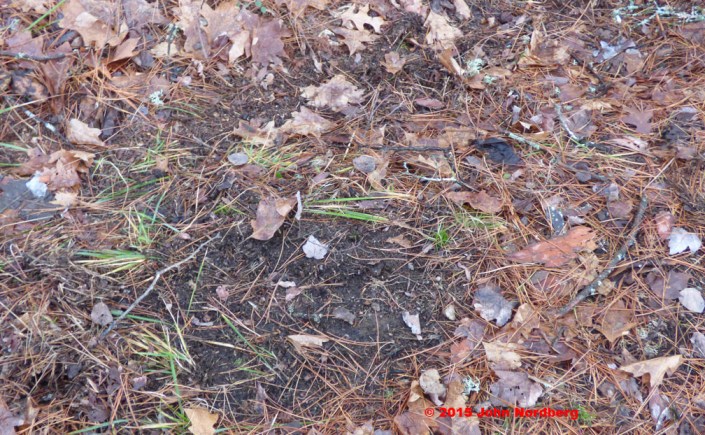
A dominant buck ground scrape not recently renewed due to unseasonably warm weather.

The unusually warm weather we experienced last October and November greatly impacted ground scrape hunting in northern U.S. states. It might even become the norm in future years. If this is true, us northern deer hunters need to know more about what to expect.

Ordinarily, a frenzy of making ground scrapes by all antlered bucks, visual and musk laden signs of intended breeding rages, begins in mid-October when nighttime temperatures customarily begin dipping below freezing. When the daytime temperatures are in the 70s, 60s or even the 50s, however, most northern bucks are not inclined to make or renew ground scrapes (or antler rubs), it then being too uncomfortable to exert themselves physically because their bodes are by then covered with winter fur that will keep them comfortable at 30–40 below zero in winter. Ordinarily, during the 2-3 weeks before November breeding begins (November third in northern Minnesota) rampaging dominant bucks also force all antlered bucks lower in their 1–2 square-mile buck pecking orders to temporarily move off-range until the two-week period of November breeding ends. Unseasonably warm weather brings a halt to this as well, meaning, unless you are an aggressive hunter, making drives or still-hunting, more antlered bucks than usual are likely to be in your hunting area during the first two weeks of November. The trouble is, few deer will move about during warmer daylight hours after about 9AM. Even breeding-related activities will then be mostly limited to nighttime hours only.

What this means is, while temperatures are unseasonably warm, even if you manage to find a freshly made or renewed ground scrape to stand hunt near, you are unlikely to see a buck at the site during daylight hours after 9 AM. This means you should try not to miss a minute of legal, cool, early morning hunting. It means you should get up at 4 AM and hike softly and non-stop in darkness to your stand (guided by fluorescent tacks previously placed on tree trunks) — the only way to avoid alarming deer you can’t see along the way. It means you should remove dead branches and twigs from your approach trail to enhance silent footing two or more weeks before opening day. It means you should arrive at your stand an hour before sunrise (a half hour before legal shooting time begins) so the thirty minutes of complete silence and lack of discernable movements (on your part) needed to allow nearby whitetails to settle down after your arrival and begin moving in your direction is over when legal shooting begins. Why will they be unsettled? Because no matter how skilled you are afoot, though deer near your stand site may not be able to positively identify you as you approach quietly and non-stop (making non-hunting footsteps) and therefore will not abandon the area, they will nonetheless hear some of your light footsteps and therefore be extra alert and curious for the next thirty minutes. You need to get that thirty minutes over with when it finally becomes light and legal to fire at a deer, thereby not wasting a minute of the most productive hunting hours of the day: the first two hours.

For you who still insist on using a doe-in-heat lure scent when hunting bucks, it doesn’t really matter where you put it (a scrape, buck made or man-made is totally unnecessary) as long as you place where you can see where it is up to 50 yards away, crosswind-only.