A Midsummer Task That can Greatly Improve Fall Deer Hunting

The area in which I have been hunting whitetails since 1990 is a large, heavily wooded wilderness area with lots of rocky ridges and hills and only one logging trail. Having long ago discovered stand sites never used before (100 yards or more from any recently used stand site) near very fresh signs made by a mature buck are by far the most productive for taking a mature bucks, I often deliberately spend an hour or so during summer to study an aerial map on my computer screen of my hunting area (usually a Bing map), searching for sites I have never hunted before and/or sites I haven’t hunting for several years.

To illustrate how productive such a map study can be, just a few minutes ago I discovered a spot about a half-mile in diameter that neither me nor anyone else in my hunting gang has never hunted before. I also found a remarkably short tentative route (no specific deer trail yet selected) to get there from crosswind while the wind is blowing from about the south or north that connects with my previously established cruise trail — a series of connecting deer trails that circles widely throughout about a square mile. This trail is used to hike to and from other connecting stand site approach trails and is the only trail I use when scouting for fresh signs made by mature bucks in that square mile during a hunting season.

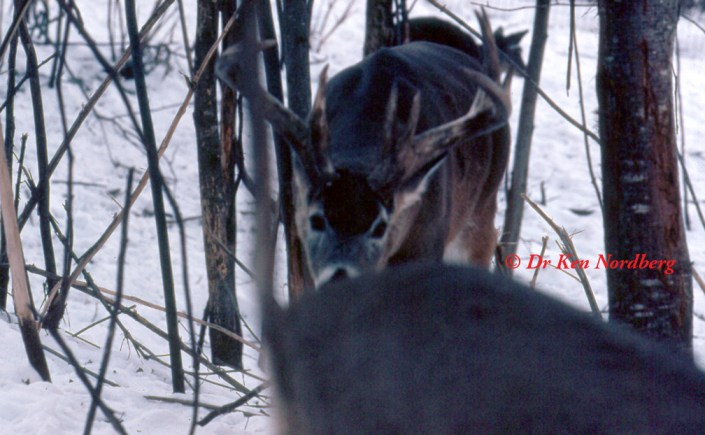
Now that I’ve discovered this new area, I can’t wait to scout it thoroughly in mid-October, then selecting 2–3 stand sites, and approach trails (existing deer trails), 100 yards or more apart in that same area that need little or no preparation for use with my backpacked stool. Having done this many time before, I know if I find fresh tracks and droppings made by a mature buck in that never-hunted area (almost certain—see above photo), my odds of taking that buck it will be much better than odds of taking a mature buck almost anywhere else in my hunting area.

Experience has also taught me it would now be prudent find 1–2 other promising spots to scout a up to a mile or more away on my map—backups in case something goes awry during my first encounter or two with mature bucks in November, which when hunting older bucks is not altogether uncommon.

Before scouting, I will download and print an enlarged copy of my map, likely taping to it copies of surrounding areas. After scouting, my computer wizard son, John, will superimpose trails and locations of my stand sites, info taken from his GPS, on a similar map, providing a day-to-day means of determining best routes to take and stand sites to use during current wind directions during the following hunting season. You can’t know how amazingly valuable such a map can be until you have one and make use of it yourself. If you haven’t taken advantage of free aerial photographs on the internet before, give it a try. Get help if needed. It’s worth it. If you do, next winter you will probably feel prompted to send me an email to tell me how great this tip was.

It’s a Wonder Anything is Left of Whitetails by the Time Hunting Begins

Right now hordes of flying insects are hounding whitetails for blood 24/7. Crawly things too, especially ticks. Even while brisk winds, rain or cool nighttime temperatures provide some relief, these deer find little comfort because bot fly larva, which cannot be dislodged by frequent sneezing or rubbing of noses with hind hooves until they are bloody, are crawling around in their sinuses and nasal passages, dining on tender tissues. If during a rush to escape flying tormentors a buck accidently injures the sensitive velvet enveloping its growing antlers on a tree branch, various meat-eating wasps such as yellow jackets join the chase, determined to carve off chunks of exposed velvet flesh for hungry larvae waiting in hanging paper nests.

Shorty before the end of August when antlers are finally fully developed, blood flow to velvet shuts down and these yet sensitive tissues begin to rot and smell, attracting a new wave of vicious flies and wasps. Typically sometime while attempting to rest, a buck won’t be able to stand it any longer. Upon leaping from its bed, it will rush to a nearby small-diameter tree trunk or woody shrub to rub off on it as much of its deteriorating velvet as quickly as possible, followed by some vigorous side-to-side thrashing of its antlers through deep grasses or leaf-covered branches in an effort to wipe off remaining tatters of velvet and blood. Generally, however, it will take 2–3 days of repeated rubbing and thrashing before the buck will finally find some relief.

Note: while driving during thunderstorms in deer country, keep an eye out for crossing fawns, many of which run without caution in such weather because they are still terrified by thunder. Two were killed near my home while trying to get past a concrete median barrier during our last storm.


Yes, There are Deer Signs That Ensure Hunting Success

Where do you like to stand hunt? Anywhere in the woods? Where you have a great field of view? Next to a deer trail? In the middle of a large patch of brush? At the edge of a cornfield? Where you got a picture of a big buck with your trail cam? Next to a corn feeder or food/bait plot? At sites where you and your hunting partners have been stand hunting for years? Sure, every now and then someone takes a deer at one of these sites. What about mature bucks? Hardly see any of those? That’s typical. Do you know about 40% of the 15–30 deer per square-mile in your hunting area are antlered?

“No way,” you say? This answer alone reveals you have much to learn.

Do you know there are deer signs than practically guarantee hunting success? If you knew what they look like, where to find them and how to take advantage of them, you can actually take a mature whitetail (not a mere fawn or yearling) or even a mature buck every hunting season.

One of the most productive of such deer signs are “fresh tracks of a walking deer in or next to a whitetail feeding area.” A walking deer is an unalarmed deer. If it remained unalarmed during the last period it fed there, it is almost certain to return to the same feeding area during the next period whitetails normally feed. If such tracks are discovered without nearby deer realizing it before 9–10 AM in the morning or after 3–4 PM in the afternoon, the deer that made them and probably others are in or very near that feeding area right now. If found after 9–10 AM or before 3–4 PM, that deer is currently bedded somewhere near or far from that feeding area. If not alarmed by a hunter meanwhile or if it has not yet discovered you waiting in ambush there, it is practically guaranteed that deer will return to that same feeding area during the next 1–3 successive periods whitetails normally feed, (the number depending on how skilled you are at stand hunting)—practically guaranteeing you will have an opportunity to take that deer (if you properly stand hunt there). If you key on such deer signs in or near one or more current favorite whitetail feeding areas every hunting season, you can actually be a regularly successful whitetail hunter, or if you prefer, a regularly successful buck hunter (accomplished by keying on fresh mature-buck-sized tracks and droppings).

Keep in mind, no matter how skilled you believe you are at approaching a stand site and stand hunting, following 1–3 successive visits to one or more stand sites adjacent to any whitetail feeding area (or any other site), few if any mature whitetails will thereafter be seen there, meaning the deer that fed there now know you are there and it’s time to move to another feeding area. Never begin a hunting season without being prepared to hunt two or more feeding areas.

This means, of course, you must be able to identify whitetail feeding areas while scouting preseason. Certain farm fields and forest clearcuts likely to be feeding areas are easy to identify. If other hunters plan to hunt them too, however, their periods of productiveness will likely be short-lived, lasting only an hour or two. To be produtive, a feeding area must contain lots of fresh and old deer tracks and droppings. Typically, there are 4–5 other whitetail feeding areas in a square mile of forested whitetail habitat that are not as easy to identify, some of which may not be visited by deer until after a hunting season begins. Learning how to identify and properly hunt feeding areas is crucial to becoming regularly successful at taking mature whitetails.


A Day of Good Buck Hunting Begins at 5AM

Most of the 98 mature bucks my three sons and I have tagged since 1990 were taken in or near forest feeding areas during the first legal shooting hour of the day, beginning one-half hour before sunrise. To avoid wasting a minute of this most productive buck hunting hour of the day, we get to our stand sites one-half hour before first light or one hour before sunrise. This means we head to our stands in darkness. Because whitetails begin feeding shortly after 4 AM in the morning, mature bucks accompanying does will be near our stand sites when we arrive. Getting there without alarming those deer is crucial, of course. To accomplish this, My hunting partners and I take a number of precautions.

First, we select stand site approach trails that will make it very difficult for feeding whitetails to identify us via sight: coursing through dense cover and/or behind intervening hills or ridges right up to our stands.

Especially within hundred yards of our stand sites, 2-3 weeks before the hunting season begins, we remove dead branches from our approach trails, existing deer trails, to make them as silent underfoot as possible. We thus eliminate as much as possible one kind of identifying sounds so characteristic of approaching human hunters: sticks frequently snapping loudly underfoot.

While doing this trail work, we mark our approach trails with fluorescent tacks which light up like Christmas tree lights in the beam of a flashlight. We place them low on tree trunks about 10-20 yards apart to keep the beams of our flashlights low. This ensures we will not stray from our trails in darkness. A triangle of tacks along the way marks the nearest we can approach without deer beyond our stand sites spotting our approaching flashlight beams. From this point on, we depend on starlight, moonlight or northern lights to light our way. When light is inadequate, which isn’t often, we silently wait at this spot until the widening band of growing light along the eastern horizon finally makes it possible to see our way.

Avoiding being smelled by whitetails near our stand sites is simple: we always approach from downwind or crosswind only (it has been proven by recent research with K-9 dogs nothing available today can completely eliminate airborne human odors).

Until whitetails can finally determine something approaching (detected by soft footsteps and or visible motions) is dangerous, they won’t abandon the area. Knowing it is nearly impossible for human hunters and even wolves and bears to keep whitetails ahead from hearing their approaching footsteps, one thing we routinely do is deliberately avoid dragging our feet, foot dragging also being characteristic of human hunters. Especially when within 100 yards of our stands, we bend our knees with each step, raising our feet well clear of the ground, and then put them down lightly.

We Also use a ruse regularly used by the gray wolves of my hunting/study area: act as if not hunting, appearing currently harmless. Like hoofed animals the world over, whitetails do not routinely flee upon spotting a predator that is not hunting – merely resting or walking past without interest in nearby prey, passing nonstop at a moderate pace while keeping its head pointed straight ahead. While on our way to a stand site, we place our feet down as lightly as possible and also walk nonstop at a moderate pace while keeping our heads pointed straight ahead (even in darkness). By doing this, as we have repeatedly proven, whitetails ahead simply move aside and wait (usually in cover) until we have passed, thereafter resuming whatever they were doing. As long as we do not halt or suddenly change direction, they do not react with ruinous alarm – bounding away with tails up, snorting and/or abandoning their ranges. Whitetails feeding near our stand sites do the same thing. Upon reaching our stand sites from downwind or crosswind and then becoming motionless and silent, it will take up to a half hour, if nothing more we do is detected, before nearby whitetails will decide, whatever we are, we are now resting and therefore harmless or we have left the area without being heard. Though cautious and extra alert at first, they will finally resume feeding and move freely about the area, likely soon becoming visible. Right about then, legal shooting time begins.

This is why the alarm clock in the Nordberg deer camp always rings at 4 AM.

Note: For more about how to do all of the above, go to my newly publihed Whitetail Hunters Almanac, 10th Edition.


A Special Bonus When Ordering Dr. Ken Nordberg’s New Whitetail Hunters Almanac, 10th Edition During July

Receive one FREE autographed copy of your choice of the limited number remaining of Dr. Nordberg’s previously published Whitetail Hunters Almanacs, 3rd, 4th, 5th 8th or 9th Edition with each order of his newly published (second printing) of Whitetail Hunters Almanac, 10th Edition during the month of July.

See subjects covered in each book and ordering information in Dr. Nordberg’s website, http://www.drnordbergondeerhunting.com. Note: out-of-print copies of Doc’s Whitetail Hunters Almanacs have been selling for as much as $250–$1000 on ebay.

    Via his more than 800 outdoor magazine articles, 12 books about whitetails and whitetail hunting, seminars, hunting schools, videos and, more recently, blogs, tweets and YouTube presentations, all based on Doc’s independent, year-round, hunting-related field research with wild deer, Doc (now 83 years of age) has been improving the hunting success of whitetail hunters all over North America for more than five decades. His constant goal since the early 1960s has been to create a new hunting method that can greatly improve the odds of taking the most elusive of whitetails, seldom-seen bucks 3-1/2 to 6-1/2 years of age. He accomlished this and quite a bit more. Among the many new subjects introduced in his newly published, 518-page, 8” x 10” Whitetail Hunter’s Almanac, 10th Edition are six new mature-buck-effective hunting methods, each guaranteed to put you close to mature bucks every day or half-day you hunt deer. These methods enabled Doc and his three sons to take all but three of 98 mature, unsuspecting bucks at short range between 1990 and 2017 on public land inhabited by low numbers of deer and great numbers of gray wolves (two were taken at 400 yards and one was bounding). Meanwhile, they passed up hundreds of opportunities to take other deer. Don’t miss this unique, once-in-lifetime opportunity to learn everything you need to know to match or exceed the Nordberg family’s amazing buck hunting success.

What is Mature-Buck-Effective? Deer Hunters, Don’t Miss Reading This Blog

Mature bucks 3-1/2 to 6-1/2 years of age are the most elusive and most wasted of whitetails during deer hunting seasons. The reason is, there is hardly a whitetail buck anywhere in America today that has survived three or more hunting seasons that does not know exactly how to safely locate, identify and avoid hunters making drives, hunters moving about on foot in search of deer and hunters using elevated or ground level stands. Dr. Ken Nordberg’s six new hunting methods, ranging in complexity from simple portable stump hunting to opportunistic stand hunting were specificlly designed to hunt such deer. All are mature-buck-effective and fair chase (no bait) hunting methods. Between 1990 and 2017 these hunting methods enabled Doc and his three sons to take 98 mature bucks on public land with low deer numbers and overabundant wolves, their best buck hunting ever.

Unlike back in the 1980s when newly introduced portable tree stands and doe-in-heat buck lures combined to launch two decades of unusually easy buck hunting, no new hunting aid is available today that can make it happen again. Our only salvation as deer hunters today is more knowedgeable and skillful deer hunting, mature-buck-effective hunting methods if you’d like to regularly take mature bucks. To be mature-buck-effectice, Dr. Nordberg’s new hunting methods include the follow key elements.

At the top of the list are special elevated or ground level stand sites…

  • Used one day or half day for the first time ever (most productive for for taking older bucks), used one day or half day per hunting season during multiple years, sometimes used an additional day or half day 4–7 days later per hunting season (for  good reasons only).
  • At a site or in a tree tree providing superior human-silhouette masking natural and unaltered cover (no man-made shooting lane) requiring little or no preparation or preparation time.
  • Can be approached without being positively identified by nearby deer.
  • Located within easy shooting distance downwind or crosswind of freshly made tracks and/or droppings made by a mature walking (unalarmed) buck in or near a whitetail feeding area (graze or browse) – the one area in which whitetails are most predictable, most easily seen and easiest targets.
  • Located within sight of fresh tracks of a buck that dragged its hooves from track to track in snow (under the influence of airborne doe in heat pheromone) in or adjacent to a feeding area or doe bedding area (must be stand hunted very soon).
  • Located within sight of lots of fresh droppings made by yearling and/or mature does in or near a feeding area when or where no snow covers the ground.
  • Located within sight downwind or crosswind of a freshly made or renewed buck ground scrape not approached within 10–20 yards by a hunter.
  • Located 10–20 yards back in timber from the edge of a feeding area.

A non-aggressive hunting method is used, namely, “skilled stand hunting,” which is much different from the way most stand hunters stand hunt these days.

The hunter scouts 2–3 weeks before a hunting season begins to find one or two mature-buck-effective stand sites per hunter per day to be used during the first 2–3 days of the hunting season.

A mid-hunt scouting method that does not alarm deer, limited to deer trails designated for this purpose during specific time periods, is used to find new mature-buck-efective  stand sites daily during the balance of the hunting season until a buck is taken. Vicinities, trails and sites being frequented by mature bucks right now, today, which are very likely to be used again by the same buck later today and tomorrow morning if the hunter does things right (with the posible exceptions of trails) – locations made evident by very fresh tracks, droppings and other deer signs – are searched for daily, selecting promising stand sites along the way without halting, to be used during the next 24 hours, or halting to begin using imediately.

A through knowledge of deer signs and the ability to accurately identify tracks and droppings made by mature bucks without halting to measure them during a hunting season are required.

The spread of ruinous lasting human trail scents in the hunting area must be minimized throughout the hunting season.

Certain proven tactics are used to avoid alarming deer along the way while hiking to stand sites and avoid being positively identified by deer near stand sites.

Precautions are taken to allow whitetails to remain in their home ranges throughout a hunting season.

As silently as possible (best done with a backpacked stool), beginning day three the hunter switches to a new stand site every day or half day (best) 100 yards or more away from any previously used stand site until a buck or other deer is taken.

Dr. Nordberg’s six new hunting methods, introduced in his newly published Whitetail Hunters Almanac, 10th Edition, have all of the elements (above) needed to be mature-buck-effective. Used properly, each of these hunting methods can put you close to one or more mature bucks once or twice every day or half day of a hunt, though you may not realize it until after you find tracks that reveal a mature buck spent some time downwind of your stand site. Do not despair when this happens. After a mature buck discovers you stand hunting (not moving about, which it can detect via smell alone), it will only quit approaching within about 100 yards of where you were sitting. It won’t abandon its range unless you somehow greatly alarm it – an all important advantage provided by stand hunting. Moving 100 yards or more to a new stand site during the following day or half day will put you back in the ball game. The buck will have to find you all over again before it can be safe  while engaging in its daily activities. Sooner or later, that buck will be a short distance away, unsuspecting, before it realizes you are taking aim at it.

Be assured, because Dr. Nordberg’s mature-buck-effective hunting methods evolved from more than a half century of scientifically-based, hunting-related field research with wild whitetails, they work. Once mastered, you will soon begin to realize tree stand hunting is no longer the best or only way to hunt mature bucks or other deer. Over the long run a ground level stand hunter usng a backpacked stool and mature-buck-effective hunting methods can outhunt any deer hunter using any other hunting method.


Portable Stump Hunting: the Most Simple Form of Mature-Buck-Effect Stand Hunting

Back when I began hunting whitetails at age ten, stand hunters were commonly called “stump sitters.” Tree stand hunting was unknown then. After fifteen years of being a member of a gang that only made drives, rarely taking bucks older than yearlings, I finally became serious about stump (log) sitting, after which I finally began taking mature bucks. In the 1960s, long before tree stand hunting became known, I began studying and hunting deer from primitive platforms nailed to trees six feet above the ground. After that, tree stand hunting was my favorite hunting method until the late 1980s, then the favorite hunting method of deer hunters all over America, At that time, however, it was becoming obvious mature bucks were learning to identify avoid hunters in trees. For this reason, I then began experimenting with stump sitting again. Real stumps being damp and uncomfortable and rarely located where I wanted to sit, I began using a homemade folding stool with a camo fabric seat, oak frame and shoulder straps, calling it a “portable stump.” The advantages provided by a portable stump, the basic tool for this most simple form of mature-buck-effective stand hunting, are amazing. The following is one of many tales I have written for outdoor magazines) about how my portable stump has provided me with great buck hunting.

It was 5 AM, pitch dark, when I arrived at the spot where I planned to turn straight east a mile north of camp, about another mile northwest of where I planned to sit. The ground level stand site I had in mind was a clump of 4-foot oak saplings with retained leaves beneath a scrubby red oak on a slope overlooking a deer trail discovered while scouting three weeks earlier. Coursing between a large hill west of that tree and a beaver pond east of it, this well-worn trail was full of fresh and old tracks and droppings made by at least two different mature bucks plus several regularly renewed ground scrapes.

The unaltered series of deer trails I planned to use to get there from downwind, illuminated by my flashlight, crossed a saddle near the south end of a high ridge and then dipped down through a low browse area much visited by whitetails during past hunting seasons. From there I followed a familiar, moss-covered deer trail through scattered spruces to the northern tip of a white granite slab of rock more than a quarter-mile long. My intended stand site was at the south end. When I halted there to decide whether I should proceed across that opening or head southeast to a deer trail that curved toward my stand site through dense brush and tall quaking aspens, a yearling doe trotted past without haste ahead of me, tail down, made barely visible by the narrow glow beginning to widen along the eastern horizon, and disappeared into a stand of young aspens on my left.

Deer obviously being in the vicinity, I decided to use the trail coursing through the tall aspens. Shortly before finding it, however, I came across a patch of snow about 20 feet in diameter where two mature bucks had obviously battled a short time earlier. Now anxious to get to my stand site as soon as possible, I proceeded at a steady pace into the wind along that deer trail, keeping my head pointed straight ahead (in case any deer along the way were watching me) until about 100 feet east of where I planned to sit. There I halted again upon discovering another heavily tracked patch of snow where the two bucks had obviously battled a very short time earlier. The smell of buck musk was still strong there. About 20 feet to the right of the site of this battle I noticed a splash of black dirt scattered across the snow. Upon taking a few steps nearer, it became obvious it was a very recently renewed ground scrape, surely made by a dominant breeding buck, November breeding being in progress. The scrape was more than four feet in diameter and an overhanging bough of an adjacent black spruce was well mangled, pieces of it scattered across the scrape.

 Now excited, I then backed carefully away downwind, soon spotting what appeared to be an appropriate spot to place my stool. After tiptoeing through a dense patch of 4-foot-tall mountain maples, managing to avoid making any discernable sounds, I sat down on my stool with my back against the rough bark of the 2-foot-wide trunk of an ancient aspen and pulled my camo headnet down over my face.

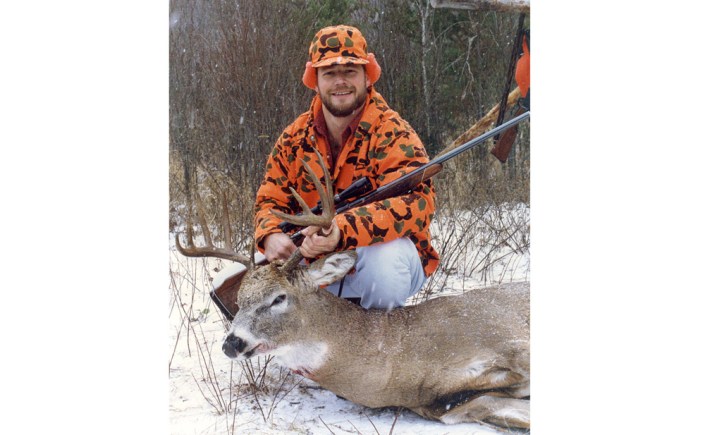
Thirty minutes later, then fully light, I was suddenly astonished to see of the head of an 8-point buck with wide antlers facing me, intently rubbing scalp musk on that ravaged spruce bough only 25 yards away. While slowly leaning to my right, I finally found a narrow, clear opening to the center of the buck’s throat patch and squeezed my trigger. After waiting about five minutes, hearing nothing, I anxiously arose and pushed through the mountain maples toward the scrape. There it was: a beautiful 8-pointer lying motionless across the scrape (see photo above).

There is much to learn about portable stump hunting, the simplest form of mature-buck-effective stand hunting. Learn it all in my newly published Whitetail Hunters Almanac, 10th Edition.


A Large-Group Stand Hunting Method for Taking Mature Bucks

Have you ever hunted a big buck for an entire week, stand hunting at a different site every half day within sight of the buck’s very fresh tracks and droppings without ever seeing it? I have, several times. I knew where this particular buck fed twice daily, a thirty acre lowland dominated by black spruces, tall aspens and alders loaded with favorite winter foods of northern Minnesota whitetails, mainly red osiers. I knew two major routes the buck used to travel daily between its feeding and bedding area, located along opposite sides of a high wooded hill with steep sides. I knew where it bedded, on the commanding tip of a rocky ridge almost a half-mile south of its feeding area. I stayed away from this bedding area because bucks such as this so often discover hunters waiting in ambush near them, their safest refuges thus ruined, after which they are very likely to abandon their entire home range for the balance of the hunting season. Wherever I sat that week, stand hunting, that buck somehow contrived to browse on the opposite side of the feeding area or use the trail on the opposite side of the steep hill. It was uncanny.

On Friday evening when my three sons and a son-in-law returned to camp from college and jobs, asking, “Did you get the buck Dad?” All I could say was, “Nope,” finally adding, “I’ve decided I need your help to get it.” I was somewhat reluctant to say this because whenever I said it in the past, one of my sons got the buck.

The help I had in mind was a large-group stand hunting tactic I created several years earlier called, “Cover-All-Bases Buck Hunting,” Though it always worked, success was dependent on superb forest navigation in darkness before first light in the morning by all hunters taking part. Every hunter had to know exactly how to get to a specific stand site without alarming the intended quarry and other deer along the way. It also required an extensive knowdge of trails and sites currently frequented by a mature buck. In this case I instructed two hunters to stand hunt at certain sites on opposite sides of the of the feeding area and the two others to hunt downwind of the trails on opposite sides of the high hill, leaving the bedding area for me.

It was snowing heavily at first light the next morning when I heard something that sounded like someone had just slammed a large barn door shut, obviously a gunshot. With that, I swung my portable stood to my back and headed downhill toward the origin of the shot, the site taken by my son-in-law. Upon arriving, there, however, no one was there. While wondered where to go next, someone slammed that barn door three times behind me, at the site taken by my son, Ken. This is the Nordberg signal meaning help is needed to drag a buck to camp.

As I rounded the north end of the steep hill, I spotted a sizable bonfire ahead. Next to some branches sticking up left of the fire stood my son, Ken, and my son-in-law. As I drew nearer, I noted Ken was grinning from ear to ear and the branches sticking up were antlers. “My buck,” I murmured, Cover-all-bases had worked again, with the usual dreaded results.

For complete information about when and how to use this large group stand hunting method and why it works so well, go to my newly-published Whitetail Hunters Almanac, 10th Edition.

The Gentle Nudge: using human airborne scent rather than an aggressive hunting method to take big whitetail bucks

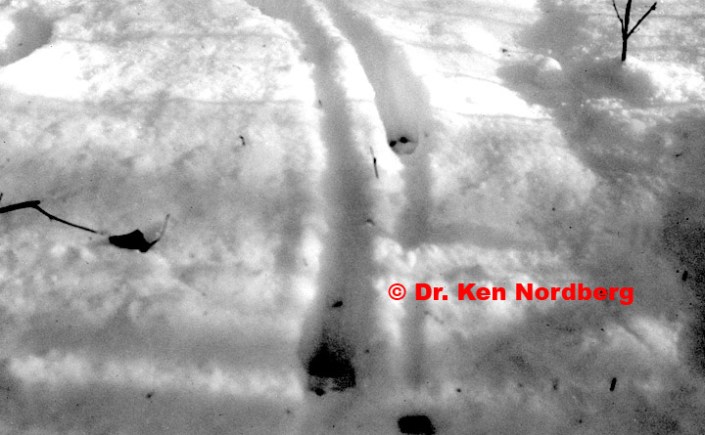
Now and then when snow covers the ground, my three sons and I take a big dominant breeding buck using an extraordinary hunting method we developed about 25 years ago, named “the Gentle Nudge.” It began with the discovery of peculiar deer tracks in snow made by a buck under the influence of the airborne pheromone emitted by a doe in heat, the buck dragging its hooves from track to track. If the hoof prints were about four inches in length (Minnesota), they were made by a dominant breeding buck, the largest buck living within the surrounding square mile. My boys named these tracks “railroad tracks.” From that time on we knew such tracks were made by a fully mature buck that was either accompanying a doe in heat (2-5/8 to 3-inch long doe hoof prints accompanying railroad tracks) or the buck was downwind of a doe in heat (no doe tracks accompanying railroad tracks). More importantly, upon first discovering such tracks, we knew that buck would be with that doe in the nearest whitetail feeding area during the first three legal shooting hours in the morning or the last two hours in the evening or in the doe’s bedding area midday during the next 24 hours – the length of time the doe could be expected to be in heat, assuming it began a short time earlier. We always realized, of course, the doe’s heat could have started much earlier, prompting us to always take quick advantage of railroad tracks.

The earlier discovery of the fact that mature bucks are rarely taken by hunters making drives had a lot to do with the development of a new hunting method we decided to use to take bucks under these circumstances. Older bucks generally have three ways to escape drives unscathed: 1) abandoning the area to be driven shortly before the drive begins, 2) outflanking the oncoming drivers, keeping track of upwind hunters via airborne scents and sounds, and 3) by hiding in dense cover between advancing drivers until they have passed. Mature whitetails (not fawns and yearlings) are determined to avoid being driven far in any direction by hunters or predators, especially downwind, apparently expecting an ambush ahead. As soon as they gain a safe distance ahead of an oncoming hunter, they’ll veer right or left and finally turn into the wind to avoid ambushers, thereafter quickly abandoning their home ranges.

Logically, then, upon realizing where a big buck is accompanying a doe in heat right now – in the doe’s feeding or bedding area – rather than attempt to drive the buck toward one or more downwind hunters, almost always certain to fail, I decided to try a non-aggressive approach, using my own spreading airborne scent drifting from a stationary upwind stand location to convince the buck and doe to depart without haste downwind (the key), typically happening on a deer trail toward the undetected downwind stand hunter. The first five times we tried this with me or one of my sons sitting upwind and my son, Ken who discovered the railroad tracks, sitting downwind, it worked perfectly. Three of those first five bucks are now on a wall in Ken’s den. Dominant breeding bucks taken by my daughter Kate and me while using this tactic are looking down at me from my office wall as I write this. To work, certain precautions must be taken while heading to decided locations of stand sites and, of course, the hunter must know locations of nearby feeding and doe bedding areas, provided by knowedgeable preseason scoutings. Done, right, the gentle nudge rarely fails. A big, unsuspecting buck usually ends up near the downwind hunter within one half to four hours. Learn exactly how and when to use this amazing mature-buck-effective, small group, stand hunting method in my newly published Whitetail Hunters Almanac, 10th Edition.