More About First-Time-Used Stand Sites

After stating in a previous blog my whitetail hunting partners have discovered first-time-used stand sites are by far our most productive for taking mature bucks, I’ve been asked by a hunter exactly when to hunt such a site. “When” depends on when the stand site is discovered: 1) while scouting preseason, 2) while heading back to camp for lunch or at day’s end during a hunting season or 3) while heading to a previously chosen stand site during a hunting season. Whatever the case, very fresh deer signs made by an unalarmed (not bounding or trotting) mature buck are the deciding factor.

We traditionally scout 2-3 weeks before a hunting season begins to ensure all deer will be back in their home ranges doing predictable things during predictable hours on opening weekend. After the first 2-3 days of a hunting season, however, mature bucks are well aware they are being hunted, which trails and which stand sites are currently being used by hunters and they are now doing the things that enabled them to survive previous hunting seasons, including avoiding known, currently-used stand sites and stand sites used and avoided during previous hunting seasons. From this point on during a hunting season, our best stands to take such bucks are those they do not yet know exist – never-used-before stand sites.

Typically, when the alarm clock begins ringing at 4 AM opening morning, everyone in my camp has a special buck stand site in mind (tree stand or ground level stand site) with some good alternatives to use if the wind direction is unfavorable (we never approach stands from upwind). We time our departures from camp to arrive at our stand sites one-hour before sunrise or 30 minutes before first good light – generally the beginning of legal shooting time, thirty minutes before sunrise.  We always want the opportunity to sit without discernable motion or sounds 30 minutes before the first and best hour for taking older bucks begins, giving nearby deer that may have heard us tiptoeing unseen to our stands ample time to decide whatever we were, we are either no longer there or we are harmless. Some hunters argue with me about the wisdom of heading to stands in darkness, but doing this has enabled my three sons and me to take most of the 94 mature bucks (none yearlings) we have taken on public land since 1990. Most were taken during that first legal shooting hour of the day. This is why no one will ever convince us heading in after first light is better.

Beginning on day three, we switch gears. Many stand sites we then decide to use are spur-of-the-moment selections, based on where very fresh deer signs made a mature buck are discovered while hiking to or from stand sites or on special connecting deer trails midday that we refer to as “cruise trails” (one per square-mile). Multiple stand trails branch from our cruise trails. Our stand trails and cruise trails provide unfailing and ample discoveries of fresh signs made by mature bucks during hunting seasons – signs that reveal vicinities of trails and sites (feeding areas) favored by mature bucks right now or will be later today or tomorrow morning (if not alarmed meanwhile). During hunting seasons, the only trails we use are our stand site approach trails and designated cruise trails, thus minimizing the spread of long-lasting human trail scents in our hunting area. By doing this (and avoiding bedding areas), our deer remain in their home ranges throughout our hunting seasons.

Some of the never-used-before stand sites we use while hunting were discovered before the hunting season began and have well planned approach trails (existing deer trails). Most are ground level sites (for use with silently-used, backpacked stools) that need little or no preparation. Very little or no preparation prevents premature stand site recognition by experienced older bucks. These sites are used during AM and/or PM hours. In the morning, as usual, we get to them one hour before sunrise, following fluorescent tacks on tree trunks adjacent to existing deer trails. We usually get our afternoon sites by 2 PM because dominant breeding bucks, alone or with does, sometimes show up as early as 2:30.

Some of our stand sites are not chosen until fresh buck signs are discovered, tracks made a short time earlier on a deer trail, for example, or tracks of a buck with or without a doe that headed toward or into a feeding area. When planning to stand hunt at a site in the morning where I had not previously selected a stand site or approach trail, I head out from camp early, as usual, but stop short where deer in the feeding area ahead still can’t see the beam of my flashlight and wait if necessary  (sitting on my stool) until it becomes light enough to quietly find my way without the use of a flashlight. In the afternoon, I give myself enough time to find a spot to sit well before deer are expected to become active.

Some of the largest bucks I have tagged since 1990 were taken as a result of unexpectedly discovering their very fresh tracks and/or other interesting signs in my flashlight beam ahead while on my way in darkness to a previously chosen stand site, prompting me to immediately back off 20 yards or so downwind and select a spot to sit on my stool where well hidden by natural cover. Three times during the past ten years, the “interesting” sign was a rare, just-renewed ground scrape in November. I don’t have time or space here to explain why such a discovery is rare or “interesting” in November, but in each case the buck that renewed the scrape showed up within 15 minutes to 4 hours and I got the buck.

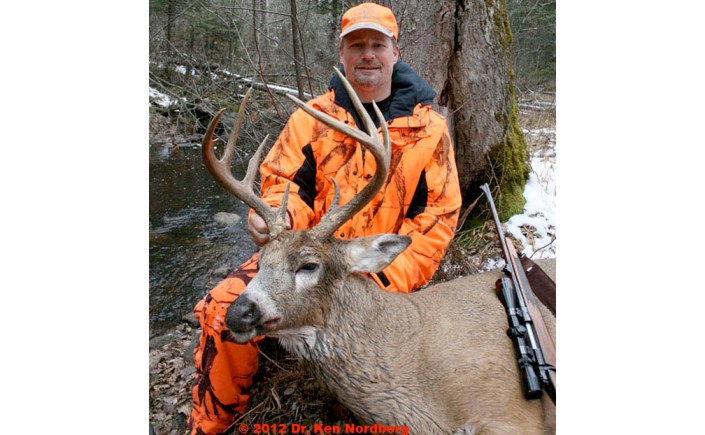
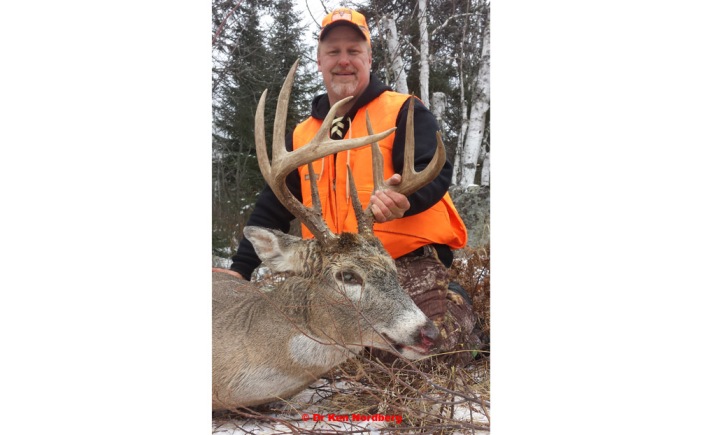
Spur-of-the-moment stand site selections are commonly used by my sons and me during hunting seasons. Using such stand sites generally requires the use of a silently carried, silently used stool (unlike a noisy to carry and noisy to install portable tree stand) at ground level and unaltered natural cover as a blind. We never feel inadequate for having done this because as we happily discovered many years ago, nothing beats natural, unaltered cover at stand sites never used before for taking the most elusive of whitetails, bucks 3-1/2 to 6-1/2 years of age, like the one taken from such a stand site by my son, Dave, pictured above.

 

Deer Tracks that Ensure Hunting Success

If there ever was a way to simplify whitetail hunting, this is it: only hunt near fresh tracks of a deer that walked next to or into a feeding area (not necessarily a farm field or clearcut).

There are lots of kinds of deer tracks, fresh tracks, old tracks, tracks of a walking deer and tracks of a bounding deer are some. Fresh tracks mean the deer that made them passed through the area where found minutes to a few hours earlier. If the deer was walking, meaning it wasn’t alarmed, such a discovery means you are now in a portion of that deer’s home range currently favored by that deer. On any one day, especially during hunting seasons, whitetails generally limit their movements to only about 10% of their home ranges. An important question is, will the deer that made those tracks walk through this same vicinity again later today or tomorrow morning when deer are active? If so, this might be a good place to stand hunt later today or tomorrow morning. If the deer was trotting or bounding, however, meaning it was alarmed, hunting there would be a waste of time.

The trouble is, whitetails generally have a dozen or more routes to use to get to whatever destination they have in mind, the choice during hunting seasons are typically dependent on quality of cover, the current wind direction and trails and sites known to being used by hunters. The odds for hunting success at any randomly selected deer trail are therefore not particularly good. Such odds can be greatly improved, however, by hunting within sight of where whitetails spend most of their time while active in early morning and late afternoon, namely, feeding areas. All deer trails funnel down to whitetail feeding areas where the odds of seeing deer are infinitely greater. Until the deer that made those tracks discovers a hunter waiting in ambush adjacent to its current favorite feeding area (mature whitetails are very good at this), it is almost certain that deer will return to that feeding area later today and early tomorrow morning (don’t count on it happening more than two days). Taking quick advantage of such knowledge provides the best odds there are for hunting success in whitetail hunting.

Potent Tips For Improving Stand Hunting

Theoretically, stand hunting is the very best way to hunt whitetails. This is because while stand hunting, you are stationary, therefore less visible to the motion-sensitive eyes of deer, less apt to make telltale sounds and not laying down ruinous human trail scents and equally ruinous human airborne scents that spread downwind throughout a lengthening area 200 yards wide.

The trouble is, stand hunters must (or should) walk on foot to get to a stand site. While doing this, they are not motionless, not usually silent and they are then laying down a path of persistent human trail scents, all the while emitting an invisible cloud of airborne human odors that temporarily permeates an expanse 200 yards wide along the entire extent of the stand site approach trail – a rather imposing expanse of potentially ruinous scents indeed. To make matters worse, upon arriving at a stand site, most stand hunters are not inclined to remain motionless or silent very long. Many even begin banging antlers together, blowing on noisemakers and/or releasing scents into the air that most mature whitetails now realize are dangerous if accompanied by human odors.

As a rule these days, between the first few minutes of using a stand site and the final minutes of the third consecutive half-day of hunting at the same stand site, virtually all stand hunters are discovered and identified by the doe and her young (including yearlings) that live within their surrounding 125-acre doe home range, the 2-3 mature bucks that live in overlapping home ranges within the surrounding 300 acres or so in your half of a square mile and the largest buck (the dominant breeding buck) that owns the entire surrounding square mile. The tipoff is usually a dark human silhouette that moves, a uniquely human sound such as a cough or metallic click and/or a complex mixture of odors only characteristic of human hunters, unexpectedly or expectedly detected by deer passing unseen within 200 yards downwind. Whitetails that have survived two or more hunting seasons generally avoid a newly discovered stand site being used by a hunter throughout the balance of the hunting season.

Many hunters believe elevated stands and products claimed to eliminate odors of hunters make it impossible for whitetails to smell them. Actually, recent experiments with K-9 dogs used by law enforcement officers in Minnesota have proven any product available today that is claimed to eliminate or cover odors of deer hunters does not in the least fool noses of dogs. It has also been proven odoriferous molecules emitted by hunters, their clothing and hunting gear drop steeply toward the ground from any stand height. This means though tree stands and such products can provide important benefits while hunting whitetails, they cannot keep extremely sensitive noses of downwind whitetails from readily identifying stand hunters (and all other deer hunters).

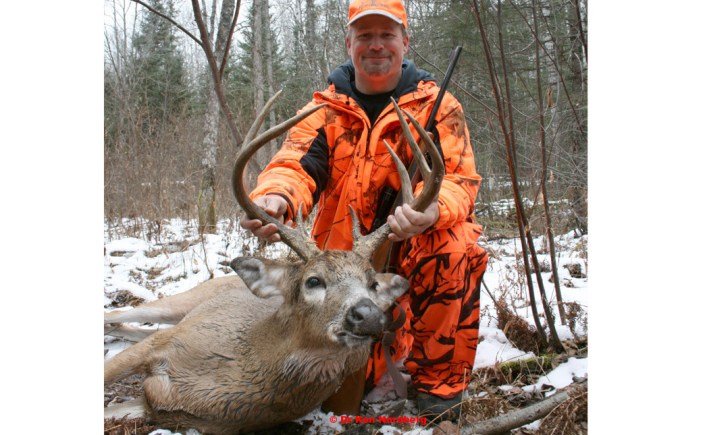
With few exceptions, therefore, it no longer makes sense to waste valuable hunting time at one stand site throughout a hunting season. When hunting older bucks, in fact, it is generally a waste of time to use one stand longer than 1/2 to 2 days per hunting season. Ideally, then, especially when a mature buck is your intended quarry, you should never begin a hunting season with less than one well-located stand site  (elevated or ground level) to use for every 1/2 to 2 days you plan to hunt My sons and I select one for each half day we plan to hunt. Many are natural, ground level blinds intended for use with a backpacked stool that require little or no preparation. First-time-used stand sites are generally our most productive for taking mature bucks (see photo).

Best Freshwater Fishing Experience Ever

Being an avid Minnesota angler since age five (now 82) and occasionally making forays via canoe into Ontario wilderness waters, I had long been of the opinion I have enjoyed the very best of freshwater fishing available in North America. When my son, Dave, invited me to join him and his family on a trip to Alaska where we’d spend time some fishing for salmon and halibut, I had no idea this trip would end up being my best freshwater fishing experience ever.

While hunting Dall sheep, (rams) in the Brooks Range of Alaska fifty-some years ago, thereafter yearning to return to Alaska some day, I fought violently battling, 6–8 pound sockeyes in a shallow pool where they were spawning until my arms finally became so sore that I couldn’t bear to hook another fish. I thus knew our anticipated salmon fishing would be exciting.

Shore enough (Minnesota talk), catching silver (Coho) salmon was much like catching those sockeyes. The first evening we were in Alaska, Dave, Tyler (my grandson) and I caught thirty-six 6–8 pound silver salmon from deep in 185 feet of salt water to the surface near the mouth of Resurrection Bay aboard a small guided boat out of Seward. Arms finally aching, I actually had to take a break before we were done, but sitting there watching the circus-like action, some hooked fish repeatedly leaping high above the water, was totally entertaining.

Halibut fishing turned out to be a different kind of action, akin to hauling a big tractor tire up to the boat in 200 feet of water. By the third time I had finally worked the first of the two 70-pounders I caught to within twenty feet of the surface (the second one released), I was pleading, “Please don’t dive to the bottom again.” Keeping my rod well bent while repeatedly raising that fish another six feet or so and then reeling in line as quickly as possible while lowering my rod to begin anther raise beat by far any exercise I’d ever used to strengthen my biceps, only in this case there was no way to take a break until the fish was gaffed. Seventy pound halibuts (or bigger) are powerful fish. They’re so powerful, in fact, that if allowed to flop about in the boat after being gaffed and hauled in they can seriously injure a fishermen and damage the boat. Imagine what a fully mature 400-pound-plus halibut could do. For this reason, big halibut are shot in the head before they are boated. Shoreline Alaskans know big halibuts are biting when they hear a lot of gunshots out on the water.

The fish that made my trip so special was a 50-pound (minus a few ounces) King salmon. The world angling record, caught in the world famous Kenai River, weighed 97 pounds 4 ounces. After my struggle to land my 50-pounderin the same water, it’s hard to imagine how such a fish could even have been landed.

My king made repeated, unstoppable, 100-plus-yard runs across and up and down more than two miles of the river while I held on hardly breathing. “Is that my fish?” I asked a couple of times upon seeing it break water a long way off near the opposite side of the river. Sometimes we had to chase it with our boat to keep my reel from running out of line or keep my line from crossing lines with other anglers. This was the most thrilling and lengthy battle with a fish than I had ever experienced. When Keith, our guide, finally scooped it up with his big dip net, he too sat down heavily with obvious relief.

That morning, my son Dave caught a 60 pounder, his wife, Lindsay and daughter, Alyssa, each caught Kings nearly as large and his son Tyler caught one weighing about 40 pounds – that’s five fish weighing about 260 pounds taken by five anglers from one boat operated by one guide during one morning of fishing. This was highly unusual. No one else we saw on the river that morning did nearly as well. The average catch for kings on the Kenai is one fish for four guided anglers during a half day of fishing (the best anywhere). Needless to say, our guide and host, Keith Holtan, the long time owner of Beaver Creek Cabins and Guide Service, is one of the best fishing guides today on that famous river.

Honestly, at least once in a lifetime every serious angler in America should try to book a trip to Alaska to fish King salmon on the Kenai River. The words “best freshwater fishing experience ever” cannot begin to describe the thrill of catching one of those swift and powerful, trophy fish weighing fifty pounds or more.

Regardless of Expected Changes in Wind Direction, Stick to Tactics That provide Best Odds for Hunting Success

I often receive letters from hunters who hunt where the wind direction often changes daily, making it difficult to avoid being smelled by nearby deer. During the 72 years I have hunted whitetails, I have tried just about everything to avoid being smelled by whitetails, things I have been recommending to hunters in books, magazine articles and seminars since 1970. My latest letter was written by a hunter who in addition to washing his hunting clothes and body with scentless soap (which is good), uses fox urine as a cover scent. Back in the 1980s my hunting partners and I routinely used fox urine and it worked for several years, even occasionally attracting bucks to stand sites. The trouble was, beginning in the early 1990s it was becoming evident many of our mature whitetails had learned hunters smell like fox urine, airborne doe-in-heat pheromone is dangerous if accompanied by human odors and it is wise to check out sites where rattling antlers and grunt calls are heard from downwind before moving near.

My sons and I eventually discovered most mature whitetails are not particularly fearful of upwind hunters if they are stationary, silent and do not emit strong and unusual odors, in which case they are very unlikely to abandon their home ranges. However, once a stand hunter was identified by mature whitetails by any means, they kept a safe distance away from the stand site throughout the rest of a hunting season. To counter this, my sons and I began changing stand sites daily and even twice daily, making it very difficult for even the most wary of bucks to continuously avoid us.

Avoiding being smelled can be difficult and frustrating in areas where wind directions often change during the day, due to winds being funneled in different directions by high hills or mountains, directions depending on velocity, and due to horizontal or vertical eddying between or downwind of high hills. At such sites, my hunting partners and I hunt high in the morning (at sunrise air begins flowing uphill on a quiet morning) and lowl in the evening (air at tops of high hills cools first on a quiet evening and flows downhill).

Despite inevitable changes that favor whitetails, we stick to three rules that have long greatly improved our odds for buck hunting success: 1) always hunt close to very fresh deer signs made by mature bucks, 2) get to our stands one hour before sunrise and 3) do our best to quietly approach our stands nonstop from downwind or crosswind and sit downwind or crosswind of where we expect to see a buck. Sure, these rules do not always work and, sure, some bucks prove to be impossible to hunt, but they only need to work once per hunting season to provide regular hunting success. Since 1990, these rules have enabled my three sons and I to take 98 mature bucks on public land where deer numbers have always been low due to enormous numbers of grey wolves and occasional severe winters. About 80% of these bucks were taken during the first two legal shooting hours of the day.

The Second Two-Week Period of Whitetail Breeding is Now in Progress (12/5/2017)

A killer buck. This buck killed another 10-pointer a couple days before this photo was taken.

The second two-week period of whitetail breeding, generally occurring during the first two weeks of December, is now in progress. Only about 10% of yearling and mature does are bred during this period (about 1 doe per 2 square-miles), meaning, there are days during this period when there are no does likely to be in heat. Deer signs that indicate breeding is happening include:

  1. hooves dragged from track to track in snow, revealing a buck is smelling airborne doe-in-heat pheromone,
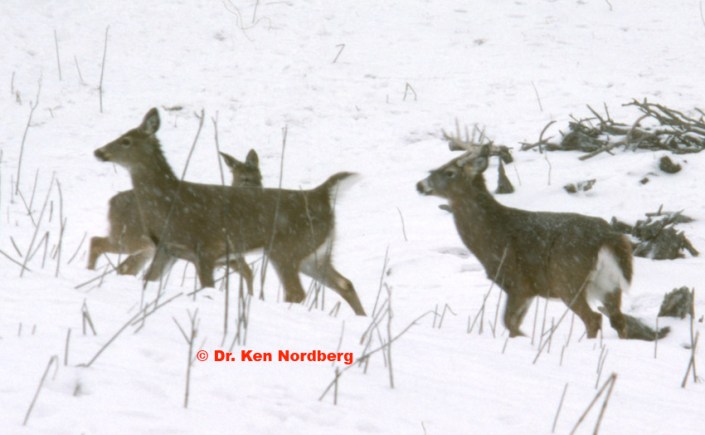
  2. larger tracks of a mature buck accompanying smaller tracks of a doe,
  3. a larger buck is seen accompanying a doe,
  4. a sizable patch of much trampled snow or soil where two bucks battled,
  5. a freshly renewed ground scrape, rare but renewed by a dominant breeding buck warning a trailing lesser buck to stay away from the doe in heat it is accompanying,
  6. a newly ravaged bush or young tree (made for the same reason as in 5),
  7. fresh and and old tracks of a large buck on a previously established scrape trail (few if any scrapes renewed) and
  8. spots of blood in deer urine (characteristic of a doe in heat).

For any of these signs to be a useful as a downwind or crosswind stand site, such signs must be fresh and taken advantage of quickly because does are only in heat and able to be successfully bred during a short period of 24–26 hours. Skilled stand hunting adjacent to sites where does and their young are currently feeding (sites with lots of fresh, off-trail tracks, droppings and nipped-off (ragged and white) stems of woody shrubs and young trees (or farm crop residues) provide better than average buck hunting success. Following days of bitter temperatures, strong winds and/or heavy snow, be sure to hunt midday (10 AM to 3 PM) during thaws or near-thaws while the wind is calm or light. Every deer in the woods will be on the move, feeding (browsing), for an hour or two.

A Frenzy of Excitement Among Antlered Bucks (10/24/2017)

Right now —10/24/2017 — antlered whitetail bucks from yearlings to dominant breeding bucks are making and renewing antler rubs and ground scrapes — no trespassing signs of their intended breeding ranges meant to warn other bucks to “keep out.” Very soon, however, the most dominant buck of each square mile buck pecking order will force all other antlered bucks to abandon their home ranges until November breeding is over. Yearling bucks will sneak back to their mothers, however, yet being dependent on them for leadership and direction when something dangerous such as an enraged dominant breeding buck is near. Some mature bucks are likely to return prematurely as well. This forces dominant breeding bucks to keep to keep musk odors deposited on their rubs and scrapes fresh and strong, renewing them every 24-48 hours (making them currently vulnerable to skilled stand hunting at scrapes) and searching around the clock for bucks that dared to return, then running them off again. Meanwhile, dominant breeding bucks will also visit mature and yearling does within their newly established 1–2 square-mile breeding ranges once or twice daily during feeding periods, anxiously awaiting the first discovery of airborne doe-in-heat pheromone, indicating the first of the three two-week periods of breeding (in November when 85% of does are bred) has begun (November 3rd where I hunt). Remember, however, making and renewing ground scrapes by antlered can be temporarily halted by unusually warm weather, strong winds, storms and discoveries (via sight, sounds or scents) of tree stand hunters near ground scrapes. Remember too, once breeding begins, dominant breeding bucks have little or no time to renew scrapes. In November, then, especially if your intended quarry is a trophy-class buck, key instead on current feeding areas of does. There, yearling and mature does are sure to be accompanied by one or more mature bucks during the short 24-26 hours each is in heat.

Battling for Dominance and the Opportunity to Breed

whitetail deer buck battle

P1020805b

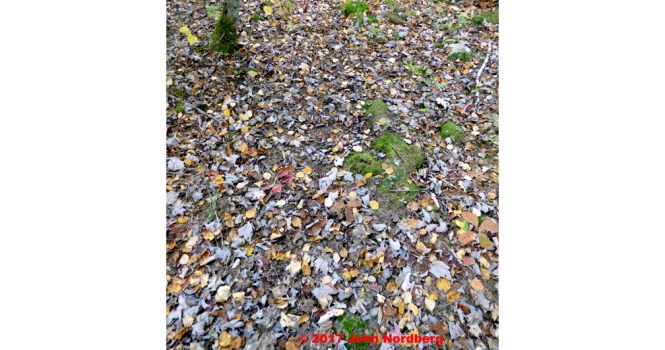
Evidence of a recent buck battle on a deer trail — torn up ground and scattered leaves — from 2017 scouting.

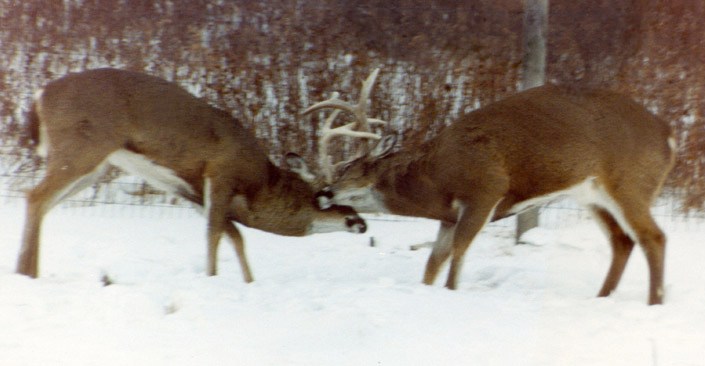
It is every antlered white-tailed buck’s number-one desire to become most dominant within the square mile it shares with 5–9 other antlered bucks (including yearlings). Dominance is achieved by winning shoving matches with other bucks, antlers engaged. Losers are bucks pushed backwards significant distances and/or forced leap way to ease pain or avoid injury (its neck being twisted or its head or neck being stabbed by an opponent’s antler tine). Battles between antlered bucks become most fierce and prolonged during the first two weeks in October, fueled by male sex hormone, testosterone, welling in their bloodstreams, making them increasingly aggressive toward one another. Most battles occur during hours whitetails normally feed in feeding areas shared by all antlered bucks in each square mile. All but one achieves a measure of dominance by defeating one or more other bucks. By mid-October, a well recognized pecking order is established in each square-mile, generally remaining the same throughout the following year year. The buck that conquered all others becomes the dominant breeding buck. It gains the exclusive opportunity to breed all yearling and mature does living in its square mile while they are in heat two weeks in November and two weeks in December by forcing all bucks it conquered to abandon their home ranges shortly before breeding begins and remain off-range until breeding has ended. In this way the fittest of bucks pass on their superior genetics, aiding in keeping mature whitetails the amazingly elusive and adaptable animals they are.

State deer managers now intend to keep deer numbers from exceeding 12 per square mile in northeast MN

Our Minnesota Department of Natural Resource’s recent decision for “moose-first” management of whitetails in our vast Arrowhead Region is based on the following: ongoing research has strengthened the understanding of disease and parasite transmission from deer to moose. Deer are the primary host which transmit fatal brain worm and liver fluke infestations to moose. Managing deer at lower, but stable numbers in primary moose range will reduce disease transmission and allow for habitat and other management activities to benefit moose.

Our state deer managers now intend to keep whitetail numbers below twelve per square-mile, the current believed maximum that should be allowed in deer/moose ranges. In this once great whitetail hunting region where deer numbers have long been less than half of numbers in most other regions in Minnesota, rather than continue to use “bucks only” hunting seasons to improve deer numbers, Minnesota hunters will now be allowed to take whitetails of either sex. It remains to be seen whether this plan will actually help improve or maintain current moose numbers. I personally believe it will fall short for two reasons.

First, whitetails are not the “only” primary hosts of brain worm infestations in northeastern Minnesota. Moose are also primary hosts. Not all infected moose die from brain worms. If all deer were somehow removed from the Arrowhead, infected moose hosts will continue to transfer potentially fatal brain worms to other moose. If whitetails not infested by brain worms were then allowed to again inhabit the same region, countless deer would soon become infested by brain worms, thanks to the presence of the primary hosts, infected moose. Which animal would then be blamed for the transmission of this disease? It doesn’t seem logical brain worm infestations among moose can be eliminated by eliminating or greatly reducing numbers of other animals living in the same region that also happen to be infested with brain worms.

The other reason is, despite being unaffected by brain worms, deer numbers in northeastern Minnesota have been unusually low in northeastern Minnesota for decades (in turn affecting moose numbers) because they are the primary prey of a now (arguably) historic high number of grey wolves in this region — made evident by the recent unprecedented, rapid expansion of the grey wolf geographic range into neighboring states. With deer numbers long being significantly lower than twelve per square-mile in the Arrowhead Region, exacerbated by recent severe winters, it is only logical our overabundant grey wolves have been forced to increase their hunting pressure on moose (plus domestic cattle), and this contributing factor to the demise of moose in northeast Minnesota will not likely change if deer numbers are reduced further or maintained at present levels.

Understandably, our MDNR game managers and most Minnesotans would agree something should be done to save our state’s fabled moose population. However, it is difficult to imagine allowing hunters to take does in the Arrowhead Region — where deer numbers have been substantially lower than twelve per square miles for decades and where as few as one deer have been taken by hunters in many ten-square-mile areas during recent hunting seasons — can significantly benefit moose. Unless something better is discovered that can break the chain of natural events that lead to infestations of brain worms in moose, these magnificent animals may inevitably become rare in Minnesota deer/moose ranges no matter what else is tried to prevent it. To make matters worse, recent studies suggest climate change may also be a mitigating factor.

Meanwhile, those of us who have long hunted whitetails in our Arrowhead region will again experience tough deer hunting this fall, probably next fall and perhaps many falls after that, all because of a worm and U.S. politicians who continue to ignore a long existing bill in Washington that needs to be passed in order to delist wolves as an endangered species in northeastern Minnesota.

First Bucks-Only Deer Signs of the Year

Buck bedded after first attempt to shed velvet.

It’s August 31, a momentous day in the lives of all antlered whitetail bucks. A few days ago, hormonal changes that were set in motion in whitetail bucks by a certain ratio of darkness to sunlight (photoperiodism) in July caused the blood flow to velvet covering their now completely developed anthers to shut down. This caused velvet to begin rotting, in turn attracting hordes of flesh-eating insects such as flies and yellowjackets.

128b

Buck scratching his nose to relieve itching from bot fly larvae.

Adding to a buck’s discomfort at this time is a different annoying horde — bot fly maggots crawling around in its nasal passages and sinuses.

Buck_Velvet_Rub2a

Buck sweeping antlers through milkweeds to remove blood and tatters of velvet from antlers.

When a resting buck can stand all this no longer, it will leap from its bed, rush to a nearby woody bush or small diameter tree and begin vigorously rubbing bloody velvet from it antlers, after which it will sweep its antlers from side to side in tall grass or other dense vegetation in an attempt to remove remaining tatters of velvet and blood. Usually, however, it takes three days to finish the job.

P1000721c

Dried rubs like this on small multiple stems found in September or October are made by mature bucks shedding velvet. They are usually found near buck bedding areas.

P1000795c

Immediately thereafter begins the season during which antlered bucks begin to battle for highest possible positions in their square-mile buck pecking orders and the right to breed.

Note: velvet rubs made in early September are almost always found in or very near buck bedding areas.