A Whitetail Buck’s Calendar for fall and Early Winter — Part VIII (Rut Phase IIId)

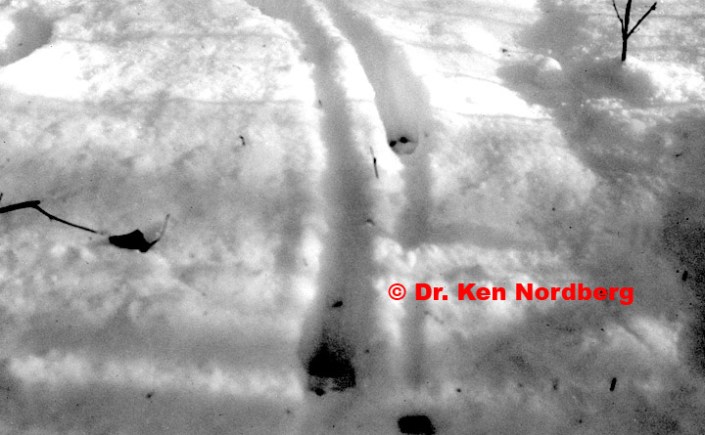
Always an exciting find—while scenting a doe in heat, these “Railroad Tracks” were made by a dominant breeding buck, heading into the wind, heading towards a well-known whitetail feeding area.

There were no fresh deer tracks in the narrow valley feeding area where I had planned to stand hunt that morning, so I climbed the steep slope in the dark on the far side and headed south into the wind toward another feeding area. Just short of the deer trail I planned to follow to a likely stand area about 100 yards ahead, a doe crossed the trail and halted in the beam of my flashlight to stare (tail down) a few seconds in my direction. About 50 yards ahead I came to a patch of snow heavily trampled by two battling bucks.

34a

These tracks were made by bucks during Phase III of the rut.

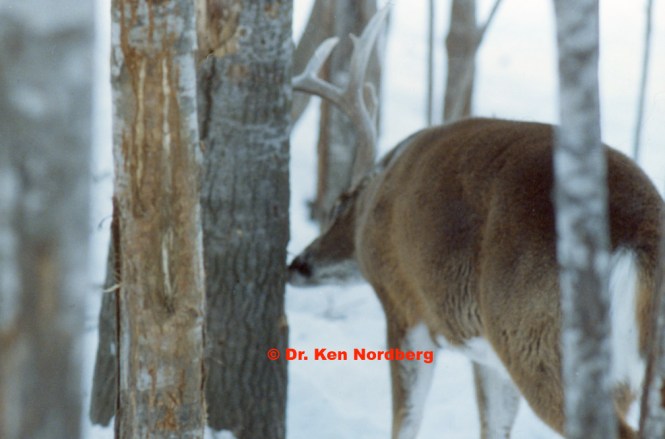
Still short of where I planned to sit, I continued cautiously on until I came to another spot where the bucks had battled. Just to the right was a large, freshly renewed ground scrape with black dirt scattered widely across the new fallen snow on one side. Knowing what this meant, I immediately backed away. As the cloudy sky began to brighten, I silently placed my backpacked stool on the ground at the foot of the two-foot-wide trunk of an ancient quaking aspen about 25 yards downwind of the scrape, surrounded by a dense patch of head-tall (while seated) mountain maple saplings. Fifteen minutes later the crosshairs of my scope were centered on the neck of a big 8-pointer rubbing scalp musk on a spruce bough overhanging the scrape.

d-blog-twitter

These tracks indicate at least 3 deer are very near: 1) a dominant breeding buck, 2) with a doe in heat, 3) and a second buck that is attempting to move in on the first buck’s doe.

This was the third time in ten years I had taken a big buck, one a 12-pointer now on the wall over my desk, soon after discovering a rare, freshly renewed ground scrape while breeding in in progress. During Rut Phase III, a freshly renewed ground scrape is not just another ground scrape. It’s a ground scrape packed with information that is almost certain to enable a knowledgeable and skillful stand hunter to soon take one of the largest bucks in the area. A freshly made ground scrape while breeding is in progress means 1) the buck that renewed it is the local dominant breeding buck, 2) it is near, 3) its is accompanying a doe in heat, 4) another buck is near, 5) the dominant breeding buck renewed the scrape to warn that other buck to stay away from the doe and 6) the nearby dominant breeding buck is almost certain to return soon to determine whether or not the scrape is functioning as intended. Sometimes it takes a few hours. If found in the evening (and the three deer were not alarmed by the hunter), the odds are good the buck will show up early the following morning.

There is another situation while breeding is in progress when a freshly renewed ground scrapes can be very productive. Mature bucks 2-1/2 to 6-1/2 years of age that are temporarily keeping a low profile in secluded areas off-range until breeding ends can also be unusually vulnerable to skilled stand hunting if you know where they are. Such bucks commonly make and regularly renew a succession of ground scrapes and antler rubs along the few deer trails found in their relatively small refuges — typically only an acre or two in size. If you can get within sight of one of these trails without the buck knowing it, approaching silently from downwind hidden by dense intervening cover or terrain, your odds of taking such a buck within a half day of hunting are excellent. A great number of the lesser mature bucks my hunting partners and I have taken since 1990 were found in such areas season after season.

Whenever you discover a freshly renewed scrape early in the morning while breeding is in progress, immediately begin stand hunting within sight of it downwind or crosswind with the breeze angling toward one cheek. If found at any other time if the day, plan to stand hunt near it during the next whitetail feeding hours of the day. Upon initially spotting it, stay well away from it. Do not deposit any of your trail scents, which will persist four or more days, or any other scents anywhere near it. Do not attempt to install a portable stand in a tree anywhere near it. Instead, sit on a backpacked stool where well hidden by natural, unaltered, intervening cover with a solid background at ground level and wear a camo headnet or mask. Remain as still and silent as possible, using no call or rattling antlers. If you take all these precautions, chances are you will soon experience a hunting adventure of a lifetime.

http://stores.ebay.com/John-and-Beth-Nordberg/Dr-Nordberg-Hunting-Products-/_i.html?_fsub=18209470012&_sid=8958092&_trksid=p4634.c0.m322#

DVD Case Cover_05

A Whitetail Buck’s Calendar During Fall and Early Winter — Part VII (Rut Phase IIIc)

Once the primary breeding phase of the whitetail rut begins in November, Rut Phase III, dominant breeding bucks have little time for renewing ground scrapes and antler rubs. Searching for does in heat, accompanying each doe in heat up to a day and a half, breeding each doe four or more times during a 24-26 hour period and likely having to keep a few pheromone crazed lesser antlered bucks away from does in heat is a full time job. For these reasons alone, stand hunting near ground scrapes and using doe and heat buck lures are not as productive as most hunters imagine they should be during this period.

There are other reasons. For one, a dominant breeding buck currently accompanying a doe in heat, and for that matter, any lesser buck that is currently shadowing a breeding pair, will not abandon that doe for any reason other than suddenly discovering a hunter is dangerously near. For another, though an antlered buck currently under the influence of doe-in-estrus pheromone may temporarily be less attentive of its surroundings, the multiple ears, ears and noses of a doe in heat and its young (not including the doe’s yearling buck which won’t be near) will be as attentive as ever, these deer ready to react and/or sound a warning (snort) the moment anything potentially dangerous is discovered. Even greater protection is commonly provided by multiple does in heat and their young. Any doe in heat that is not quickly discovered by its dominant breeding buck will soon begin to search for it, easily found because by this time such bucks reek (by deer standards) with musk and urine, after which the buck will have two does in heat to deal with. On several occasions since 1970 I have counted as many as eleven antlerless deer (does and young) accompanying a dominant breeding buck. When suddenly made aware of nearby danger, a dominant breeding buck will typically abandon a doe in estrus, preferring to depend own its own prowess to avoid danger rather than that of the doe. By nightfall, however, the buck will usually be back with the doe.

If you are old enough to have experienced the extraordinary buck hunting attributable to doe urine containing pheromone back in the 1980s, I’m sure you, like me, wish that kind of hunting still existed today. Many hunters, like two of my sons, who grew up using this lure and still use it, hope some big buck will come along that hasn’t yet learned to steer clear of airborne sources of pheromone accompanied by airborne human odors. These sons are regularly successful at taking mature bucks, often one for the wall, but no more than two that I can recall were attributable to using such a lure since 1990.

So, where does this leave us? Where and how should we hunt mature bucks while breeding is in progress today?

The best place to hunt a mature buck is where it is right now. While breeding is in progress, it’s where a doe in heat is located right now, or soon will be, but not for long (a day and a half at the most). To determine where that is, you have to be aware of habits of does during this period. Being in heat does not greatly alter their habits. When it’s time to eat, does eat and when its time to rest and chew cud, they rest and chew cud. During periods of the day when it is legal to hunt whitetails, whether a doe is in heat or not, expect does to be feeding from first light in the morning until 9–10 AM and from 3­–4 PM until dark. Between 10 AM and 3 PM they will be in their bedding areas. Most breeding, occurs in doe bedding areas (which are 10 acres or more in size), meaning the breeding pair may be up and moving about short periods midday. The best places to hunt big bucks while breeding is in progress is therefore a feeding area currently frequented by one or more mature and yearling does in the morning, a doe bedding area midday and the same or a different feeding area currently frequented by one or more mature and yearling does in the afternoon and evening.

The trouble is, any doe you decide to keep an eye on during this period may not currently be in heat. If it isn’t, the dominant breeding buck of the surrounding square-mile will be with a doe somewhere else. You can keep hunting feeding areas favored by does, hoping to eventually find yourself at one in which a doe is accompanied by a dominant breeding buck or you can improve your odds in one of a few ways.

If the feeding area you elect to hunt near is large, a clearcut or farm field for example, it is likely to be shared by multiple does living in adjacent home ranges, in which case your odds will improve considerably. With three mature does and one or two yearling does feeding in the area, the odds at least one doe will be in estrus will be about 5-in-7 (almost a sure thing).

If while hiking to a feeding area stand site early in the morning you come across fresh yearling or mature doe-sized tracks in snow accompanied by fresh tracks of a mature buck that dragged its hooves from track to track (meaning the doe is in heat) and if they were headed toward a feeding area, it is almost 100% certain that buck is with that doe in that feeding area right now. If you find such tracks in the afternoon or evening, your odds of seeing that buck with that doe in the nearest feeding area during the next hours whitetails feed will be excellent. That doe may yet be in heat the following afternoon and evening, but not after that. If you don’t have snow, fresh tracks of a big buck accompanying fresh tracks of a doe is enough to indicate that doe is probably in heat.

Preserving the hunting value of such deer signs requires certain skills and knowledge. If you are unable to discover such deer signs daily without alarming nearby deer and/or you are unable to take quick advantage of such deer signs because you lack a prepared downwind or crosswind stand where deer are currently feeding, these very productive deer signs for trophy buck hunting will have no hunting value for you (much more about this in future blogs).

DVD Case Cover_05

http://stores.ebay.com/John-and-Beth-Nordberg/Dr-Nordberg-Hunting-Products-/_i.html?_fsub=18209470012&_sid=8958092&_trksid=p4634.c0.m322

A whitetail Buck’s Calendar for Fall & Early Winter — Part VII (Rut Phase III)

As the glow along the tree lined eastern horizon began to widen, a red squirrel behind me greeted the new day with a long soft trill. It was November 17th, the next to last day of Minnesota’s 1990 firearm deer hunting season and the final day of the first and most important of the three two-week periods does would be in heat. Spreading before me while seated on a new stool behind spreading boughs of a young pine atop a rocky outcropping was a wide, snow covered valley loaded with the red bark dogwoods favored by our whitetails in winter and lots of fresh, zigzagging deer tracks. After thirty minutes passed without spotting a movement, I decided give my new grunt call a try, inhaling softly through its connected plastic tube rather than blowing through the call at the other end. The grunt was perfect, not loud but steady for about three seconds. Almost immediately a doe stepped from a clump of tall spruces about 100 yards away on my right and stopped, glancing left and right as if undecided about where the buck it just heard was located. When it turned away, I grunted once more. With that, it turned back and began walking straight toward me. At this point a mature 8-point buck emerged from the spruce clump and followed the doe until the two halted directly in front of me about twenty yards away. At 7 AM, field dressing completed, I began a day long, sometimes hair-raising drag back to camp.

Though that morning’s events were typical of many that would follow in this region after moving 100 miles north in 1990 from my original whitetail hunting/study area (1970–1989), this was a morning of monumental hunt-changing firsts: the first time I had used a backpacked stool at ground level to stand hunt, the first time I had used a grunt call, the first time I realized skilled stand hunting actually does enable dominant bucks to remain in their home or breeding ranges throughout a hunting season and the first time while dragging a deer I had been closely trailed by a pack of occasionally howling wolves all the way back to camp.

Taking this buck was a sign I was getting somewhere with my hunting-related studies. Taking quick advantage of fresh deer signs, impossible when reliant on fixed tree stands, was beginning to pay off. During previous years I was convinced it was hopeless to attempt to key on big dominant bucks while breeding was in progress, here one day and a mile away the next. Back then, about the only place I could be sure a dominant breeding buck was likely to be located two or more days in a row was its bedding area after breeding ended. Though tough to hunt a buck successfully at such a site, I did manage to take several while they were approaching or departing their bedding areas. Today, it’s different. Not only are my hunting partners and I now fairly proficient at taking mature bucks while breeding is in progress in November, but we’ve since learned avoiding buck bedding areas helps keep them from abandoning their ranges during hunting seasons.

There’s a lot to know about Rut Phase III. It is the first of the three two-week periods during which does are in estrus (heat) in fall and early winter, a period during which does emit an airborne pheromone from their bodes and urine that attracts and sexually arouses antlered bucks. This is triggered by a specific ratio or darkness to light that doesn’t change significantly during the following two months. Breeding begins on the exact same day in November year after year (same days later in regions south). Where I hunt, it begins November Third.

All does do not experience estrus (heat) on the same day during this period. Only about 10–12% are in heat on any day, making this period last two weeks. Each doe is in heat only once during this period for 24–26 hours. In a four square-mile of my study area, two does, mature or yearling, may be in heat in one square mile one day, none in a neighboring square-mile the same day, one in another neighboring square-mile the same day and none in the fourth. The next day it may be completely opposite. There can be days when twelve hunters stand hunting in these four square-miles during this period see no does accompanied by mature bucks or discover no fresh doe-sized tracks accompanied by fresh mature-buck-sized tracks being dragged from track to track in snow, revealing when a doe is in heat — iconic sights and deer signs of this rut phase.

097b_railroad_tracks

We call em, “Railroad Tracks.”

Unlike the they’re-really ruttin’ event many hunters imagine, there is no peak when whitetails are expected to more active during daylight hours than at any other time. Instead, this breeding phase is a relatively quiet event with bucks lower than the top rung in their square-mile pecking orders keeping a low profile in secluding hideaways off-range, with does and their young active only during their usual early and late feeding hours and with a few extraordinarily elusive dominant breeding bucks quietly going about their business, managing to breed 85% of does in in their individual square-mile breeding ranges in two weeks, mostly at night, despite being handicapped by the presence of unusual numbers of hunters.

Click Ad to go to Amazon…

Track Guide Cover_twitter_Kindle

A Whitetail Bucks Calendar for Fall & Early Winter — Part VI

A displaced 3-1/2 year-old buck checking trails scents (on a snow-covered scrape trail) to determine whether or not the dominant breeding buck had recently used it.

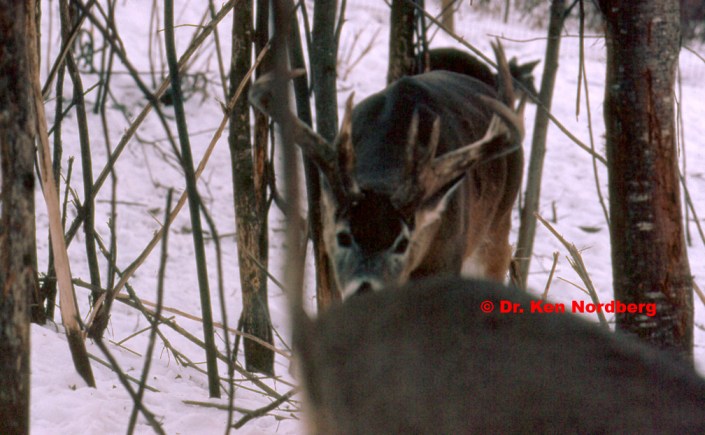
Let’s imagine it’s well into the 2–3 week period called Phase II of the whitetail rut. Unless it is unusually warm, stormy or windy, the increasingly dangerous dominant buck (caused by welling testosterone in its bloodstream) that recently forced all antlered bucks that lived in its square-mile home/breeding range to flee off-range is now regularly cruising its range in search of them, intending to fiercely attack any that dared to return.

103b

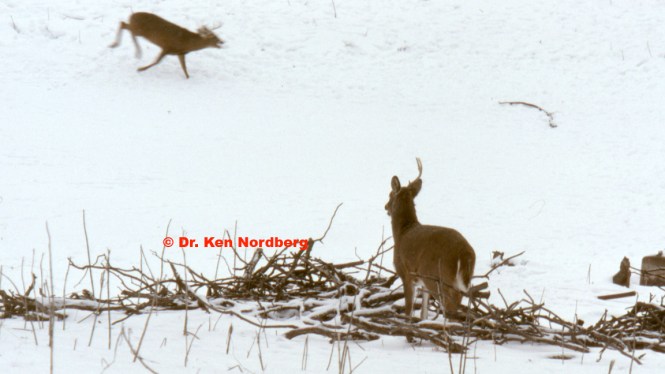
An angry dominant breeding buck — who is now getting tired — attacking a younger buck — who has already lost one antler — but is not nearly as tired. (The youngster keeps jumping over brush piles to keep away. The doe in heat is out of the frame.)

One or two of such charges is usually enough to convince most mature bucks that had experienced such behavior from a dominant breeding buck in the past it is now best to keep a low profile off-range until does no longer emit doe-in-heat pheromone. Inexperienced yearlings that still depend on their mothers to provide leadership when threatened by danger can be expected to sneak back several times. By the end of October most have learned it is best to remain off-range for awhile like older bucks.

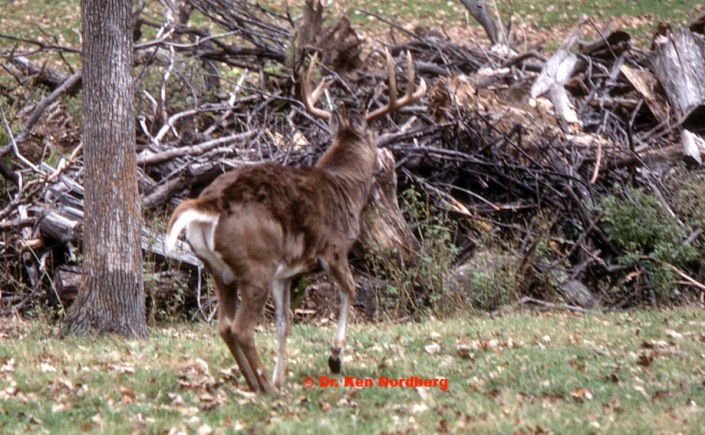
This not a perfect way to end buck conflicts. In time even some older bucks (likely future dominant breeding bucks) will work up enough courage to return while breeding is still in progress, emboldened by an obvious lack of renewal of the dominant buck’s breeding range markers and/or airborne whiffs of doe in estrus pheromone.

Until breeding begins, the dominant breeding buck of a square-mile will strive to keep many of its rubs and all of its scrapes effective at warding off other bucks by renewing their appearance and musk odors least once, sometimes twice, every 24–48 hours. All are strategically located at sites used by former dominant bucks along well-used trails within the home ranges of all mature and yearling does living within the dominant buck’s square-mile breeding range.

Scrapes no longer renewed during October and early November are generally those of lesser bucks that were run off by the dominant breeding buck or scrapes near which hunters were discovered waiting in ambush. In farm areas where whitetails are typically crowded in limited wooded habitat after crops like corn are harvested, antler rubs and ground scrapes are likely to be shared by multiple bucks, in which case several may continue to be renewed long after dominant breeding bucks were forced to abandon them (one of many extreme adaptations made by whitetails upon invading intensely farmed regions during the 1900s).

While cruising scrape trails, dominant bucks also make it a point to visit all does in its range while they are up and about feeding, AM and PM, likely anxious discover the first one expected to be in heat during the coming week or so. This plus maintaining scrapes and rubs and searching for and running off lesser bucks, all the while taking every precaution to avoid near encounters with stand hunters, forces dominant bucks to persevere with less rest and food. By the time the second and third periods of breeding finally come to an end, many will have lost up to a third of their weight and will have little or no fat stores remaining to keep them going through a moderate to severe winter — a reason very few wild bucks 6-1/2 years of age survive their seventh winter.

p1000760b_clumped_fresh

At about this time, you will begin to spot clumped droppings. Clumped droppings are a form of diarrhea—a result of all the stresses on the buck.

p1000736a

Sometimes, the biggest bucks in the area — the monsters — don’t seem to get clumped droppings.

Freshly made ground scrapes characteristic of Rut Phase II have potentially greater hunting value than any other deer signs throughout fall and early winter. Nothing today can lure the most impressive of bucks better than such a buck’s own unadulterated ground scrape during this rut phase. If properly taken advantage of, theoretically at least, a skilled and knowledgeable stand hunter should be able to take a trophy-class dominant breeding buck every hunting season. The fact that it doesn’t often happen means most whitetail hunters, maybe all of us, are not knowledgeable and skilled enough to accomplish such a feat annually. Often is good enough for my sons and I and knowing we can do it often keeps us trying to do it every hunting season.

There are several reasons why hunting bucks at ground scrapes is so difficult to do. For one, whitetail dominant breeding bucks in their prime, 4-1/2 to 6-1/2 years of age are among the world’s most elusive and resourceful big game animals. I’m good at hunting older bucks but for every one I’ve taken, I failed to take six or more others I had to admit I could not take. For another, there are so many ways to screw up your chances of taking one. While scouting and preparing to hunt such a buck, for example, you or someone else will likely alarm every buck in a square-mile enough to make them abandon their ranges without realizing it happened. It then may take two weeks for them to return and resume normal habits and behavior. For another, you probably won’t be able to resist loading up with every so-called hunting aid that promises to improve your buck hunting success, including your ATV or OHV, all or many of which may only make it easier for such bucks to keep safe distance away from you today. Finally, you like most other hunters, serious about hunting mature bucks or not, will probably hunt the way you’ve long been hunting, usng a method now only effective for taking 1–2 trophy sized bucks in a lifetime, if you’re lucky. Those bucks will again have you thinking there are very few if any of them living in your hunting area.

Yes, there’s a lot more to learn to become regularly successful at seeing and taking mature bucks. Learning truths about them is a very good start.

A Whitetail Buck’s Calendar for Fall & Early Winter – Part V

A dominant breeding buck working on a ground scrape.

Rut Phase II, the buck breeding range establishment phase, is least understood by whitetail hunters, yet no period of the rut receives more attention from hunters. Normally triggered by a certain low temperature at night in mid-October, 32 degrees in Minnesota (60 in South Carolina), it begins with a frenzy of making antler rubs and ground scrapes by all antlered bucks. More than 90% of rubs and scrapes are made during this period. It is commonly believed all this buck activity can only mean one thing: breeding is in progress (They’re ruttin’. Yahoo!). This belief in turn triggers another frenzy: that of bowhunters using doe-in-heat buck lures. Contrary to this belief, the first of the three two week periods of whitetail breeding is triggered on the same date annually by a specific ratio of darkness to sunlight (photoperiodism) in early to mid-November (a bit later in the south than in the north). This is absolutely proven by the fact that following the usual seven-month period whitetail does are pregnant, 85% of fawns are born in May, 10% in June and 5% in July. Breeding begins only when it becomes obvious bucks have quit renewing ground scrapes in early November.

This phase of the rut is the only one triggered by a certain temperature at night (rather than photoperiodism), making it difficult to predict exactly when the characteristic buck signs of this period will first be discovered in your hunting area. Whitetail fur is part of the equation that determines when it will happen. By mid-October, the scant red summer fur of whitetails has been replaced by a heavy two-layered tan coat that enables them to survive the coldest winter temperatures of their regions. If temperatures are unseasonably warm during the second half of October, heavily furred bucks are reluctant to exert themselves greatly, temporarily delaying or quitting making antler rubs and ground scrapes until temperatures return to normal. If unusually warm temperatures continues until breeding normally begins, the year will be remembered by hunters as one of very few rubs and scrapes.

107b

So why do bucks make rubs and scrapes? It’s the same reason many species of wildlife, even our pet dogs, mark their home ranges with urine: to warn others of their species to keep out — each animal determined to have a certain amount of space of its own and this being nature’s way of assuring each animal will have adequate food. The degree to which marking ranges with urine is respected by whitetails is different among bucks and does. Mature does with young vigorously defend their separate home ranges from being used by any other doe or any other fawn of either sex, driving them away with vicious kicks and furious pursuit. Mature bucks (2-1/2 years of age or older), however, are allowed to wander through or live within doe ranges without interference.

The number of mature bucks living in a square-mile, typically 3–5 of them, and their pecking order (which may change after shedding velvet in September) is quickly settled early each spring. Though antlerless and less combative then, brief skirmishes of a different kind are not uncommon among them — bucks with drooping ears nimbly prancing about on hind legs while pummeling one another with forehooves. Though their larger home ranges necessarily overlap, they live with relative peace among one another until after they have shed velvet in fall and their bodies and temperaments are being transformed to make then gladiators anxious to determine which of among them is most superior physically and will thus pass along its superior genetics while breeding is in progress.

Part of this transformation includes an increasing production of aromatic musk in certain glands of antlered bucks: tarsal glands located on the inner surfaces of the hocks of their hind legs and smaller glands located beneath their scalps. Emissions of fluids containing scalp musk are especially noticeable on dominant breeding bucks, oozing down both sides of their heads onto their necks and causing a series of deep vertical wrinkles to form in the fur on the sides of their necks. Musks now become the primary odors of ground scrapes and antler rubs — antlered buck range markers made after mid-October to identify and delineate their home ranges, now considered intended breeding ranges.

Using their forehooves, antlers, musk glands and urine, antlered bucks make remarkably visible and readily smelled (by deer) breeding range markers. With forehooves, they paw away turf, leaves, moss and/or snow to create bare patches of soil (ground scrapes) adjacent to much used deer trails within the home ranges of does living within their individual buck ranges. They then position all four hoofs on each scrape and while pressing their tarsal glands together to squeeze out musk they urinate on their hocks to carry the musk to the ground. Some bucks wag their rumps from side to side while doing this to express greater quantities of musk.

Scrapes made by dominant breeding bucks generally have certain unique characteristics. Though they may be small at first, they end up being larger than those of other bucks — typically three or more feet in diameter. Some I have measured were as large as 10 feet in length or 10 feet in diameter. They commonly appear to have been made by bucks that were enraged, soil, turf, moss or leaves pawed as far as ten feet to one side. To add further to their conspicuousness, especially as breeding draws near, dominant breeding bucks mangle branches or evergreen boughs overhanging their scrapes and rub scalp musk on them. If overhanging branches are not available, some big bucks will make do with an adjacent young evergreen tree or a woody multi-stemmed shrub, vigorously stripping off boughs and much of the bark from the tree or mangling branches of the shrub, then lacing the remains with scalp musk.

294c

Buck checking his scent on an antler rub and ground scrape.

As explained in a recent blog, antler rubs are as important to bucks as home or breeding range markers as ground scrapes. After painstakingly stripping bark from a tree trunk to bare a patch of brightly colored wood high enough above the ground to make it visible great distances away, bucks carefully rub acrid scalp musk from the sides of their heads onto the bared wood. After doing this, I have often observed bucks lick the rub (or a bare section of a branch overhanging a scrape) as if using their sense of taste to determine when they have deposited enough musk on it. Unfortunately (for hunters), rubs aren’t ordinarily renewed often enough to be preferred stand sites.

Peaking testosterone causes all antlered bucks to be restless during this period. After returning to their individual bedding areas between feeding and range marking hours, they sometimes satisfy their growing aggressiveness by battling tree trunks that will bend (become the loser) but not break. Yearling bucks prefer one-inch-diameter tree trunks, 2-1/2 year-old bucks prefer 2 to 2-1/2 inch tree trunks and 3-1/2 to 6-1/2 year-old bucks prefer tree trunks three or more inches in diameter. Clusters of newly made antler rubs are thus common identifying signs of buck bedding areas after mid-October.

The trouble is (for bucks), for each antlered buck marking an intended breeding range in a square-mile there are 4–7 others doing the same thing. This would be a recipe for pandemonium if not for the goal of the most dominant buck of each square-mile. Growing more hostile as each day because of peaking testosterone, it has no intention of allowing all those other antlered bucks to remain in their intended square-mile breeding ranges while does living there are in heat.

A Whitetail Buck’s Fall and Winter Calendar — Part IV

Doc examining a large area of dirt torn up from a buck battle.

34a

This is an example of tracks made by two bucks battling in snow.

Generally, only archery hunters, 99% of which are stand hunters, are allowed to hunt whitetails during this rut phase, September through the first half of October. Activities of bucks during this period are limited to feeding, watering, bedding and battling with other bucks. The usual frenzy of making and ground scrapes and antler rubs does not begin until nights cool sufficiently to trigger this activity during the latter half of October. Searching for scrape trails and hunting with doe-in-heat buck lures is therefore likely to be a waste of time during this rut phase.

During this rut phase, the absolute best spot to hunt antlered bucks of all ages is a location where they spend most of their time while not bedded and are most visible (while leaves still cover trees and shrubs): a feeding area currently frequented by multiple bucks. Deer trails adjacent to such feeding areas and/or sites where bucks have been battling (sometimes discovered outside of feeding areas), are also likely to be productive.

Typically, forest region feeding areas are fairly open, where sunlight can reach the ground to enable grasses, clover and other favorite greens of whitetail to flourish. Do not overlook stands of oaks at this time. Acorns become a number-one favorite of whitetails after they begin falling in late August. Clearcuts and farm crops such as corn, alfalfa, hay and soybeans are sure to be favorite feeding areas at this time as well. To zero in on older bucks, however, scout at least two weeks before hunting, searching for signs that indicate which feeding areas are favorites of multiple numbers of mature bucks. Such signs include lots of deer tracks 3-5/8 to 4 inches long and droppings 5/8 to 1-1/4 inches long, buck droppings often clumped by this time. Smaller tracks and droppings mean mature does, yearlings and fawns are also feeding there. Heavily tracked patches of dirt or turf 10– 30 feet in diameter are favorable signs to find as well — made by two bucks battling. Generally, one quick hike across a buck feeding area is all you will need to become convinced you’ve found a great place to stand hunt, which is good, because the less time you spend in a feeding area, the better. Depositing your trail scents all over the place, which will persist for many days, will quickly convince the most elusive of whitetails, older bucks, to begin feeding elsewhere.

Your next project, which I have explained in detail in recent blogs, is to select stand sites and figure out how to get to them and remain undiscovered by bucks in the feeding area. Always approach a stand site from downwind or crosswind, always stand hunt downwind or crosswind of where you expect to see a deer and never cross a feeding area to get to a stand site. When hunting older bucks at feeding areas, or any other area for that matter, no matter how skilled at stand hunting you believe you are, never count on remaining undiscovered by mature bucks longer than 2–3 consecutive half days. After that, if unsuccessful, it’s time to move to a new stand site.

Finally, the day you discover a freshly made ground scrape or antler rub in mid-October, Rut Phase I has ended. It’s then time to begin hunting mature bucks elsewhere.

A Whitetail Buck’s Fall and Winter Calendar — Part III

This is a great photo of a dominant breeding buck in his prime. Unfortunately, this buck was killed by a poacher. Note his arched tail, his enlarged neck, and the wrinkles on his neck. That wrinkling is caused by fluid from scalp musk. Note the enlarged tarsal gland on the inside of his left rear leg — with its tuft of white hair.

Following a summer of little activity ending with velvet shedding about September 1st, Phase I of the whitetail rut begins. This is the first period during which antlered bucks begin preparing for breeding, still more than two months away. First on the list of whitetail bucks 2-1/2 year of age or older is exploring the entire extent of their home ranges. This important step improves their odds for survival during their most dangerous seasons of the year, the season of being hunted by great numbers of humans, and in Minnesota, the much longer season of being hunted by packs of grey wolves, newly formed in early November. While exploring, bucks also become acquainted or reacquainted with all other deer living within their ranges, many of which will play prominent roles in their lives durng the coming 4-1/2 months.

Next on the list of all antlered bucks, including yearlings, is battling with other bucks to achieve the highest position possible in their hierarchy of bucks living in the square mile home range of the previous year’s dominant breeding buck. This goes on for about a month and a half (until Mid-October). The overall victor finally wins a year of mastery over all other deer living within this square mile plus the exclusive opportunity to breed all mature and yearling does living there — the genetically driven goal of every white-tailed buck. Only about 10% succeed, however.

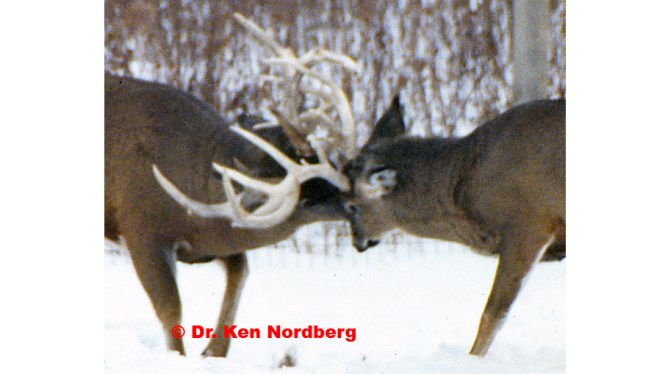
Within a few days after velvet shedding, all antlered bucks living in their shared square mile begin to graze in one feeding area twice daily. Late during feeding hours, whether accidental or deliberate, bucks often feed so near one another that their antlers touch — an action regarded by all bucks as a provocation to battle.

Battles between whitetail bucks are actually shoving matches. With heads lowered, antlers engaged, they push with considerable might toward one another until one is driven several yards back and must leap way to avoid injury. After one or more of such engagements, the victor is accepted by the loser as being dominant throughout the following year. The loser is obliged to move quickly aside when approached by the victor, back away when threatened, flee when pursued and even allow the victor to take possession of the food it is feeding on or the wintering area bed it is lying on. Failure to comply earns a swift kick to the ribs. Thus is created the pecking order of all bucks living within a square mile. One buck ends up at the bottom of the pecking order, then subservient to all other bucks, and one ends up at the top of the pecking order, then domineering over all other bucks (none of which will have the opportunity to breed, except, perhaps, in their wintering area following the third week in December). The dominant breeding buck and most other non-breeding bucks 3-1/2 years of age or older are dominant over all does (except those in heat) and their young. While in the presence of any of these other deer, a dominant breeding buck will typically display its badge of royalty: an arched tail held slightly away from its rump.

Initially during this phase, bucks very briefly spar with one another, antlers clicking a few times, showing little enthusiasm. By the end of September and throughout the first half of October when testosterone is beginning to peak, battles become fierce and extended, tempers flaring. Yearling bucks, always anxious to provoke battles with other bucks including those highest in the pecking order are quickly defeated, but that doesn’t seem to discourage them. Battles between older, more evenly matched bucks, are usually prolonged, occasionally repeated, and sometimes bloody.

During this rut phase certain physical changes occur in antlered bucks. Muscles of their necks enlarge to varying degrees, especially noticeable on dominant breeding bucks 4-1/2 to 6-1/2 years of age (few live longer). Some (not all) younger bucks including yearlings develop unusually enlarged necks as well. Bucks with enlarged necks likely have an advantage over other bucks, enabling them to overpower and painfully turn or twist the necks of less muscular opponents while driving them backwards, soon forcing them to give up the battle.

disc3fixlargeb

Note how the buck has his rear knees close together and his tail is arched. He is urinating on his rear tarsal glands while rubbing them together. When bucks wag their rear ends back and forth while doing this it resembles a hula dance. In the process, this dance carries the scent from his tarsal glands to the ground scrape he is working on.

Enlarging testicles is another change, signaling the production of viable sperm. Tarsal glands on the inner surfaces of their hocks (on hind legs) also enlarge, beginning to produce a viscous fluid containing musk. This musk is carried to ground scrapes by drenching the tarsal glands with urine while pressing them together to squeeze out the musk. While doing this, some bucks wag their rears bucks from side too side, appearing to be doing a hula dance.

Certain glands beneath the scalps of all antlered bucks (between their antlers) also become active, producing an acrid musk carried by a syrupy fluid that oozes down both sides of a buck’s head and down onto its neck, producing the rows of vertical wrinkles in fur most common on necks of dominant breeding bucks. This musk, seemingly most intense on dominant breeding bucks, is rubbed on antler rubs and branches or evergreen boughs overhanging ground scrapes during phase II of the rut, likely identifying the dominant buck that made these breeding range markers and reminding bucks that smell it they are in a perilous location.

A Whitetail Buck’s Fall and Winter Calendar — Part II

Before continuing this series, I need to set the stage for all breeding-related activities of antlered whitetail bucks. For most bucks, everything happens within about one square-mile; for a few, about two square miles. In farm areas 640-acre (one square-mile) ranges of mature bucks can be long and skinny, composed of connecting woodlots, brushy watercourses, forested lowlands and steep woody slopes.

128b

The four months before breeding-related activities begin, May through August, is the antler growing season. Except in intensively farmed regions where suitable habitat is limited and whitetails are crowded, bucks two years of age or older are generally loners during this period, doing little but bedding, feeding and watering in relatively small and secluded areas. At the end of August antler growth is complete and the flow of blood to antler enveloping velvet shuts down. The odor of deteriorating velvet then begins to attract swarms of flesh-eating insects such a yellowjackets and flies, finally forcing bucks to rid their antlers of velvet by vigorously rubbing it off on small diameter tree trunks and woody shrubs. This usually takes a few days.

Once free of velvet, about September 1st, Phase I of breeding-related activities of whitetail bucks begin. The minds of antlered bucks (including yearlings) now turn to three important activities: 1) exploring the entire extent of their home ranges, 2) becoming acquainted or reacquainted with all other deer living within their home ranges and 3) using their new antlers to gain dominance via battles (shoving matches with antlers engaged) with all other antlered bucks living in the surrounding square mile — typically the largest buck home range established by the largest and most aggressive of bucks 4-1/2 to 6-1/2 years of age in that area. The overall victor of battles earns exclusive breeding rights throughout its range after does begin experiencing estrus (heat) in November.

Home ranges of whitetails are areas in which they normally live (spend most of their time) during spring, summer, fall and early winter (until about the end of the third week in December in Minnesota), after which they migrate and live in wintering areas until snow melt in spring. They are sometimes forced to temporarily abandon their ranges by hunters or large predators. Lesser antlered bucks (yearlings and mature bucks prevented from breeding) are temporarily driven off-range by dominant breeding bucks beginning about mid-October — 2–3 weeks before November breeding begins — and are generally kept off-range by dominant breeding bucks throughout the two-week breeding period in November. Some older bucks I have trailed off range appeared to be knowledgeable of areas as large as 36 square-miles. Whitetails are also sometimes drawn off-range by special foods such as falling acorns, scarce water or airborne pheromone emitted by a doe while in heat. Yearling bucks and does, normally live within the ranges of their mothers throughout their yearling year, typically beginning to explore short distances off-range in fall. When nearing two years of age, early during their second spring, they are driven off-range by their mothers, then forced to seek and establish their own first home ranges. They not uncommonly travel many miles before locating appropriately sized areas of suitable habitat not inhabited by other deer (Nature’s plan for preventing in-breeding).

Depending on deer densities, home ranges of does with young are 90–250 acres in size, averaging about 125 acres. Doe ranges do not ordinarily overlap. They are separated by buffer zones made up of natural features such openings, roads, ridges, swamps, lakes and watercourses. In habitat where whitetails are not overabundant, there is usually four, sometimes five, doe home ranges in a square-mile.

First home ranges of bucks two years of age are generally 150–300 acres in size. Lesser bucks 3-1/2 to 6-1/2 years of age (bucks that lost battles with one or more other bucks) establish ranges 300–600 acres in size. Most dominant breeding bucks (bucks at the top of their buck pecking orders) establish home ranges at least a square-mile (640 acres) in size. Some larger and more aggressive dominant breeding bucks will have home ranges as large as 1000–1300 acres. Ranges of mature bucks generally overlap parts or entire home ranges of other bucks and does, enabling to 3–5 mature bucks, 2–6 yearling bucks, 4-5 mature does, 2-6 yearling does and 4-10 fawns to live in peace within one square-mile (lower numbers are characteristic in wolf country).

A Whitetail Buck’s Fall and Winter Calendar — Part I

My father introduced me to whitetail hunting in 1945. That was long before tree stands, lure scents, cover scents, scent killers, camo head nets, hand warmers, rattling antlers, grunt calls, rifle scopes, compound bows, backpacked stools, portable blinds, camo and blaze-orange clothing, bait, corn feeders, GPSs, trail cams, snowmobiles, ATVs and OHVs became traditional deer hunting gear. As you might imagine, I’ve experienced quite a few changes in whitetail hunting, some due to my own efforts. The most remarkable change occurred in the 1980s and early 1990s, attributable to the introduction of portable tree stands and doe-in-heat buck lures. These innovations produced astonishing buck hunting success at first, but after nearly four decades of use by tens of millions deer hunters annually, most bucks and does 2-1/2 years of age or older now routinely identify and avoid hunters perched in trees and recognize the danger of airborne doe-in-heat pheromone accompanied by odors of hunters using them. Mature bucks are therefore as elusive as ever. Undaunted, whitetail hunters continue to make use of the growing deluge of old and new products that are claimed to improve buck hunting success.

Are such products really necessary to successfully hunt bucks? Based on my last 26 years of keeping track of numbers of mature bucks responding favorably or unfavorably to their use, I am now convinced many products that once enabled me to take quite a few braggin’-sized bucks are now likely making it easier for mature bucks to identify and avoid me. Whenever I give my favorite grunt call a try these days, for example, it seems as if bucks within hearing are saying saying to one another, “That might sound real but I can tell it was made by that human with the white beard. Let’s get outta here.” Though changes of this kind are surely disappointing, a certain overwhelming fact keeps me from throwing in the towel when it comes to hunting older bucks: for more than 10,000 years millions of North American deer hunters using primitive weaponry with no knowledge whatsoever of the products listed above routinely provided their families with venison, antlers to make tools and hides to make clothing and footwear. Rather than continue to rely wholly on old or new gimmicks, I decided back in 1990 to begin relying on truths gained from my whitetail studies instead and use them to develop more productive buck hunting methods.

Truths? Shortly after I began my 46 years of studying habits and behavior of wild whitetails, much of what I knew about these deer, learned from my father, uncles and outdoor magazines, turned out to be untrue. Beginning in the 1980s, many new myths (untruths) were added, some seemingly logical, intended to explain why whitetails do certain things, and some intended to convince deer hunters to purchase certain new products.

Just to give you a sampling of how myths continue to cloud whitetail hunting today, consider the following truths:

Antlered bucks are engaged in five different, breeding-related activities during a period lasting 4-1/2 months beginning with velvet shedding about the first of September.

Everything bucks and does do that is related to breeding, except possibly one, is triggered by certain ratios of darkness to sunlight (called photoperiodism), causing them to occur during the exact same calendar periods annually.

Does not bred in November experience heat again 28 days later and 28 days later again if still not bred, meaning does are in heat during three different two-week time periods during a ten-week span beginning in early November and ending after the first week in January.

Only 10–12% of does are in heat on any one day while breeding is in progress, meaning there is no peak of the rut. Each doe is only in heat 24–26 hours.

Does in heat do not deliberately urinate on ground scrapes to let bucks know they are in heat. Airborne doe-in-estrus pheromone emitted from does and their urine does that wherever they are located.

About 90% of scrapes and rubs are made during the 2–3 weeks before breeding begins, meaning bucks are not “really ruttin’” as so many hunters are fond of saying upon discovering freshly made ground scrapes.

Rather than attract does, buck ground scrapes are intended to serve as easily seen and smelled no trespassing signs to warn other bucks to stay away from intended buck breeding ranges.

No matter how high you are in an elevated stand, all whitetails 25–200 yards downwind smell you. Some, mainly lone, inexperienced fawns and yearlings, fail to recognize the danger and approach from downwind regardless.

Trophy Buck Elusiveness

In 2001 Doc had an article published in Midwest Outdoors, called Trophy Buck Elusiveness.

Doc’s son John has been remaking Doc’s articles and putting them on his website.

Doc’s website is:

http://www.drnordbergondeerhunting.com

Doc’s articles are at:

http://www.drnordbergondeerhunting.com/hypertext/Articles.html

Trophy Buck Elusiveness is at:

http://www.drnordbergondeerhunting.com/hypertext/Articles/Trophy_Buck_Elusiveness.html