Why Scout? (One of Doc’s articles from 1988)

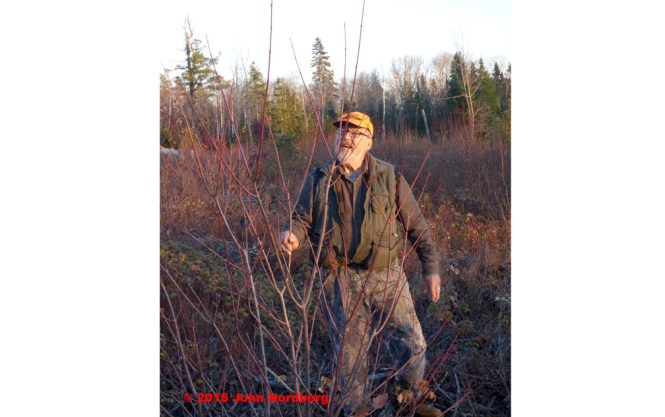
The importance of pre-season scouting cannot be over-emphasized. Here the author’s son, Ken, inspects a scrape site. He’ll log this find on a map, along with other deer sign he finds in his hunting area, and analyze a game plan for the coming season.

Back during my first 15 years of whitetail hunting, beginning in 1945, nearly every hunter I knew either hunted deer by making drives or simply wandering or sneaking through the woods, calling it “still-hunting.” A few hunters called themselves “stump-sitters,” but none I knew sat on a stump very long. That was about it. Tree stands were unknown back then. Being a member of a gang that only made drives, though we regularly “filled out,” I was regularly disappointed by our lack of taking mature bucks. After I finally talked my father into leaving the old gang so we could still-hunt whitetails on our own, our buck hunting success did not particularly improve. During the following years when my own children were becoming old enough to begin hunting deer, I decided to try to improve their odds for taking mature bucks during “bucks only” hunting seasons (deer numbers were low in Minnesota back then), using my considerable knowledge and experience in research to study hunting-related habits and behavior of whitetails — an elaborate form of scouting. What I began to learn was so fascinating and so helpful — my kids taking mature bucks during their first hunts — that not only did this research became my life-long passion but the reason I’ve been encouraging hunters to scout ever since. Below is one of my earliest magazine articles about scouting, published in 1988.

Published in Sportsman’s Press
Deer Hunting Section
Thursday, September 15, 1988

Why Scout?

By Dr. Ken Nordberg

Scouting is locating productive hunting areas where interference from other hunters is less likely (especially important when hunting older bucks). Scouting is locating whitetail home and breeding ranges and important range elements such as bedding, feeding and watering spots. It’s locating deer trails often used by specific deer. Scouting is gaining the knowledge necessary for formulating effective hunting strategies, for locating and preparing productive stand sites and/or productive hunt routes, relying primarily on knowledge gained from deer signs.

Wherever you hunt, whitetails utilize only about half of the available habitat. On any one day, they use about one-third of that half. In other words, whitetails use only about 17 percent of what you see. To be a successful hunter, you must locate and spend most of your hunting hours (undetected) within that productive 17 percent. Searching for that 17 percent while hunting is not only a waste of valuable hunting time, but a practice likely to cause deer to leave their home or breeding ranges, or cause them to limit movements to nighttime hours only.

Scouting is the only step that can minimize the role of luck in hunting. Luck is never a good ally, especially when hunting adult bucks. For those who do not scout, the odds for harvesting a 2-1/2 year-old buck (hunting on foot) are only about 1-in-60; about 1-in-120 for a 3-1/2 to 6-1/2 year-old buck. Hunters who scout and recognize strategic values of stand sites enjoy no less than 1-in-4 odds for harvesting adult bucks. Scouting is that important.

WHEN TO SCOUT

When scouting, you must invade normally secure areas of whitetails. If a stand hunter, upon discovering spots with obvious promise, it is usually necessary to alter the landscape somewhat — erecting stands, brushing-out shooting lanes, cleaning-up stand trails, etc. [Editors note: Remember this was written before most deer hunters considered scouting, before commercials stands were readily available, and before hunting regulations restricted the use of permanent stands, trailmaking, and shooting lanes. Now, that also includes recovering trail cam data.] All of this is viewed with considerable alarm by whitetails. Range abandonment or regular detouring around new stand sites is likely to follow for a period of five to 10 days or longer. Scouting, then, and preparing stand sites, should take place no later than two to three weeks before hunting.

283c

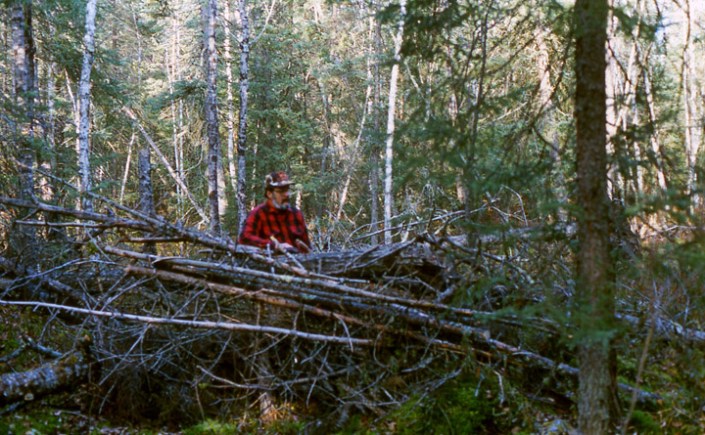
[Editors note: An example of the type of tree stands we made back then.]

HOW TO SCOUT

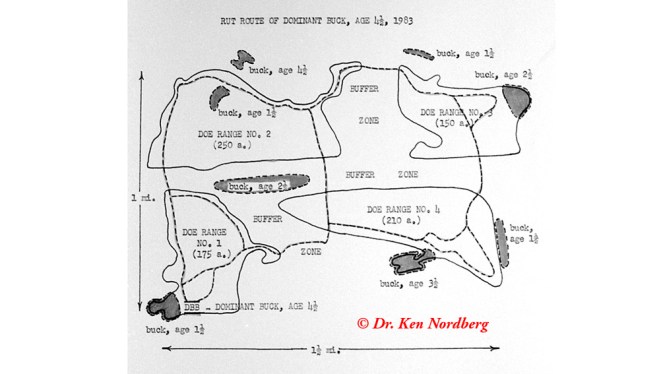
Starting with a U.S. Geological Survey Map, make a large sketch of your hunting area. Then, while cruising in the field, sketch in major deer trails and landmarks. Wherever you find significant deer signs — tracks, droppings, beds, antler rubs, ground scrapes and evidences of feeding and watering — note them on your map. During the hunting season, update your map daily, noting fresh deer signs and sightings of deer.

Sure, it sounds like a lot of work, but when you’re done (it might take a couple of days), not only will your scouting/hunting map make it possible to formulate effective hunting strategies daily while you hunt, but it will be the basis for hunting success far into the future, only requiring a little updating from year to year.

When you’re a bona fide buck hunter, scouting is the real hunt. The hunting season becomes merely a time of waiting for certain bucks to do the things you know the will do at specific sites sooner or later (when influencing factors, such weather, are favorable). Buck hunting skill, then, is skill in scouting. No amount of aimless wandering can make up for a lack of it.

Next week: 15 Buck Stand Sites (a series)
map-090b

[An example of one of Doc’s maps from back then. Now-a-days, his maps are huge Photoshop files, with multiple layers for trails, signs, and satellite images spanning many years.]

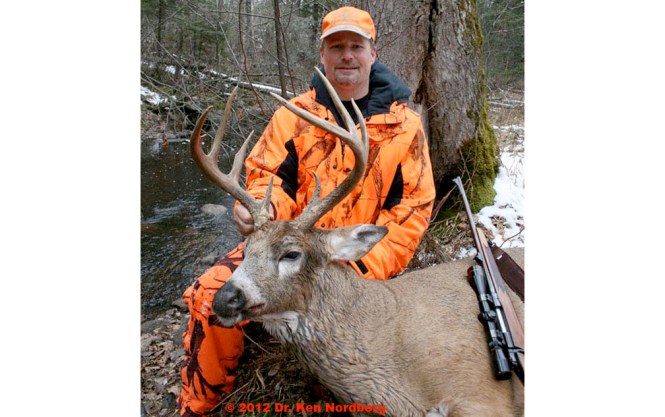
Despite the heat, fresh droppings, not tracks or deer sightings, enabled us Nordbergs to take our usual four bucks this year.

Very fresh, ¾-inch-long droppings enabled author’s son, Ken, to take this buck on opening morning.

Note — originally — this blogpost was published a month or two ago — but for some reason it has dropped off of my blog — so I am posting it a second time.

Very fresh tracks of unalarmed whitetails are not only the most rewarding of deer signs, but they enable the hunter to regularly key on specific classes of deer — mature bucks, for example. The trouble is, they can be difficult to find. A lack of snow, dry or frozen ground or falling leaves are notable reasons.p1020006a_clumped_not_fresh

Clumped buck droppings — hard, dry, dull — not fresh. When you see clumped droppings — think, “buck sign” — then measure the droppings to approximate the class of buck. Clumping is a sign of the stresses the buck is going through.

Second best are fresh deer droppings (scats). “Fresh” means shiny and soft with no frost crystals on them in sub-freezing temperatures. Beginning in September, droppings of antlered bucks are commonly clumped (stuck together). Doe droppings remain separate. Whereas one set of droppings can contain a few larger and smaller droppings than most and sizes of droppings from individual deer can vary a bit with diet, for the most part the more common lengths (not including the little knobs at the ends) in a puddle or clump of droppings nonetheless provide two bits of information that can greatly improve odds of hunting success: 1) the class of deer that made the droppings and 2) the vicinity, trail or site currently frequented by that deer, meaning, it is likely to be seen in that same vicinity, on that same trail or at that same site within a few hours, later the same day or the following morning (don’t count on it after that). Very fresh droppings discovered in the vicinity of a current favorite whitetail feeding area (sites characterized by greater numbers of off-trail droppings, fresh and old) are the most rewarding.

p1000750a

From a trophy-class buck that we didn’t get in 2016.
(Unclumped, found while scouting, before stresses of breeding.) We absolutely love to find droppings like this when we do our final fall scouting — about 2 weeks before the season opener.

p1000736a

From another trophy-class buck that we didn’t get in 2016. (Unclumped, found while scouting, before stresses of breeding.) Notice this detail: while the droppings of both of these trophy-class bucks were large, on average, they had distinctly different sized & shaped droppings.

In northern Minnesota where I hunt and study whitetails, mature does (two or more years of age) and yearling bucks have droppings measuring one-half inch in length. Droppings of fawns and yearling does are shorter. All longer droppings are those of mature bucks (two or more years of age). In fall, droppings measuring ¾ to 1-1/4 inches in length are those of bucks 3-1/2 to 6-1/2 years of age (considered “trophy-class” by most hunters).

Hunting Whitetail Bucks at Feeding Areas — Part VIII

The dark silhouette of a hunter against the bright sky is readily recognized by today’s mature whitetails.

Once you are settled at your stand site, you are still not safe from discovery by feeding deer. Though I am sure there are many tree stand hunters who are very skilled at hiding their silhouettes in trees, the only two I personally know who are consistently successful at doing it are my sons Ken and Dave. When not well hidden, today’s mature whitetails are almost certain to spot and identify a stand hunter soon. Common reasons are as follows.

  1. The hunter’s large and upright silhouette is dark and clearly visible against the sky or a light-colored background such as snow.comparison2
  2. Uncovered skin of the hunter’s face and hands contrasts greatly with surrounding natural cover making it eye-catching to deer.
  3. Motion-sensitive eyes of whitetails readily spot movements made by a hunter.p1020031b
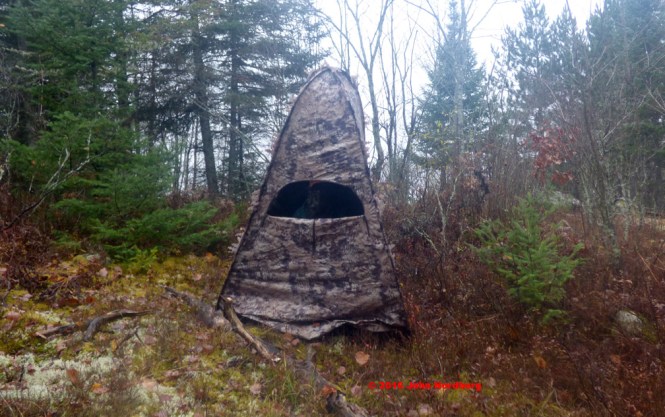
  4. The hunter’s stand or blind is inadequately hidden and unnatural or unusual in color, material and/or shape.
  5. The stand site’s surroundings have recently been significantly altered.
  6. The stand site has been used too long and too often (day after day and year after year).
  7. The stand site is too close to the edge of a feeding area. Ideally it should be located 20 yards back in adjacent forest cover with 2–3 natural shooting windows in front of it.

While a hunter is properly stand hunting downwind or crosswind of where deer are expected to be seen, whitetails are likely to pass within 200 yards behind the hunter, downwind. An unseen downwind mature whitetail is certain to positively identify the hunter for three common reasons:

  1. The stand site reeks with long potent odors of gasoline and bar oil from a chainsaw).
  2. The stand currently reeks with fresh-from-the-box-odors emitted by a new portable tree stand or a new portable blind.
  3. The hunter’s body and clothing reek with waterproofing freshly applied to boots, tobacco smoke, pancakes and sausages, hamburgers with fried onions, pizza, wood smoke, oil and exhaust fumes from riding an ATV and a host of other odors picked up in camp, restaurants and places where drinks are sold.

Remember, though downwind whitetails are unlikely to react with much fear upon discovering a stationary stand hunter (unless very near), strong unusual odors substantially increase the odds of triggering great alarm in a deer, which in turn can quickly spread throughout the vicinity of the hunter’s stand site and ruin hunting there for the rest of the hunting season.

An unnatural sound can have the same affect. Common ruinous sounds at stand sites include coughs, sneezes, nose blows, snoring, zipping a zipper, opening Velcro™, squeezing shut a coat snap, sounds made while installing a portable stand in a tree (clanks, rattles, clunks, chopping and sawing), loading a cartridge into a rifle chamber, a click made by a rifle safety when moved to its “off” position, a click when improperly cocking a carbine, bumping a rifle barrel against something or opening a can of pop. All these sounds and more can heard by whitetails greater distances away than hunters realize, the most ruinous of them being metallic sounds.

Upon discovering the location of a stand hunter, a mature whitetail will never forget it. Mature whitetails have excellent memories. Whenever near a remembered stand site thereafter (then deliberately well hidden and/or a safe distance away), a mature whitetail will use its senses to determine whether or not the site is again occupied by a hunter throughout the rest of its life. Moreover, accompanying deer will learn to do the same. Within my study area are several previously productive buck stand sites that have been routinely detoured by mature bucks and other whitetails for 5–15 years (revealed by tracks in snow).

For all of the reasons described above and in previous blogs, it pays to change stand sites every day or half-day, scout and finish preseason preparations 2-3 weeks before hunting begins and be as quiet, still and odor-free as possible while stand hunting. The best (most productive) of stand sites are those that have never been used before, require no preparations (except perhaps flattening some tall dead grass. pushing aside some dry leaves or pruning off a couple of twigs that might interfere with shooting) and are located well hidden within easy shooting distance downwind or crosswind of sites or trails currently frequented by whitetails. These are made obvious by very fresh deer tracks and/or droppings. The most rewarding of such sites are feeding areas (hubs of whitetail activities) and deer trails adjacent to feeding areas. Today, when a mature buck is an intended quarry, stand hunt within easy shooting distance of fresh 3-1/2 to 4 inch-long tracks and/or fresh 3/4 to 1-1/4 inch-long droppings at least a half-mile (six blocks) from where a motorized vehicle was parked before hiking on foot to the site.

Hunting Whitetail Bucks at Feeding Areas — Part VII

Like invisible odoriferous molecules of burning wood and even its smoke all hunter odors fall to the ground downwind.

My son’s, grandsons and I always double check the wind direction before heading to a stand site and often listen to weather forecasts on our deer camp weather radio to learn whether or not the wind will change in direction during the day. The reason is, we never want to make the mistake of approaching and sitting at a stand site with the wind at our backs, no matter how promising the site might be for taking a mature buck. Patiently or impatiently, we always wait for an adverse wind to change direction before hunting at such a site. Meanwhile we stand hunt at a different feeding area that can be safely approached from downwind or crosswind. This precaution almost always pays off (see accompanying photo).

ken_2012b

Keep in mind, all unnatural odors characteristic of whitetail hunters spread vertically (soon touching the ground from tree stands) as well as horizontally throughout a widening cone-shaped area up to 200 yards wide 200 yards downwind. All these odors are quickly recognized by most downwind whitetails 2-1/2 years of age or older (not always true of yearlings and fawns). Degrees of responses upon detecting a hunter’s odors are largely determined by their intensities. The stronger the smell, the worse the response. One alarmed whitetail can soon alert or alarm all deer in the vicinity of a stand site with or without a hunter’s knowledge. It pays, then, to begin and remain as odor-free as possible while stand hunting for whitetails.

Hunting Whitetail Bucks at Feeding Areas — Part VI

Nothing can long eliminate the strong odor of rubber boot soles.

Few hunters realize many of the myriad of odors emitted by human hunters cannot be eliminated by items bought in sporting goods stores (despite claims), odors of firearms, for example, or human breath and hair or rubber boot soles. Most of these items merely add another unique smell to the cloud of odoriferous molecules continuously emitted from a hunter’s body, clothing and hunting gear, including odors created by the millions of bacteria that normally live on human skin. The only way to be completely certain hunted whitetails with noses estimated to be 10,000 times more sensitive than human noses cannot identify you via trail or airborne scents is to approach sites where you expect to see deer from downwind or crosswind with the breeze angling toward one cheek beginning 100–200 yards downwind or crosswind and then stand hunt downwind or crosswind of were you expect to see the deer. Never hesitate to make a wide detour, if necessary, to get to a downwind or crosswind starting point 100-200 yards away before turning toward your stand site.

Mature (experienced) whitetails routinely approach a feeding area from downwind to assess airborne scents drifting from the area before exposing themselves there. In the morning, then, its okay, actually best at first, to approach a feeding area on a downwind deer trail because the deer you hope to take will already be feeding there — upwind and unable to smell you. Freshly made deer tracks and droppings on your trail will prove they are there (that’s always exciting to discover). Keep in mind, however, you will be depositing your fresh human trail scents along the way and those scents will persist at least four days unless it rains or snows soon thereafter. Unless the wind changes direction midday, your trail scents there might be the reason no deer show up at that feeding area that evening and why it might be best to wait four days or more to hunt at that feeding area again if you fail to take a deer there the first day.

In the afternoon, I make it a rule to get to my stand site by 2 PM because under certain conditions whitetails sometimes show up as early as 2:30. Getting there early eliminates the possibility of being seen or heard by feeding deer while approaching my stand site. Later in the day, deer will approach a feeding area from downwind as usual, meaning, it is best to approach a feeding area on a different deer trail from crosswind and then stand hunt crosswind in the afternoon and evening. While hiking crosswind, the breeze should be angling toward one cheek from left or right because your scents will spread right and left as they drift downwind from your stand site. Angling crosswind will help ensure whitetails approaching the feeding area from somewhere along the downwind end will not be able to smell you unless directly downwind.

p1000147a

Keep in mind many whitetails bed where they can keep an eye on the area where they intend to feed next. Where adequate cover is available, some whitetails, including mature bucks, will temporarily bed in the middle of a feeding area. This is especially common and can continue for a couple of weeks after acorns begin falling or corn ripens. For these reasons, never cross a feeding area to get to a stand site.

Hunting Whitetail Bucks at Feeding Areas — Part V

The hunting value of a feeding area is short-lived for several reasons. For one, few hunters are able to approach a stand site without being identified by feeding deer because of identifying sounds they make: loud footsteps, dragging heels and twigs and branches often snapping underfoot combined with frequent brief (ominous) periods of silence (halts). On a quiet morning all these sounds are readily recognized up to 200 yards away as those of a dangerous hunting human by experienced whitetails 2-1/2 years of age or older.

Another common reason stand hunters are quickly identified is, few hunters heading to a stand site use adequate intervening cover or terrain to make their their moving silhouettes indistinguishable to deer in a feeding area. Most hunters ignore the fact that whitetails normally begin feeding about 4 AM and can see, hear and smell hunters and their approaching ATVs, snowmobiles or other motorized vehicles as well in darkness as in daylight.

Moreover, few hunters heading to a stand site in early morning realize the beam of a flashlight is a dead giveaway. The hunter must be prepared to reach a stand site without the aid of a flashlight while in sight of a feeding area (the place to begin determined in daylight). Actually, this is not often difficult to do. After my flashlight is turned off upon reaching a special marker made to remind me to do this, a triangle of three fluorescent tacks low on a trailside tree trunk, I stop to allow my eyes to adjust to darkness for a minute or so. After that, moonlight with or without clouds or starlight on a cloudless night usually provides enough light to enable me to quietly make my way along my familiar path to my stand site. Whenever existing light is inadequate upon reaching my warning marker, I sit down on my backpacked stool and silently wait for black evergreens about me to begin turning green (about 40 minutes before sunrise) and then silently proceed to my stand site.

Hunting Whitetail Bucks at Feeding Areas—Part IV

On that day, this feeding area had 6 bucks feeding and sparring.

Beginning in early September, most whitetails feed with other deer. Typically, mature does are accompanied by their fawns and yearlings and sometimes by older bucks. Bachelor groups of five or more antlered bucks of all ages living in the same square mile will regularly feed, spar and battle with one another in chosen feeding areas until mid-to-late October. Does with young may be seen feeding in the same areas. While feeding, whether close together or within sight of one another, one or more deer will briefly take turns as sentinels while the others feed, making it difficult for a wolf or hunter to stalk near and or wait unnoticed in ambush (stand hunting). Actually, rare is the stand hunter who can avoid being identified by deer in a feeding area between less than an hour after beginning to stand hunt to the end of three consecutive half days of hunting there. Typically, once one or more hunters have been discovered, most or all of the whitetails that originally fed there will either feed in the same area in darkness only, feed elsewhere for the next four or more days or abandon that feeding area for the rest of the hunting season.

Hunting Whitetail Bucks at Feeding Areas — Part III

Few forest region whitetail feeding areas are year-round feeding areas. Currently favored feeding areas are those with a current abundance of favorite foods and lots of fresh deer tracks and droppings. Most of their favorite foods mature at different times. Shortly after snowmelt in early spring, green newly emerging grasses are their favorites, the earliest commonly found adjacent to roads. Throughout spring and summer, whitetails feed on a great variety of greens, including uppermost leaves and green stems of various woody plants. In late summer, falling acorns and mast from beech trees become favorites.

p1000814a

Doc inspecting sugar maple saplings (“suckers” coming out of a logged stump) in one of his favorite hunting spots.

054

Green, thin-bladed grasses, and small acorns of scrub red oaks and leaves turning red on deer-tall mountain maples and sugar maple saplings are favorite foods of whitetails in fall in my study area until the beginning of the second week in November (unless buried by snow earlier and sometimes beginning later if not buried by snow).

browse-03a

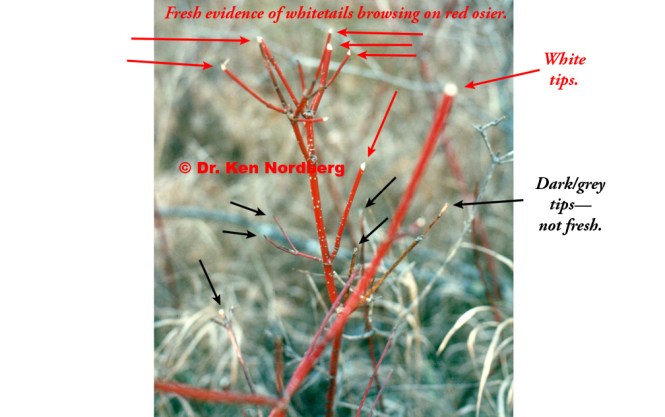
At this point, my whitetails abruptly (an overnight change) begin feeding on thin woody stems with developing buds of red osiers (dogwoods), sugar maple suckers (red stems growing from stumps in recently logged clearcuts), willows, mountain maples and black ash saplings — made evident by a sudden appearance of great numbers of ragged white tips on stems on these plants. Foods relished by whitetails are likely similar but different where you hunt.

Hunting Whitetail Bucks at Feeding Areas — Part II

A very choice late fall feeding area, red with browse.

Most whitetail feeding areas have certain physical characteristics. They tend to be relatively open (mature timber sparse) where sunlight can reach the ground and promote the growth of shorter green vegetation and certain woody shrubs, tree saplings and other foods relished by whitetails. Though whitetails find adequate food just about anywhere small or large throughout spring, summer and fall, they prefer to feed in areas large enough to enable them to continuously zigzag into the wind while grazing or browsing until they’ve eaten their fill, thus making it difficult for predators or hunters to trail or stalk near or wait in ambush undetected. Feeding areas 2–3 football fields in size (preferably end-to-end) or larger seem to be ideal when the wind direction is proper. During hunting seasons, whitetails of my current whitetail study area much prefer feeding in long and narrow sections of clearcuts 100 yards or so in width rather that wide clearcuts roughly square or round and 20–40 acres in size.