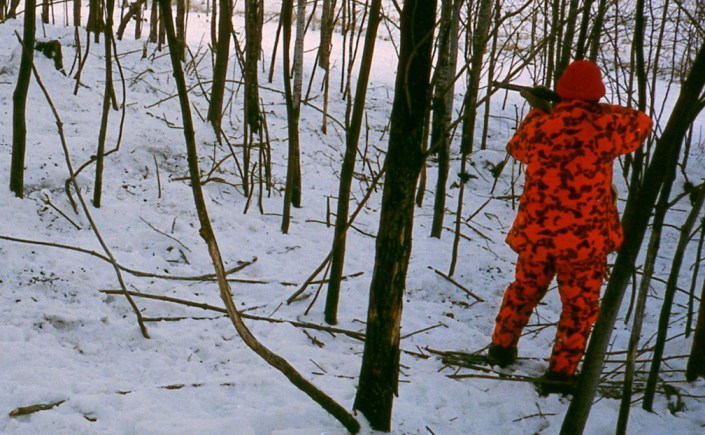
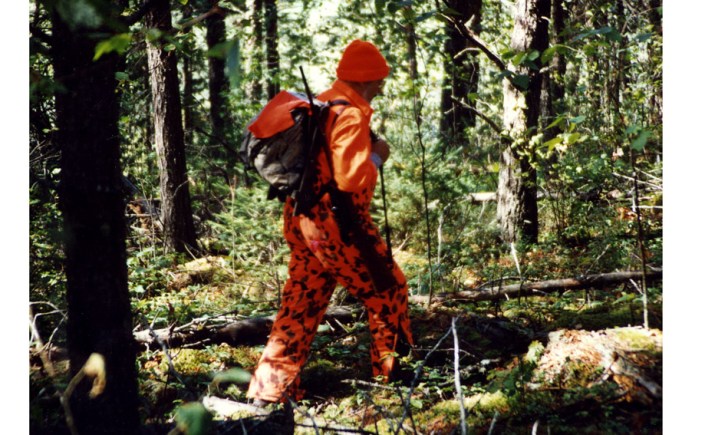
Though vital to success when hunting mature whitetails, fresh deer signs soon lose their hunting value.

Droppings with dull (dry) surfaces have no hunting value. (However, you don’t need a trail cam to know you want to hunt the buck that left these droppings. This buck — a trophy-class buck — is frequenting this area!)

Wherever fresh deer signs (tracks, droppings, beds, antler rubs, ground scrapes and/or evidences of feeding) made by mature whitetails (2-1/2 years of age or older) are discovered, you are located within a currently favored portion of the home or breeding range of the deer that made the signs — a site therefore having much greater hunting value than any other site selected for stand hunting without regard for fresh deer signs. During hunting seasons, unfortunately, the hunting value of such signs is short-lived. Especially while intending to take a mature whitetail only, especially a buck 3-1/2 years of age or older, never waste time stand hunting near of newly-discovered deer signs longer than 1–3 consecutive half-days. Though there are a host of reasons mature whitetails frequently begin using different portions of their home ranges during fall and early winter hunting seasons, hunting is the likeliest cause. Within 1-3 consecutive half-days of stand hunting at one site, almost all whitetails 3-1/2 years of age or older living within a half-mile will discover and identify you, either at your stand site while approaching it, with or without your knowledge. Thereafter, they will remain out of sight of your stand site until the hunting season is over. This isn’t true of all whitetails. Most lone fawns, many lone yearlings and a few 2-1/2 year-old bucks or does will not yet be adept at doing this.
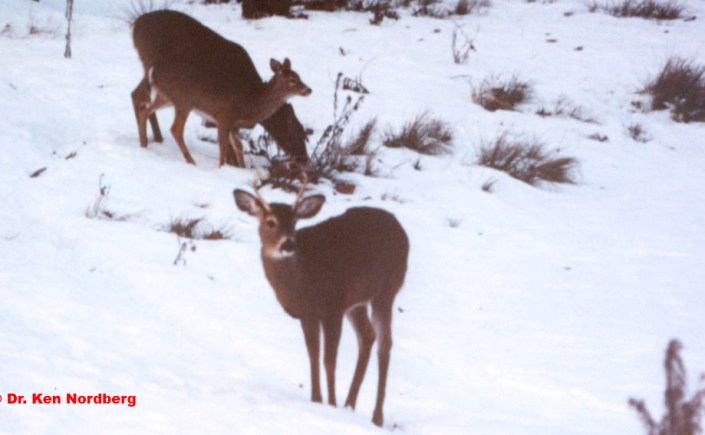
Fresh whitetail droppings provide a number of facts that can contribute to greater hunting success.

Certain viable, hunting-related conclusions can be drawn from discoveries of deer droppings. Lots of off-trail droppings, fresh (shiny) and old (dry with dull surfaces) scattered over an area several acres in size are characteristic of whitetail feeding or bedding areas (bedding areas also have beds, of course). Discovering droppings about 1/4 inch in length, fawn droppings, mean two deer live in the area: a fawn and mature doe. Lots of three-inch tracks and half-inch droppings are characteristic of mature does and their home ranges. Half-inch droppings and three-inch tracks of two deer traveling together (in fall) are likely made by a mature northern state doe accompanied by its yearling (1-1/2 year-old) buck. Droppings and tracks of normally smaller yearling does are somewhat shorter. Yearling bucks and yearling does without young remain in the ranges of their mothers until the beginning of their third spring.

Fresh droppings longer than one-half inch, made by mature bucks only, are regularly found in doe home ranges after about September 1st for two reasons: 1) larger buck ranges normally overlap several doe ranges and 2) after shedding antler velvet, mature bucks regularly visit does and their young during periods of feeding until the third two-week period of breeding ends in early January.

Droppings of whitetail bucks 4-1/2 to 6-1/2 years of age (the largest of bucks) measure ¾ to 1-1/4 inch in length in my northern Minnesota hunting/study area. Though most bucks of similar ages have droppings of similar lengths, their diameters can vary considerably, some droppings appearing long and skinny and others appearing egg-shaped, revealing the presence of more than one buck of similar age or size living in the area. Where I hunt, any buck that has droppings 7/8th to one inch in length is almost certain to be “trophy-class,” a buck you’d want to have mounted. Some of our bucks with ¾ inch droppings, generally 3-1/2 year-olds with wide and tall but more slender antlers, fall into this category.

If from this day on you skillfully limit your stand hunting to trails and sites marked with fresh buck droppings ¾-inch in length or longer (usually clumped in fall) and resist the urge to take lesser bucks or does, you will begin to enjoy the most incredible whitetail hunting of your life.

One advantage provided by deer droppings is, it is easy to determine whether or not they are very fresh

If droppings are not fresh, they have little or no hunting value. If fresh, they have great hunting value. Whatever their color (tan, brown or nearly black), droppings that are soft and have shiny surfaces are “very fresh.” Unless the deer that made the droppings was alarmed, very fresh droppings, especially in or near a whitetail feeding area, means one or more of four things:

  1. the deer is near right now,
  2. the deer will likely be near sometime between first light and 10 AM this morning,
  3. the deer will likely be near sometime between mid-afternoon and dusk this evening and/or
  4. the deer will be near between first light and 10 AM tomorrow morning (unlikely after that).

Beginning shortly before making such a discovery, your relative skill as a hunter will largely determine whether or not you will spot that deer without alarming it within easy shooting range (an easy target) during one or more of the periods listed above.

One shortcoming of fresh droppings is, they do not ordinarily reveal whether or not the deer that made them was alarmed, meaning, while stand hunting near fresh droppings, you may waste a half-day hunting a previously alarmed deer that has temporarily abandoned its range (a major reason why my hunting partners and I change stand sites every half-day). Occasionally a deer will defecate along a path 5–10 feet in length, indicating it was alarmed and trotting or bounding while defecating, therefore unlikely to be seen in the vicinity for the rest of the hunting season.

Very fresh, ¾-inch-long droppings enabled author’s son, Ken, to take this buck on opening morning.

Very fresh tracks of unalarmed whitetails are not only the most rewarding of deer signs, but they enable the hunter to regularly key on specific classes of deer — mature bucks, for example. The trouble is, they can be difficult to find. A lack of snow, dry or frozen ground or falling leaves are notable reasons.

p1020006a_clumped_not_fresh

Clumped buck droppings — hard, dry, dull — not fresh.

Second best are fresh deer droppings (scats). “Fresh” means shiny and soft with no frost crystals on them in sub-freezing temperatures. Beginning in September, droppings of antlered bucks are commonly clumped (stuck together).

p1000760b_clumped_fresh

Clumped buck droppings — soft, wet, shiny — fresh.

Doe droppings remain separate. Whereas one set of droppings can contain a few larger and smaller droppings than most and sizes of droppings from individual deer can vary a bit with diet, for the most part the more common lengths (not including the little knobs at the ends) in a puddle or clump of droppings nonetheless provide two bits of information that can greatly improve odds of hunting success: 1) the class of deer that made the droppings and 2) the vicinity, trail or site currently frequented by that deer, meaning, it is likely to be seen in that same vicinity, on that same trail or at that same site within a few hours, later the same day or the following morning (don’t count on it after that). Very fresh droppings discovered in the vicinity of a current favorite whitetail feeding area (sites characterized by greater numbers of off-trail droppings, fresh and old) are the most rewarding.

p1000750b

From a trophy-class buck that we didn’t get in 2016.
(Unclumped, found while scouting, before stresses of breeding.)

p1000736a

From another trophy-class buck that we didn’t get in 2016.
(Unclumped, found while scouting, before stresses of breeding.)

In northern Minnesota where I hunt and study whitetails, mature does (two or more years of age) and yearling bucks have droppings measuring one-half inch in length. Droppings of fawns and yearling does are shorter. All longer droppings are those of mature bucks (two or more years of age). In fall, droppings measuring ¾ to 1-1/4 inches in length are those of bucks 3-1/2 to 6-1/2 years of age (considered “trophy-class” by most hunters).

Proper scouting during a hunting season is step-one of the most rewarding method of hunting whitetails today: Opportunistic Stand Hunting.

Yes, it’s possible to scout during a hunting season without alarming whitetails enough to make them abandon their ranges or become nocturnal. Grey wolves, America’s most successful whitetail hunters, do it all the time (as follows). To accomplish this, the following rules must be strictly adhered to:

  1. While scouting, walk non-stop at a moderate pace without regard for wind direction and the minimal noises you might make.
  1. Keep your head pointed straight ahead, while searching non-stop for very fresh deer signs (not deer) and nearby natural, downwind or crosswind ground level stand sites 20–50 yards away along your path.
  1. Only scout on connecting deer trails that course widely through your hunting area.
  1. Restrict scouting to three periods: 11AM to noon or 1 PM (while deer are bedded), while hiking to a stand site and while hiking from a stand site.
  1. Upon discovering very fresh tracks (or other signs) characteristic of a desirable quarry that was not alarmed (not trotting or bounding) while hiking to a stand site in early morning or late afternoon, consider quietly backing off 20–50 yards to an appropriate stand site (providing adequate natural cover downwind or crosswind) and sitting down on a backpacked stool to stand hunt up to five hours. If near or adjacent to a feeding area, the odds of seeing that deer at that site will be especially favorable within the next few hours, later the same day or the next morning (not particularly favorable after that). If found midday, continue past the signs and an appropriate stand site without stopping and return quietly and non-stop later that day or the following morning from downwind or crosswind only.
  1. Scout for fresh signs following every morning hunt daily until you take a deer. While hunting in this manner, you will be close to deer (or a mature buck if its fresh tracks are 3-5/8 to 4 inches in length) every half-day you hunt.

Is Scouting During a Hunting Seasons the Same as Still-Hunting?

Let’s imagine you are still-hunting like the average deer hunter still-hunts these days: sneaking through the woods, often changing direction, often halting to listen for sounds made by a deer and scanning ahead from side to side, your main objective being to spot a deer within shooting range. You rarely remain at one location more than a few minutes. Because most deer you hear or see are noisily bounding away, making them very difficult targets, you carry a firearm that enables you to quickly fire several times. All of this makes it very easy for whitetails that have survived your aggressive style of hunting during two or more previous hunting seasons to quickly identify and avoid you. Within a day or two, most if not all mature whitetails that lived in your hunting area will have abandoned their home or breeding ranges, unlikely to return for several days or until the hunting season is over. Still-hunting as practiced today is the least efficient of methods to hunt whitetails and one of the two most destructive to additional hunting in the area until the beginning of the following hunting season.

Next blog: Properly done, scouting during a hunting season is step-one of the most rewarding of ways to hunt whitetails today.

How to Avoid Being Seen by Experienced Whitetails at a Stand Site

How to avoid being heard by a nearby whitetail while stand hunting is a no-brainer. Avoiding being visually identified is quite another matter. A stand hunter’s unique body or silhouette is large and unlike that of any other creature known by experienced whitetails, therefore readily recognized by them. To make your body indistinguishable while stand hunting, your body or silhouette must first be disguised by a fairly solid, natural background, dense enough to prevent being easily discerned against a sunlit, moonlit or starlit sky or a blanket of snow.

016b

Next, the stand hunter must sit (becoming more stump-like than human-like) remain as motionless as possible 4–5 hours (hard to do). Better yet, the huner should be hidden well enough by natural cover in front and sides to hide necessary movements. Skin of the hunter’s head and face, which contrasts greatly with natural cover, must be hidden by a camo headnet or mask and skin of the hunter’s hands must be hidden by dark gloves. From nose to foot (while seated on a stool) the front and sides of a stand hunter’s body and accompanying hunting aids (firearm, stool, etc.) must be masked by natural cover or naturally-appearing cover — a U-shaped blind made with natural vegetation found lying on the ground in the vicinity (made at least 2-3 weeks before a hunting season begins) or a portable blind covered with a camo fabric that blends well with natural surroundings and is not sky-lighted to keep its unusual shape from drawing the attention of mature nearby deer.

Unconcealed movements, fast or very slow, are a stand hunter’s greatest failing, especially while hunting older bucks. Except when winds are moderate-to-strong, whitetails rarely fail to spot movements made by hunters or just about any other live creatures near or far away. When a movement is spotted, experienced deer study its location intently, up to fifteen minutes or more, or until whatever moved is judged harmless, potentially dangerous or dangerous, the deer then reacting accordingly.

22b

The trouble is, human hunters depend almost wholly on their eyes to detect approaching or passing deer. Having eyes in the front of their heads, it necessary for stand hunters to often turn their heads and bodies 90-degrees or more to scan for upwind or crosswind deer. After a desirable quarry is spotted, it then becomes necessary for the stand hunter to raise a firearm or bow before taking aim and firing. Many archers stand up from a sitting position before taking aim. When unconcealed, these sweeping motions invariably draw the immediate attention of mature whitetails within 50 yards or more, often without the hunter realizing it and often with disappointing and long-term consequences. Unless a hunter’s upper body is at least 90% hidden when shooting movements are required, the hunter should always wait to raise a gun or bow until the quarry’s head is pointed straight away or both of its motion-sensitive eyes are well hidden by intervening cover.

doc_takes_aim_02c_med

(Note — Stand height rules have changed over the years. Always use a safety strap.)


Prerequisites of Opportunistic Stand Hunting

Learning to recognize tracks of whitetails and their many meanings is a vital first step to learning how to use my newest, amazingly productive form of stand hunting to hunt mature bucks and other deer. I call this hunting method “opportunistic stand hunting,” a means of taking quick (necessary) advantage very fresh tracks and/or other signs made by unalarmed deer. To successfully use this new hunting method, the hunter must be ready and able to move quietly to two new, unused stand sites near newly discovered fresh deer signs daily, made practical by the use of a folding backpacked stool and stand hunting at unprepared stand sites at ground level. Then, while stand hunting or while approaching a stand site on foot, the hunter must be very difficult to be positively identified by nearby deer via sight or hearing and impossible to smell (unlike while scouting mid-hunt).

Why My Hunting Partners and I Scout During Hunting Seasons

Most stand hunters see few mature bucks because they do not realize how quickly such deer discover and identify stand hunters and thereafter avoid them. Most stand hunters therefore end up wasting a lot of hunting time where the odds of seeing such a deer have become practically zero. Beginning at 11 AM on day three of a hunting season, my sons, grandsons and I no longer depend on stand sites selected before a hunting season begins to keep us close to mature bucks. From that time on, we keep close to mature bucks by stand hunting only near very fresh tracks and/or droppings (sometimes freshly renewed ground scrapes) of unalarmed bucks at two different sites daily, one in the morning and a different one in the afternoon and evening. Such sites are found via daily scouting, primarily along stand trails or other trails (all originally made by deer) selected for that purpose between 11 AM and noon. When there is no snow on the ground and the the ground is dry and hard, making tracks difficult to discern (like last November), we key on very fresh droppings made by unalarmed does, hoping to end up near one in heat accompanied by a buck, which eventually happens.

Scouting While Stand Hunting

Stand hunting is most effective when preceded by scouting for sites currently frequented by desirable quarries. Without scouting, you’re just guessing where to hunt, relying on luck only and not much of that. While scouting and selecting and preparing stand sites 2–3 weeks before a hunting season begins, no precautions are necessary to avoid alarming whitetails. By opening day, all deer will be back in their home ranges doing predictable things during predictable hours at predictable places.

While scouting for fresh deer signs during a hunting season — next places to hunt — certain precautions are necessary to avoid alarming whitetails, thus keeping them from abandoning their ranges or becoming nocturnal. While scouting at this time, the hunter must appear harmless, predictable and easy to avoid. This is done by walking non-stop along selected deer trails at a moderate pace (without regard for wind direction or sounds made) and keeping your head pointed straight ahead (eyes assessing deer signs on the fly along the trail ahead), the hunter acting as if only interested in reaching some far off destination (an effective deer hunting ruse regularly used by grey wolves). The moment you begin displaying hunting behavior while scouting at this time — suddenly halting to stare at something or visually scan the surrounding area, kneeling to inspect or measure tracks or droppings, slowing your pace, sneaking and often haltng or suddenly or often changing direction — any unseen deer that sees and/or hears you doing this will soon abandon the area and not return for several days or the balance of the hunting season, meaning, you’ve cancelled the hunting value of fresh deer signs found within 100–200 yards.