Taking Quick Advantage of Fresh Deer Signs, a New & Much More Productive Way to Hunt Whitetails — Part II

It’s noon. After a morning of unsuccessful stand hunting and later hiking along selected deer trails on foot in search of fresh signs made by older bucks, I’m back in my wall tent, large enough to house a pickup. The barrel woodstove in one corner, backed by a neat stack of split deadwood, is popping and crackling, making it warm enough inside to leave my hunting coat hanging outside alongside my rifle slung on the end of an eve pole — one of the nine long spruce poles that make up the gale-resistant framework that supports my cozy wilderness home.

p1020096a

It’s lunch time, generally a quick repast of cold sandwiches and fruit that don’t taint hunting clothes with food odors.

It’s also time to plan the afternoon hunt, aided by memories of new locations of fresh deer signs, a compass and an aerial map of our hunting area overlaid with colored lines that represent the maze of familiar deer trails we use. Before unfolding the map on the table, I take a quit look at smoke billowing from the chimney top outside to check the current wind direction, as vital to our planning and hunting as fresh deer signs. Wherever we decide to stand hunt, we must be able to get there from downwind or crosswind (with the breeze angling toward the front of one cheek). If it can’t be done, no matter how exciting the deer signs at the site might seem, we won’t hunt there, hoping for an opportunity to do it another half-day when the wind direction is favorable and newly made deer signs are again near. Sometimes a stand site that was used a week or a year or more earlier will be near, in which case we’ll use it. Often, however, a usable stand site that provides adequate concealment within easy shooting range downwind or crosswind of fresh signs has never been used before. When not sure the needed perquisites for a proper stand site are available near promising new deer signs, the site is reserved for afternoon and evening hunting only when a suitable stand site can be located without noisily bungling about in darkness with a flashlight in hand. A nearly-silent approach through well masked by natural cover is always vital for success. In the dense wilderness forest we hunt, however, rare is an area near promising buck signs that does not provide adequate concealment in several directions and at least one path to get there through a narrow natural opening, an existing deer trail or the back side of an intervening ridge. We make it a rule to look for approach trails that angle toward selected stand site through cover dense enough to provide concealment from deer that might be feeding out on front of a stand site, making it approachable in moonlight or starlit without the aid of a flashlight an hour before sunrise in the morning. Being accustomed to noticing adequate natural blinds immediately following discoveries of fresh buck tracks and/or droppings, sometimes no more than a single six-foot evergreen at a choice location, we generally know exactly how to quietly return to a newly selected in darkness the following morning. Whenever I’m close to an unfamiliar site, but cannot locate it without the use of a flashlight, I sit down on my stool, turn off my flashlight and wait without motion or sound until it becomes just barely light enough to see my destination, after which I quietly tiptoe to the spot.

I’ve rarely been met in the dark by a snorting deer. When it happens, little can be done to alleviate matters except immediately sitting down and avoiding movements for thirty minutes. If the deer deer did not positively identify you as a hunting human, you may yet spot it after it becomes light enough to legally fire at a deer. Curiosity is sometimes fatal to a deer

As first light begins turning black evergreen trees into green evergreen trees near a stand site I’ve never used before, I commonly begin to notice a number of thin twigs and woody stems that are going to make it difficult to find a clear opening through which to fire at a buck standing where I expect it will be when I fire at it. After nothing deer-like is spotted or heard for fifteen minutes or longer, I will generally dig my sharp pruner from the packsack attached to my stool and slowly and silently stand and reach forward to silently snip off enough of those troublesome twigs and stems to create two or three clear shooting windows, usually no larger than 6-9 inches in diameter. I have often been glad I did this and occasionally been sad because I didn’t.

Okay, no more whispering. We are watching that narrow clearcut where that buck with four-inch tracks browsed early this morning. I’m now ready to hunt deer.

Taking Quick Advantage of Fresh Deer Signs, a New & Much More Productive Way to Hunt Whitetails — Part I

It’s 9 AM on day three of our hunting season. I’m sitting on my stool, well hidden ten yards back in the woods downwind of the edge of a whitetail feeding area I studied well while scouting two weeks before opening day. I haven’t seen a deer. At this time of the day, they are obviously feeding somewhere else, a place where I’d most like to be right now.

Between 11 AM and noon while whitetails are normally bedded (the best time to scout during a hunting season), I planned to swing past the browse area 200 yards north of where I sat and then take the deer trail past the east side of the narrow clearcut where I took a buck two years earlier. I don’t have to see deer feeding to know where they are currently feeding. It’s actually best if I don’t see deer at this time. The way I travel on foot when searching for one or two spots to stand hunt next is very unlikely to alarm unseen deer along the way — walking non-stop at a moderate pace on deer trails without sharply changing direction and keeping my head pointed straight ahead, all without regard for wind direction. All I need to see to determine where deer are currently feeding is some very fresh, sharp-edged tracks and/or soft and shiny droppings somewhere within 20-50 yards of an edge of a known feeding area (previously discovered).

Fresh tracks of walking deer entering the browse area north of where I sat that morning were made by two does or a doe and yearling buck (both deer having 3-inch-long hoof prints). Very fresh, nearly-four-inch-long tracks made by a big buck walking from the narrow clearcut into the surrounding evergreen forest past a freshly pawed ground scrape were more interesting, though paradoxical. Should I hunt the nearby browse area where the other deer were feeding, hoping one is a doe in heat, should I hunt the narrow clearcut where the buck is likely to feed next unless attracted away from the area by a doe n heat or should I sit where I can keep an eye on that freshened ground scrape? Rarely discovered ground scrapes that have been very recently freshened while breeding is in progress in November can be amazingly productive buck stand sites. During the past decade, I have taken three big bucks and should have taken a fourth within fifteen minutes to several hours after sitting down on my stool downwind of such a scrape.

Something of importance that should be explained here is the fact that I never stop to measure hoof prints or droppings while searching for fresh deer signs (next stand sites) during a hunting season because displaying an obvious keen interest in a whitetail’s tracks or droppings is very alarming human behavior when witnessed by a mature whitetail, likely to cause it to soon quietly abandon the vicinity and thus destroy the otherwise great hunting value of the fresh deer signs. Also, because of my long experience measuring deer tracks and droppings, I rarely error while estimating their lengths on the fly, walking steadily past them.


“There is only one big buck per ten does living in my hunting area. Something’s got to be done about it.”

The above lament is common wherever whitetails are hunted. The trouble is, though during a hunting season most hunters see very few of the most elusive of whitetails, bucks 3-1/2 years of age and older; and depending on what a hunter defines as a “big buck” and the size of the area the hunter hunts, the above statement may actually be true but nothing can be done about it. Why? Because unless fenced in, big bucks, not humans, decide how many big bucks live in any one area. If a dozen or more were stocked in any square mile of suitable, unfenced habitat, within a very short period of time, only one is likely to be found living in that area.

The distribution of the various classes of whitetails is fairly consistent wherever they live. Take does. In forested regions does two years of age or older accompanied by their fawns and yearlings live spring, summer, fall and early winter in areas averaging about 125 acres in size (occasionally traveling off-range for a few reasons). Each range is separated by a surrounding buffer (no doe) zone. Where numbers of deer are high, doe ranges can be as small as about 90 acres and where numbers are low, they can be as large as 250 acres. Except in temporarily shared feeding areas between their ranges such as clearcuts and farm fields, does with young can be quite vicious when defending their home ranges from invasions by other does with young, including former young. In farm regions doe home ranges can be considerably smaller and even shared with other does with young until farm crops are deer tall, after which their ranges expand to more normally sized, separate ranges.

Now bucks. In early spring (after snow melts) bucks two years of age establish their first individual home ranges, typically about 300 acres in size. Two-year-old bucks seeking their first ranges typically end up traveling many miles before finding a suitable range not inhabited by an older buck (nature’s way of preventing in-breeding). Most grouchy mature bucks are not inclined to share significant portions of their ranges with newcomers.

During succeeding years, buck ranges become larger. On becoming dominant breeding bucks, typically at age five when bucks are in their prime (sometimes earlier), their ranges are about 600 acres in size (about a square-mile) and somtimes more than a thousand acres in size (up to two square-miles). In farm regions, though typically narrow, ranges of dominant bucks can be several miles in length. Normally, unlike doe ranges buck ranges overlap to varying degrees with ranges of other mature bucks. They also overlap or include entire ranges of does with young. Usually, there are 4–5 entire doe home ranges within the square-mile range of a dominant breeding buck.

Be sure to read my next related blog.

Each square-mile of suitable habitat typically contains home ranges of 4–5 does with young, ranges of 2–4 lesser mature bucks and the range of one dominant breeding buck.

Normally, there is only one like this in a square mile.

Normally, in forested regions where deer are not overabundant, each square mile includes 4–5 doe ranges, 2–4 ranges of “lesser antlered bucks” — bucks 2–6 years of age (few live longer) that do not have opportunities to breed because they are lower in their 1–2 square-mile buck pecking order than the one big, dangerous “dominant breeding buck” of the area. There are thus usually about fifteen-plus deer per square mile in a northern forest region and twenty-three-plus (twin fawns being more common) in southern farm regions.

Therefore, if your definition of a “big buck” is a “record book buck,” though roughly 40% of bucks including yearlings in your hunting area are actually antlered bucks, it is almost certain you only have one “big buck” per ten or more does (some of which are actually be buck fawns that appear to be does) per square-mile of your hunting area. This is normal. Whitetails insist on it. If your definition of a “big buck” includes all antlered bucks older than yearlings and if it was possible for you to actually see all bucks of these ages in your hunting area during a hunting season (which it isn’t), you’d actually see 4–5 “big bucks” per ten or more does (some of which are actually buck fawns that appear to be does). This is normal, though you aren’t likely to be able accurately establish such numbers.

Keep in mind, genetics and calcium-rich water flowing from limestone account for more younger bucks growing outstanding antlers in some regions.

What all this means is, to take more “big bucks” wherever you hunt you must become skilled enough as a hunter to see more “big bucks.” Otherwise, settle for taking the usual 1–2 trophy-class bucks in a lifetime.

Patience While Stand Hunting

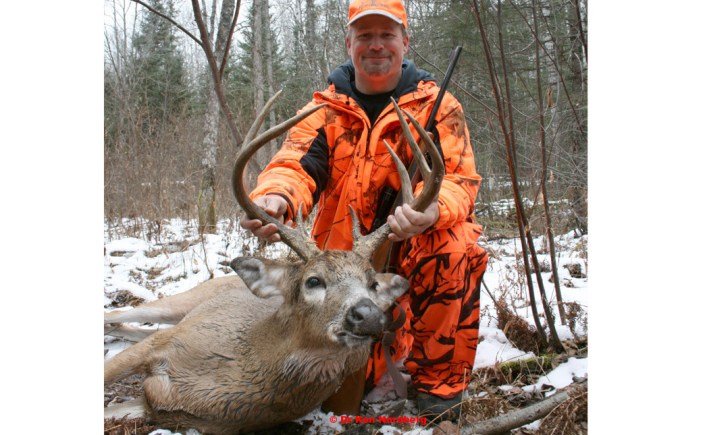
Only 30 minutes of patience was required to take this buck.

Patience is good while stand hunting…up to a point. Patience can also make you waste time at unproductive stand sites, eliminating chances to take deer (mature bucks) elsewhere. Nothing, not even patience, improves stand hunting success more than taking quick and quiet advantage of fresh deer signs…up to a point. Yes, this sounds like gobbledigook, but let me explain.

Back in the old days using one stand site per hunting season often worked, but not today unless you are willing to settle for an inexperienced fawn or yearling. Today, sitting at one stand site throughout a hunting season can soon become a dreadful waste of time. Whether using an elevated stand or a ground level stand site, within the first hour to three continuous half-days of hunting, today’s mature stand smart whitetails will almost always discover and identify you, more especially while you are approaching your stand. After that they avoid you. In my deer camp, our buck hunting rule is this: if you stand hunt within easy shooting distance of very fresh tracks and or droppings made by an unalarmed mature buck for a half-day but don’t see that buck, unless it was windy, stormy or unseasonably warm, that buck likely discovered you with or without your knowledge and it is already avoiding you. Unless we have a very good reason for thinking otherwise, we therefore change stand sites every half-day.

Where do we stand hunt next? Depending on wind direction (we always approach stand sites from downwind or crosswind and never cross feeding areas), during the first two days of a hunting season we hunt each half-day at different stand sites selected near where lots of fresh tracks and droppings made by mature bucks were found while scouting 2–3 weeks earlier. After that, we stand hunt wherever we discover new very fresh tracks, droppings and/or other signs made by unalarmed (not trotting or bounding) mature bucks — found while hiking non-stop (non-stop doesn’t frighten unseen nearby deer) between 11 AM and noon along deer trails previously selected for rapid mid-hunt scouting or while hiking non-stop to and from stand sites. A new discovery of very fresh signs made by an unalarmed buck often induces us to change our minds about where to hunt next. We call quickly deciding where to hunt next based on very fresh deer signs, “opportunistic stand hunting.” We never stand hunt where there are no very fresh tracks and/or droppings made by an unalarmed mature buck within easy shooting range upwind or crosswind. While stand hunting in this manner (five hours of planned patience per half-day of hunting generally adequate) — made effective by using a silently backpacked stools and ground level cover that hides our silhouettes and motions — no buck can endlessly avoid us unless it abandons its range or becomes nocturnal which doesn’t often happen where all hunters are stand hunters (like where we hunt).

Hunting Values of Various Deer Signs, Part II

Buck ground scrapes are the most misunderstood of deer signs. Very few are made or renewed while breeding is in progress. Dominant breeding bucks have little time for that then and they have run off most lesser, scrape-making bucks by the time breeding has begun in November. Made by all antlered bucks beginning after weather cools 2-3 weeks before breeding begins, most scrapes are simply visible, tarsal-musk-laden signposts of intended buck breeding ranges. They are not made to attract does.

p1010973a

They are “no trespassing” signs intended to warn other bucks to stay away from intended breeding ranges. Scrapes of dominant breeding bucks, victors of battles with all other bucks in their ranges, are respected and feared by all other bucks. Does do not intentionally urinate on scrapes to inform bucks when they are in heat — buck-attracting airborne pheromone emitted from the urine of each doe in heat for 24-26 hours attracts bucks wherever does are located. Does in heat do not wait near scrapes for a buck to appear. If necessary, they search for the dominant buck, easy to find because they reek with musk and urine. Only 10-12% of does are in heat on any one day during the first two-week period of breeding (in November).

Unless whitetails are seen feeding somewhere, with the exception of farm fields and forest clearcuts most hunters find it difficult to identify whitetail feeding areas — hubs of whitetail activities and the most productive of stand sites. Whitetail feeding areas are areas where lots sunlight reaches the ground.

43d

Feeding areas will have lots of zigzagging tracks of unalarmed deer.

Deer signs that identify them are lots of zigzagging, close-together, off-trail tracks of walking deer, fresh and old, lots of droppings, fresh and old, and lots chewed off stems of various plants — green vegetation and acorns where available in early fall and stems of woody shrubs and suckers and saplings of trees in late fall and winter.

220d

Late fall & winter feeding areas will have evidence of browsing.

174b

Feeding areas will be littered with fresh doe, yearling, and fawn-sized droppings.

p1020038a

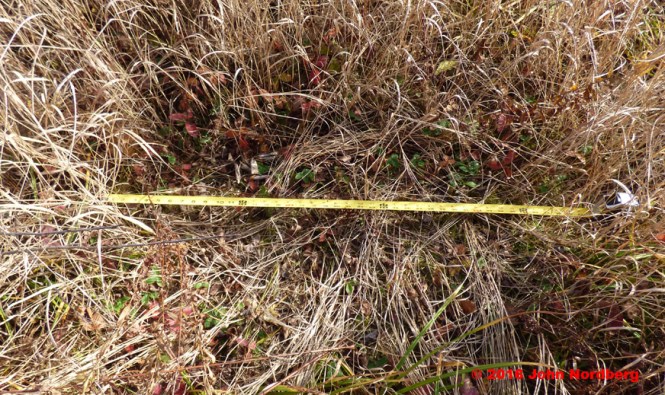
Keep an eye out for beds.

P1020007a.jpg

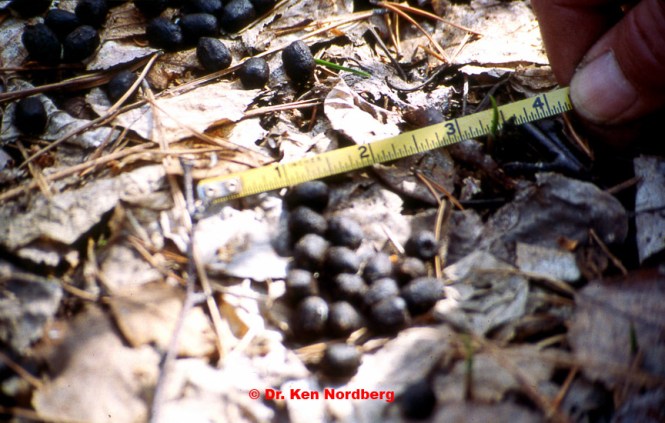
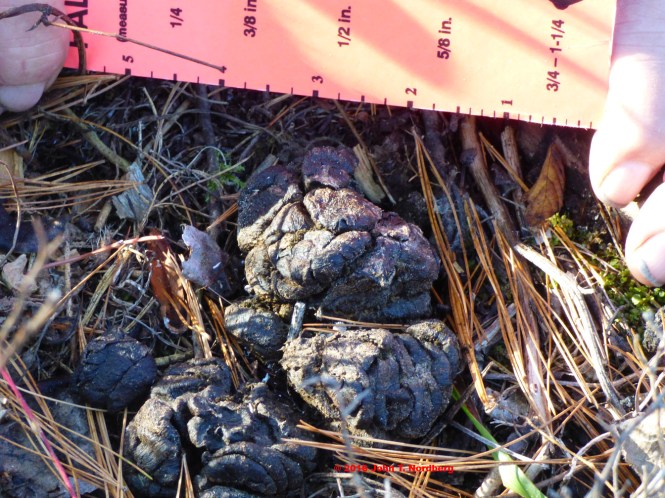
The size of clumped droppings in the feeding area will help you identify the class of the bucks that are keeping tabs on the estrus cycles of your does. (Be sure to get yourself a set of Doc’s Sign Guides.)

Being obvious deer signs, well-used deer trails are popular stand sites of hunters. Most are made by repeated passages of small deer herds — does trailed by their fawns and yearlings — becoming silent-to-use tunnels through cover. The odds of seeing mature bucks on such trails are relatively poor. Typically, doe trail openings are too narrow and low to allow silent passage of mature bucks with wide antlers and human hunters as well. Except where openings of trails are two or more feet wide and five feet high, while making or renewing ground scrapes along frequently used doe trails after mid-October or while trailing does in heat in November, older bucks travel off-trail up to 50% of the time. Add to this the fact that depending on wind direction, needed cover while returning crosswind or downwind on the way to downwind areas after feeding before turning toward their bedding areas and the fact that mature whitetails quickly discover trails and sites currently being used by hunters, whitetails therefore have at least a dozen different routes to use when travelling from one place to another.

p1000750a

While unclumped, these are very large droppings made by a trophy-class buck on a trail within sight of an important feeding area.

The odds of seeing a mature buck on any trail far from hubs of whitetail activities such as feeding areas, watering spots or not-advisable-to-hunt bedding areas are poor. The closer a trail is to a currently favored feeding area, the better your odds for success will be whatever class of deer you hope to take.

Hunting Values of Various Deer Signs, Part I

Fresh deer tracks of unalarmed whitetails (walking or feeding), especially near or within feeding areas, always have great hunting value. They not only reveal kinds of deer that made the tracks (via measured lengths) but reveal vicinities in which they are located right now or likely will be later today and/or tomorrow morning (if not alarmed by hunters meanwhile). During hunting seasons, don’t count on such predictability at same sites after three half-days have passed.

Fresh droppings of unalarmed deer also have great hunting value for the same reasons as fresh tracks. They are most common in feeding areas, aiding in identifying current favorite feeding areas — hubs of whitetail activities.

Lengths of whitetail beds reveal kinds of deer that made them but have dubious hunting value. Though deer may often change locations in which they feed and travel during hunting seasons, whitetails with safe bedding areas (deliberately avoided by hunters) where all hunters are stand hunters generally remain in their home ranges during hunting seasons, maintaining predictable habits at predictable sites during predictable hours. Whitetails that lack safe bedding area soon abandon their home ranges.

076b

Freshly made antler rubs (damp with damp fragments of bark on the ground beneath them) antler on tree trunks three or more inches in diameter adjacent to well-used deer trails are signposts of breeding areas made by older bucks, likely the largest in your hunting area. Trails thus marked are most traveled by these bucks during the 2–3 weeks before breeding begins (during archery hunting seasons). A rare rub found freshly made in November is likely to be visited and possibly renewed by the buck that made it within a few to 24 hours.

Signs of Buck Bedding Areas

Two or three weeks before each deer hunting season begins, my sons, grandsons and I spend considerable time scouting off-trail in search of secluded bedding areas of mature bucks. The first clue that tells us we may be near one is a newly made antler rub, bright and easily spotted over a considerable distance.

There are three kinds of antler rubs. One kind is made on small diameter tree trunks or clumps of woody shrubs by bucks about September 1st to strip deteriorating, insect-attracting velvet from their then fully developed antlers. These are usually made within or very near their bedding areas.

085b

More commonly seen are single rubs made on larger diameter tree trunks adjacent to well-used deer trails after weather cools in mid-October. These function as visible, musk-laden signposts of intended breeding ranges.

The third kind is made off-trail by mature bucks in their bedding areas during the two weeks before much anticipated breeding begins, a means of releasing pent up energy and aggressiveness by via mock battles with tree trunks. Where one rub of this kind is discovered (commonly within 100 yards of water), several more are soon likely to be discovered within the surrounding acre or two — the usual size of a buck bedding area. Six to twelve rubs are most common. Some older bucks will make thirty or more.

110c

Wherever several off-trail rubs in a small area are discovered, we then search for deer beds in fallen leaves or deep grasses, 45–56 inches long for bucks 2-1/2 to 6-1/2 years of age (few live longer). They will all be the same size because older bucks generally bed alone at this time. We also search for and find lots of droppings, commonly clumped, 5/8 to 1-1/4 inches long, because whitetails generally empty their bowels upon rising from their beds.

Now this might seem strange, but the main reason we search for buck bedding areas while scouting preseason today is to avoid them during following hunting seasons. Before 1990 I made it a point to hunt near bedding areas of older bucks (with limited success) after breeding came to an end on November 17th because at that time it was the only spot I knew of where such a buck could be counted on to show up after feeding in the morning. My studies after 1990 convinced me this was a terrible mistake.

As I had noted earlier, bucks I didn’t take, that discovered me stand hunting near their bedding areas, with or without my knowledge (tracks discovered later in snow revealing what had happened) not only abandoned the bedding areas they had been using spring, summer and fall but abandoned their entire home or breeding ranges until well after the hunting season ended. In fact very few ever used the same bedding area again during following years.

As further studies finally revealed, most mature bucks that have safe bedding areas throughout a hunting season will generally remain within their home or breeding range throughout a hunting season, or at least until becoming alarmed enough by hunters to raise their tails and flee with all possible speed, after which most quickly abandon their ranges and/or become nocturnal.

Whitetails Recognize Preludes to Hunting

Today’s mature whitetails recognize preludes to hunting seasons & differences between hunting & non-hunting humans.

Like last year, a big buck with especially large antlers and drop-tines spent spring, summer and early fall feeding, watering and bedding within or adjacent to my longtime Wisconsin hunting partner’s forest home. Often viewed with yearning and discussed by local deer hunters, weeks and even months before the firearm hunting season began the region surrounding the buck’s range rang with hammer blows and motorized equipment used to prepare stand sites, post lands, clear trails, create shooting lanes and offer generous quantities of baits such as apples, corn and growing clover or alfalfa. Contrarily, my partner deliberately avoided disturbing deer inhabiting his own wooded property throughout the year, but again, that canny buck was nowhere to be seen during during the 2016 firearm deer hunting season.

Such a tale is common wherever whitetails are hunted, one reason being, experienced whitetails that have survived three or more hunting seasons recognize preludes to deer hunting such as scouting, preparations of stand sites, discharges of firearms at targets and game such as grouse, waterfowl and black bears during earlier hunting seasons and an increasing frequency sounds made by off-road vehicles within their home ranges. They then realize it will soon be time to begin taking the evasive actions that enabled them to survive previous hunting seasons.

Mature whitetails also quickly recognize differences between hunting and non-hunting humans. When harmless humans they have often observed throughout the year suddenly don blaze-orange clothing and begin sneaking into their ranges, often halting to peer about and listen, or when humans form long lines that attempt to drive them toward waiting lines of downwind humans, they instantly begin taking previously effective precautions. Though conservative at first, as soon as it becomes obvious it will thereafter be difficult to avoid short-range encounters with hunting humans, they readily abandon their home or breeding ranges for extended periods, not uncommonly taking refuge several miles away on posted property or in habitat seldom invaded by hunters such as wooded swamps. Older wolf-country bucks I have studied were knowledgeable of safe sites in areas as large as a township (36 square-miles). Many experienced deer simply become nocturnal when threatened by hunters, stubbornly refusing to leave their secluded beds within their home or breeding ranges during daylight hours.

Now you know some major reasons why such deer are so difficult to hunt.

Characteristics of Productive Stand Sites

Whitetails are generally active in only about 10% of their home ranges on any one day. Typically, this 10% is long, and shaped like a skinny, lumpy donut with a secluded bedding area and current favorite watering spot in two parts and one or two of several feeding areas in other parts. To be productive, therefore, a stand must be located somewhere within this donut. This 10% is easy to distinguish, being well marked by often-used deer trails, fresh deer tracks and droppings and other very recently made deer signs. The trouble is, depending on wind direction, needed cover, currently available foods, known locations of trails and sites frequented by hunters and hunting methods used by hunters, this 10% can change in location, shape and size as frequently as twice daily during a hunting season, confounding efforts made by hunters. For this reason, preseason scouting is generally most rewarding during the first 2–3 days of a hunting season. After that, most hunters must depend on luck.

This is only the beginning of this lesson on deer hunting.

During any one day during the course of a hunting season, where are deer right now? Unfortunately, If you’ve been making drives or wandering dark to dark through your hunting area, they’re likely somewhere else, perhaps miles away. At the very least, most mature whitetails in or near your hunting area are now nocturnal — active during darkness only. If you are a skilled stand hunter, however, one who does not ordinarily alarm deer while hiking to and from stand sites, beginning on day three of your hunting season, mature whitetails are likely living fairly normal, predictable lives out of sight and safe distances from the trails you use and your stand sites. Their current locations are clearly marked by fresh tracks and droppings of walking or feeding deer.

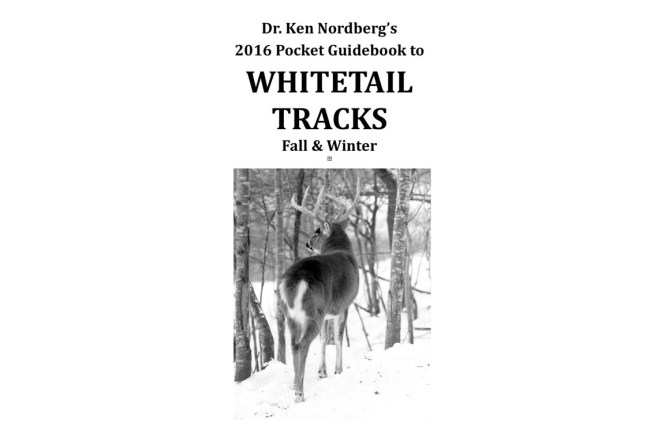
How to find and recognize these signs without spooking deer and how to successfully take advantage of such signs are book-sized subjects — soon-to-be published in my Whitetail Hunters Almanac, 10th Edition. I plan to touch on these subjects piece by piece via blogs during coming months. Recognizing deer tracks and their meanings is now well covered in my recently-published, $4.95 ebook entitled Dr. Ken Nordberg’s 2016 Pocket Guidebook to Whitetail Tracks Fall and Winter which can be downloaded to any device.

Track Guide Cover_01c

Apple iBooks version of Track Guidebook

Amazon Kindle version of Track Guidebook