Not Positively Identified

Upwind whitetails inadvertently alerted by an unidentified sound or motion made by you will not soon abandon the area if they can’t positively identify you.

After being alerted by an unidentified sound or motion (not true of human odors) made by you, nearby whitetails upwind or crosswind that cannot positively identify you via sight or hearing won’t soon abandon the vicinity of your stand. Take the buck my son, John, took on the fifth day during our past hunting season. When our deer camp clock began ringing 4 AM that morning, it was 28 degrees outside, the air was calm, the starlit sky was moonless and clear and a south west wind wasn’t expected to begin blowing until 9 to 10 AM.

“It’s a perfect morning to hunt at my blind on the north east side of the Moose Mountain clearcut (our name for a certain tall, steep-sided hill),” John declared. “I’d better get a move on. It will take me almost two hours to get there.”

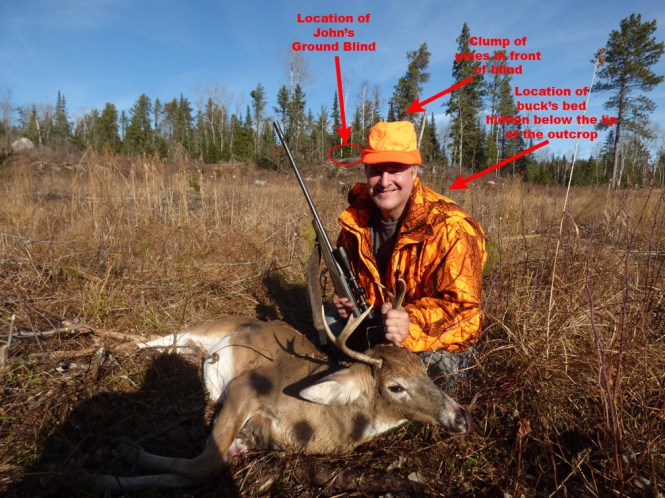
John was especially cautious as he began to make his way up the slope toward his blind — a naturally formed stack of storm-toppled evergreens atop a fifteen-foot high rocky outcropping overlooking the clearcut. Having discovered deer bedded directly in front of that outcropping upon approaching the his stand site during a previous hunting season, John was deliberately bending his knees with each step to make sure he didn’t drag his feet in dry leaves and putting his boots down lightly, avoiding stepping on any branches or twigs lying in his path. Uncharacteristic of human hunters, any deer that might be feeding near his stand ahead would find it very difficult to hear his footsteps, much less determine what was making them. Upon sighting his three fluorescent tacks on the base of a tree trunk ahead, intended to warn him when he was near his destination, John turned off his flashlight and silently slipped on his hunting coat that had been carried lashed to his backpacked hunting stool to ovoid perspiring during his arduous, two-mile hike. When his blind finally loomed up before him, John slipped his stool from his back and knelt before it to remove his camo headnet from its attached packsack. At this point, however, something inside the packsack made a soft, but strange sound. John then heard something moving away through the deep grasses about 20 yards out in front of his blind.

It was 6:40 AM, twenty minutes before it would be light enough to clearly distinguish a deer and legally fire at one. Under the starlight sky, nonetheless, John could make out the dark form of a single deer with modest antlers moving south across the clearcut, often halting to stare back in his direction. In an attempt to fool the deer into believing the sound it heard was made by other deer, John dug out his rattling antlers and softly tapped them together a few times, holding them high enough above the top of his blind to be seen by the retreating deer. It being obvious the buck had not positively identified him because it was not trotting or bounding away with its tail up and/or snorting, John hoped it would remain near until it was light enough to be more clearly seen.

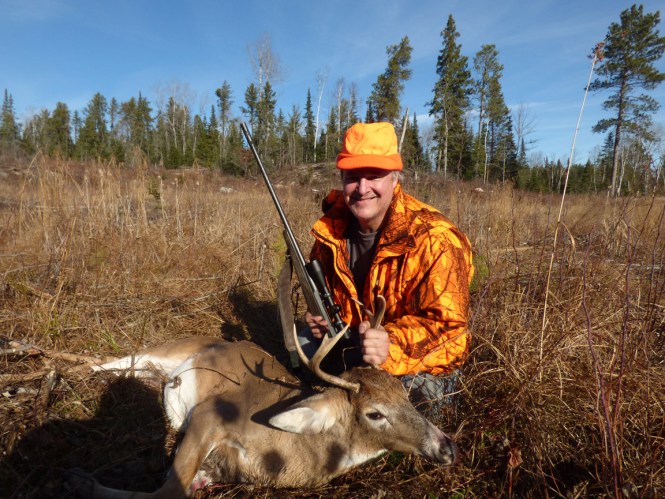
The deer finally disappeared and nothing was seen stirring until 8:45. Alerted by soft footsteps, John was staring south when he spotted a buck on his left — a 2-1/2 year-old six-pointer lacking one tine. It was stalking slowly north west past his blind about 45 yards away, seemingly searching for something — likely the two bucks it thought it heard touching antlers earlier. Ordinarily, John would have passed up such a buck, but being a year with low expectations due to much reduced deer numbers, he decided to take it. As soon as the buck stepped past a clump of mature evergreens that enabled John to raise his rile and take aim without being seen by the deer, he squeezed his trigger. At the shot, the buck dropped in its tracks.
p1020065d

Tracks 3-3/8 inches in length revealed this buck was the same deer that had been in front of John’s blind earlier. This proved again, though you may inadvertently alert nearby whitetails as you approach a stand site, if they cannot positively identify you via seeing, hearing or smelling — you being motionless or your motions being well hidden when they look your way, your silhouette is well disguised by natural cover, you have no bare skin showing and you are downwind or crosswind — those deer may be suspicious and extra alert for about 30 minutes, but they will not soon abandon the area.

Metallic Sounds & Experienced Whitetails

Did you see anything today?” I asked my grandson, Tyler, as he entered our deer camp wall tent a week ago Wednesday evening.

“Yup,“ he answered with a haunted expression on his face. “It was the biggest buck I’ve ever seen in the woods. I couldn’t tell how many tines it had, but there were lots of them. Many were really tall and its main beams were much wider than its body.”

“I got to my ladder stand with the railing by the river well before first light this morning,” he continued. “After carefully climbing to the platform and sitting down, I reached up and carefully eased the railing down to its horizontal position. Just before sunrise, however, the railing unexpectedly dropped into its locked position with a metallic click.

“About 100 yards away on the opposite side of the river, huge antlers immediately rose up from some deep yellow grasses. After lurching to its feet, the buck took a few quick bounds to dense cover and stopped where it was difficult to see. After I raised my rifle and began scanning for it with my scope, it began bounding straight away, tail up, zigzagging with each leap, an impossible target. It stopped again about 200 yards away. It was partially hidden, but I could see its body. Holding about six inches above the center of its chest, I fired, after which I never saw the buck again. I crossed the river at the ford where Uncle Ken got his biggest buck and spent an hour and a half searching for signs of a hit around the spot where I last saw the buck. I found no blood or hair anywhere. My bullet must have ricocheted off of something.”

“Too bad,” I reflected. “I had the same thing happen to me last year. Big bucks are lucky. You’ll remember this one for the rest of your life.”

“Metallic sounds likely have and likely will ruin your chances to take other big bucks in the future, with or without your knowledge. From now on, whatever sounds you make while hunting whitetails, try to make certain none are the kind that most frighten experienced mature whitetails, namely metallic sounds.”

No Snow Buck Hunting

During the past decade or so, a lack of snow has become an almost regular feature during the first week of our November firearm deer hunting seasons in Minnesota. This year (2016), daytime temperatures were in the 50s, 60s and one day even in the 70s during the first week, an amazing change from our once usual sub-zero temperatures during the same calendar period in past decades. A lack of snow and visible deer tracks in snow has not only made whitetail hunting more difficult for Minnesota hunters, but especially this year, upon taking a deer, hunters were forced to quickly find a way to preventing spoilage of their venison due to excessive heat.

Realizing our ability to key on mature bucks was now being severely handicapped by a lack of visible deer tracks in snow, my hunting partners and I quickly began using what we expected would be a less effective variation of our favorite hunting method, opportunistic stand hunting, relying mostly on fresh doe droppings rather than now less commonly found fresh tracks made by bucks to keep close to bucks. Logically, because the first of the three two-week periods of breeding was in progress (beginning November 3rd), we decided to key on (stand hunt near) more commonly found fresh — soft and shiny — half-inch-long droppings made by unalarmed, mature does, hoping any thus selected to hunt near was currently in heat and accompanied by a dominant breeding buck (generally the biggest buck in the surrounding square-mile).

p1000729

What we discovered while doing this was somewhat amazing. Ordinarily (while temperatures are normal for the period), there are very few lesser antlered bucks within a dominant buck’s 1–2 square-mile breeding range when breeding begins, having been driven off by the dominant duck during the previous two weeks. By mid-October when sub-freezing temperatures are common at night in Minnesota, winter coats of our whitetails are fully developed, preparing them to survive long periods of temperatures as low as 45 below zero during the coming months. For this reason, Minnesota whitetails are not as physically active while it is unusually warm during the latter half of October and November. Bucks are then less inclined mark their intended breeding ranges with antler rubs and ground scrapes. Something more happened this time: our dominant breeding bucks had obviously become less diligent about searching for and running off lesser bucks before and while breeding was in progress. For the first time ever during my 46 years of studying whitetails, younger antlered bucks were common wherever there were mature does (some likely in heat) during the first two weeks of November. This wasn’t true everywhere. Much of our hunting area is yet devoid of does due to losses during past severe past winters and continuing depredation by excessive numbers of protected grey wolves. Though our deer numbers were down and fewer deer were seen on the move during daylight hours, most that were seen were lesser antlered bucks. We actually saw more antlered bucks than does. Initially, we felt we’d be fortunate to take two mature bucks this year. Though we failed to tag a dominant breeding buck, quite surprisingly we took our self agreed on limit of four antlered bucks set during previous years (intended to prevent overhunting of bucks) rather handily: two 3-1/2 year-olds, one 2-1/2 year-old and one yearling.

20161113_151229a

p1020065b

20161106_181715a

If global warming means we can expect similar changes in habits and behavior in northern whitetails in the future (frustrating changes for hunters using old, traditional hunting methods), skilled stand hunting near very fresh droppings made by unalarmed does appears to be a way to enjoy great future buck hunting regardless.

For Tasty Venison

Venison in the freezer can be wonderful or not so wonderful, depending on what the deer was doing when taken, how it reacted upon being hit and how well the venison was cared for afterwards.

Venison from an alarmed deer — tail up and fanned, snorting and/or bounding or trotting — abruptly becomes loaded with adrenaline, blood sugar and lactic acid, giving it a “gamy” flavor. Gaminess peaks while a deer is fleeing any great distance, whether wounded or not. The best (most tasty) venison comes from a deer that was unalarmed (unaware the hunter was near) and dropped to the ground immediately or moments after being hit.

To preserve “tastiness,” after being dropped by a quickly fatal shot, the carcass must be quickly cooled, made possible by immediate field dressing and allowing cool air to enter the body cavity. My hunting partners and I are always careful to avoid hitting a deer in the abdominal cavity and always equally careful to avoid spilling contents of abdominal organs (stomach, intestines, urinary bladder and rectum) into the abdominal cavity, all capable of seriously tainting venison. During late fall or early winter where I hunt whitetails (northern Minnesota), outside air temperatures capable of quickly cooling venison are generally perfect (and insect free). To make certain all venison is soon adequately cooled, immediately upon transporting our deer to camp (hauled on foot on a heavy duty plastic toboggan), we hang the carcass clear of the ground, head end up, to allow complete drainage of blood and prop the body cavity wide open to hasten cooling. During the few hunting seasons when it was unseasonably warm, we quickly transported our deer to the nearest deer processing business to be cooled and butchered or we butchered it ourselves (we are good at it) and then transported our packaged meat to the same business to be quickly frozen. Usually, however, our daytime temperature rarely exceeds 40-degrees, perfect for cooling and aging. To enhance tenderness and flavor, we prefer to hang our deer carcasses (hide on) up to a week before butchering.

Venison is little marbled, making it healthier to eat than other meats. The fat generally lies outside or between muscle bundles. Unlike fat of beef and pork, venison fat not only has a slightly offensive flavor, but has the unfortunate characteristic of solidifying on the roof of your mouth at your normal body temperature. While butchering, therefore, we trim off all the fat we can. Fat being an important ingredient of sausages and ground meat, while grinding tougher cuts such a shanks and trimmings, we mix in 15–20% beef or pork fat and grind again. Quickly pan-fried or grilled venison steaks are served medium-rare to ensure juiciness and tenderness. Our roasted venison is cooked in various ways to keep it from becoming dry and tough even when well done (draping bacon over a roast, adding a half cup of water and other preferred ingredients and cooking it slow at 300 degrees in a cast iron roaster with the lid on, for example).

For great tasting venison, then, drop an unsuspecting deer at close range in its tracks (with a heart/lung or spine shot in the forward part of the chest or neck), carefully remove entrails, cool the carcass quickly, trim off fat (and wipe off deer hair) while butchering and cook properly to avoid toughness and dryness.

I hope all the tips I’ve provided via blogs, You Tube, my website, my books, videoa and Midwest Outdoors articles this fall will help you to enjoy one of your best deer hunts ever.

Best of luck everyone.

Doc

One of the Best Times Ever to Hunt Whitetails

Though not likely applicable to hunting whitetails in states where the temperature does not commonly drop below ten degrees during a hunting season, a thaw or near thaw with the wind calm or light following a few days of very cold weather will trigger an unusually productive 2–3 hour period to hunt sometime between 11 AM and 3 PM. Not realizing this, most northern deer hunters waste these hours thawing out in camp or automobiles and having lunch.

I’ll never forget the last time it happened. Following our third morning of 12-below zero temperatures with bitter winds blowing, everyone was back in camp shivering by 9–10 AM. While we sat around our cracking, two-barrel wood stove, complaining about the lack of deer sightings (only two bucks taken thus far), the weather was beginning to make an unexpected change outside. A warming sun was emerging from the clouds and the wind was dying. I didn’t notice the change until I heard drops of melting snow dripping from an eave of our tent, after which I immediately stepped outside to check our thermometer. Moments later I rushed back in, excitedly saying, “Get right back out there you guys. We’re about to have a midday thaw. Every deer in the woods is going to be up and feeding in a matter of minutes!”

While heading back to our feeding area stand sites that morning, most of us saw deer (I saw three does and glimpsed a buck). During the next sixty minutes, single shots echoed across our hunting area. By noon we had taken our self-imposed limit of five mature bucks (established years earlier to avoid over-hunting our older bucks).

NEVER MISS STAND HUNTING MIDDAY WHILE A THAW OR NEAR-THAW IS IN PROGRESS AND THE WIND IS LIGHT OR CALM FOLLOWING TWO OR MORE DAYS OF BITTERLY COLD WEATHER.

Changes in Whitetail Habits & Locations in November

Expect whitetails to make a number of changes in habits and locations during November hunting seasons that have little to do with hunting. While the first two-week period of breeding is in progress, for example, dominant bucks will be accompanying different does in heat almost daily (individual does are in heat only 24–26 hours), feeding and bedding with them. During this same period, most antlered bucks will not be in their usual home ranges, having been temporarily run off by rampaging dominant breeding bucks. As soon as breeding is over, lesser bucks will return and dominant bucks will rest in seclusion a week or so. After deciduous leaves have fallen, whitetails will favor different deer trails, those with adequate remaining cover. While there is moonlight in early morning, whitetails will quit feeding earlier than usual. While there is moonlight in evening, whitetails will not begin feeding again until the last legal shooting hour of the day. In Minnesota and most northern U.S. states, whitetails will quit eating grasses in one area and begin eating browse (stems of woody shrubs and saplings) in another during the second week of November. Whitetails will not move from their beds until the second night following the first heavy snow of winter (six inches or more). Hunters, of course, also cause changes. In one day those who hunt on foot can cause quick and lasting changes, forcing whitetails to abandon their ranges and/or become nocturnal. Stand hunters cause less severe changes, most deer remaining out of sight within their ranges, utilizing portions not currently being hunted (next blog: temperature related changes).

Dr. Ken Nordberg’s Most Valuable Hunting Tool

Back in 1960 when I switched from making drives to stand hunting, there was no such thing as a tree stand. Rather than actually stand upright while stand hunting, most stand hunters sat on something — a stump, log, boulder, brush pile or the ground. I sat on such objects throughout 30 hunting seasons, but not without complaint. Typically, such seats were unyielding, lumpy, cold and damp or downright wet. During our wintery Minnesota deer hunting seasons, an inevitably soaked rear sometimes made stand hunting unbearable. Moreover, such seats were rarely located at sites that might be considered ideal. Us stump sitters nonetheless took deer fairly regularly, including some braggin’-sized bucks.

Now that mature whitetails everywhere have convinced many veteran hunters tree sand hunting isn’t near as effective as it once was, ground level stand hunting has been making a strong comeback, as evidenced by the relatively sudden wide-scale demand for folding, easily-packed hunting stools and chairs and portable blinds.

stool_09

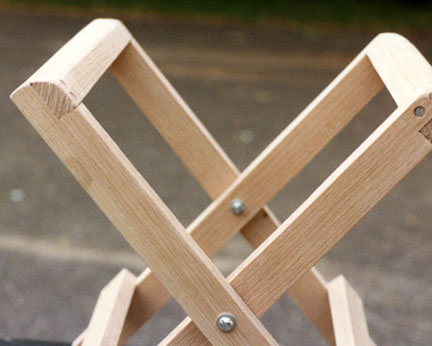
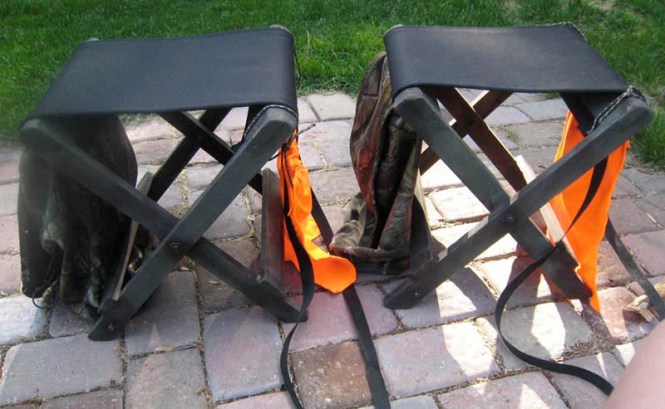
After trying using a few of the first commercially made folding stools in the early 1990s, typically having aluminum or steel frameworks with canvas seats, I decided to make one of my own with an oak framework, an attached packsack and custom-fitted shoulder straps. I preferred a wooden framework for two reasons. First, to eliminate metallic sounds easily heard over great distances and readily identified as sounds made by human hunters by experienced mature whitetails. When my stool’s wooden framework inadvertently bumps a branch or tree trunk, it makes a natural sound like that made when two branches or tree trunks bang together in a breeze, harmless sounds commonly heard by all forest region whitetails throughout their lives. Second, wood made it easy to create a stool height comfortable for my legs and knees with wide, rounded edges across the top of the stool to eliminate the discomfort characteristic of sitting long hours on the small-diameter, metallic pipe frameworks of folding stools of that period. Custom-fitted shoulder straps, joined in the center in back, eliminated the need for metal or plastic buckles and attachments in front. My attached packsack with a simple draw string is large enough to enable me to stuff my hunting coat (and all other needed gear) inside to avoid perspiring during long and arduous hikes to distant stand sites. My stool has been remarkably durable for more than twenty years years, the only new part needed being a camo canvass seat.

It gets better: My stool provides me with an instantly available, dry and comfortable seat whenever and wherever I decide to stand hunt (sit). It enables me to freely use great numbers of promising stand sites without the need for preseason preparations. Silent to carry, it is ever ready to be placed silently on the ground where I am well hidden within easy shooting distance downwind of just-discovered, very fresh tracks, droppings or other fresh signs made by a mature buck. It has thus made me regularly successful at taking mature bucks. I thus consider it my most valuable deer hunting tool.

(Here is a link to an article on my website on how to make your own stool.)

two_stools_john_made

Look to the Sky for Predicting Hunting Success

Much of my youth was spent on a northern Minnesota farm where the ability to predict tomorrow’s weather had a lot to do with how successful a farmer was at growing crops. No farmhouse I knew of back then lacked a current edition of The Farmer’s Almanac, noted for its accurate long-range weather predictions. For day-to-day weather changes, however, my grandfather Nordberg regularly looked to the sky for answers. If, for example, he saw high clouds that looked like mare’s tails blowing in the wind or herring bones, he’d likely say, “We’ll have to wait a few days before we can cut hay,” such clouds generally meaning it was going to rain within the next 12-36 hours. Being avid deer hunters, us youngsters learned early certain weather phenomena also portended tomorrow’s hunting success.

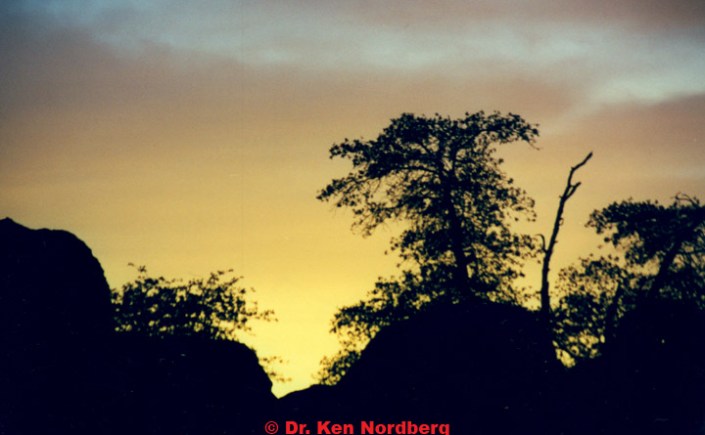
For example, if the western sky at sunset is yellow, wind will be strong the following day. Knowing whitetails bed early when the wind exceeds 9–10 mph or remain bedded while wind exceeds 15 mph, refusing to even feed or drink water until the wind subsides at sunset, we have long made it a rule to get to our stand sites well before first light the next morning, taking full advantage of the 2–3 hour daylight period when the air will still be calm or the wind light. Strong winds generally do not become strong enough to make whitetails scurry to their secluded beds until about 9–10 AM.

If the western horizon at sunset is gray (cloudy), rain or snow is likely during the night and the next morning. If light to moderate precipitation is falling before first light the next morning, whitetails will nonetheless be active until mid-morning. If precipitation is heavy at that time, it might be better to sleep in, but remember the old farmer’s saying, “Rain before seven quits before eleven (not 100% true),” after which whitetails everywhere will suddenly begin feeding for an hour or two. The first heavy snowfall of winter (six or more inches) is likely to keep whitetails in their beds until the second night following the storm.

312c

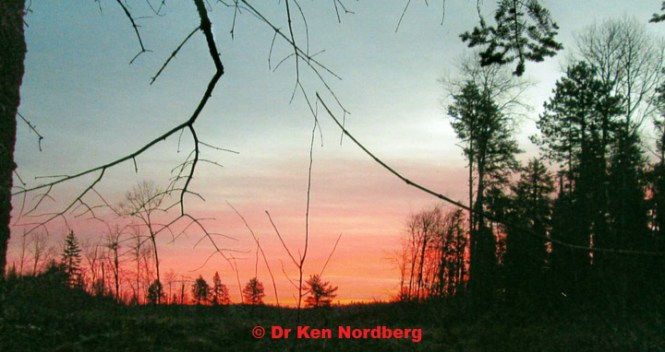
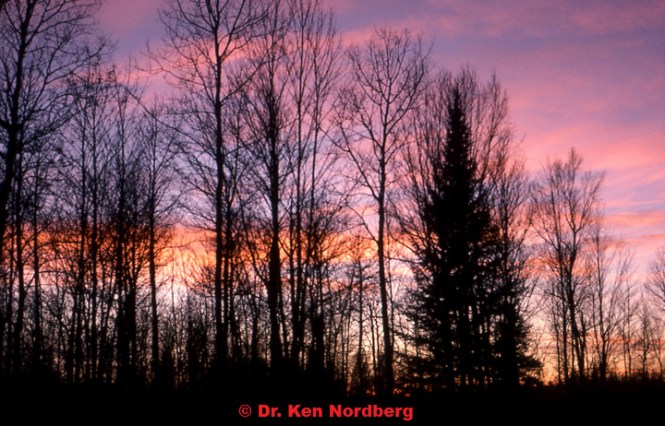
If the western sky is a brilliant red at sunset (I call it a “deer hunter’s sunset”), expect great hunting the following morning, perhaps all day. The sky will be blue, the wind will be calm or light and whitetails will be active later than usual. There may be heavy frost at sunrise, which is great, whitetails then certain to be active until 10-11 AM when the sun begins melting the frost away. It might be foggy at sunrise, which is also great because whitetails will be very active until the fog lifts. Don’t miss a minute of legal hunting time during a day following a red sunset, a day when your odds for hunting success will be at their peak…that is if you truly understand what the word “skilled” in “skilled deer hunting” means.

(Here are a couple of more examples of red Hunter’s Sunsets.)

280a

261b

A Whitetail Hunter’s Greatest Challenge

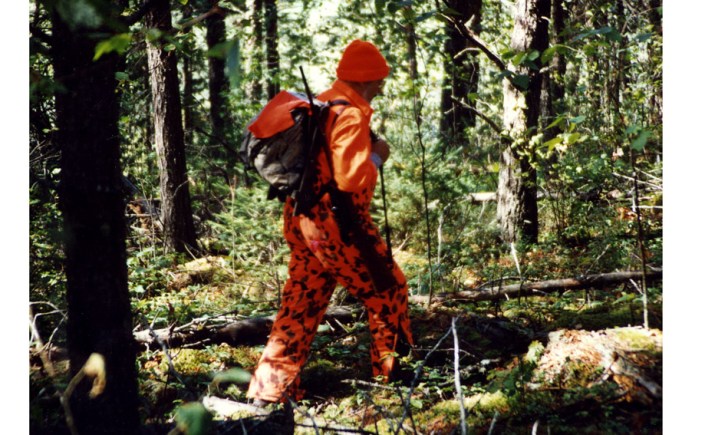
It’s eight days before the opener of our Minnesota firearm deer hunting season. I’m done scouting. I’m in the process of getting all my gear ready, including a trailer load of camp equipment. I still have to get to the rifle range, and, darn, I still have lots of leaves in my yard to get rid of. Most importantly, I also have to finish getting ready for taking on a whitetail hunter’s greatest challenge: getting to a stand site where I expect to see a mature buck without the buck knowing it. The final 100 yards leading to the sites I plan to hunt opening weekend have been cleared of dead branches. The soft-surfaced clothes I plan to wear have been washed with scentless laundry soap and are now drying outside under the roof of my back porch where they will be aired out throughout the coming week. My new lightweight boots, now well broken in, and my homemade backpacked stool with an attached backpack are hanging out there as well. Everything metallic I plan to carry will be checked for telltale metallic rattles, including my rifle sling swivels and hand-held flashlight. The only other thing left to do will be done when I begin my hike to my stand site well before first light opening morning — planning to arrive at my stand site one hour before sunrise or 30 minutes before the first legal shooting minute of the day. I will drive no motorized vehicle to my stand trail or stand. No metallic pickup doors will be slammed there and no one will talk out loud once we leave camp. My clothing will not be tainted by gas, oil and exhaust fumes after riding a noisy ATV, OHV or snowmobile. At the beginning of my trail, I will remember to begin bending my knees with each step and putting my feet down lightly, like a silently stalking bear. Black bears do this so well. This is difficult to continue very long without thinking about it the entire way to a stand. Sure, I’ll be stepping on dead leaves and grasses or snow, but as long as I don’t halt the entire way, drag my feet, make loud footsteps or break dead branches underfoot, deer ahead (upwind or crosswind) won’t be able to determine what I am via hearing. If they can’t identify me by my footsteps, they won’t abandon the vicinity of my stand site before I get there and my chance of seeing that buck soon after at first light will be as favorable as it can be. This I know because in 70 years of whitetail hunting I’ve succeeded in doing this so many times.

Tent Camping Among Whitetails

Other deer hunters who have never tried tent camping in winter typically find it difficult to believe we can actually walk around barefooted in our tent in complete comfort while it is as cold as 27-below-zero outside. We sometimes even find it necessary to open a tent door for awhile to cool things down. The only time it is uncomfortably cold inside is when our alarm clock begins ringing at 4:00 AM in the morning. At that time it is customary for me to crawl out of my sleeping bag rated for 20-below, get a gas lantern going, stack and light wood in our two-barrel Alaskan-type wood stove, get some coffee water heating on our propane kitchen stove, pull on a jacket and boots to head to the latrine outside and check the thermometer and the direction smoke is billowing from our stove pipe on the way back. By then it’s cozy warm inside, my hunting partners are sitting up on their cots yawning and stretching and asking, “How cold is it outside?” or “Which direction is wind blowing?” having certain stand sites in mind.

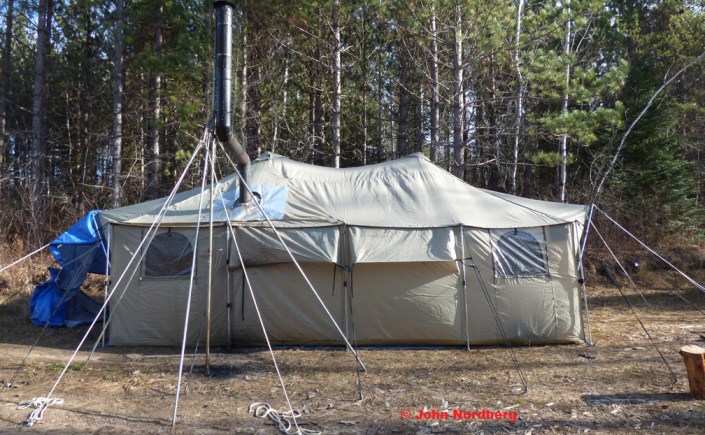
We began our cold weather tent camping in 1965 beginning with a 10X10 umbrella tent and aluminum bunk cots, heating the tent with a Coleman cook stove perched on a homemade rack and a gas lantern only when necessary. I have to admit, we had to be Minnesotans accustomed to cold winters to endure cold nights in deer country back then. As my hunting gang grew in number, we graduated to larger tents and improved heating systems. Today we use two big tents, 14×18-20 feet long, heated with barrel woodstoves. We are now thinking about replacing one of our tents, 31 years old, with a 27-footer to accommodate our growing gang.

Though necessary for some of us to head north a few days early to set up our camps and cut, split and stack firewood, we would hunt whitetails no other way. Our camps and parked cars mark our favorite deepwoods hunting area like bucks mark their breeding areas with antler rubs and ground scrapes. More than 99% of other Minnesota deer hunters, always welcome for coffee, have respected (not hunted in) our current hunting area for 25 years.

Half of the joy experienced during our deer hunting seasons comes from our tent camping. The sounds of wood snapping, popping and mewing in our barrel stoves, Coleman lanterns hissing above, the smells of tent canvas and sumptuous hot evening meals shared in one tent, spiced with spirited games of cribbage, our latest tales of hunting adventure and howling of wolves on distant ridges beneath the moon make our days in deer camp among the most revered and rewarding of a lifetime.