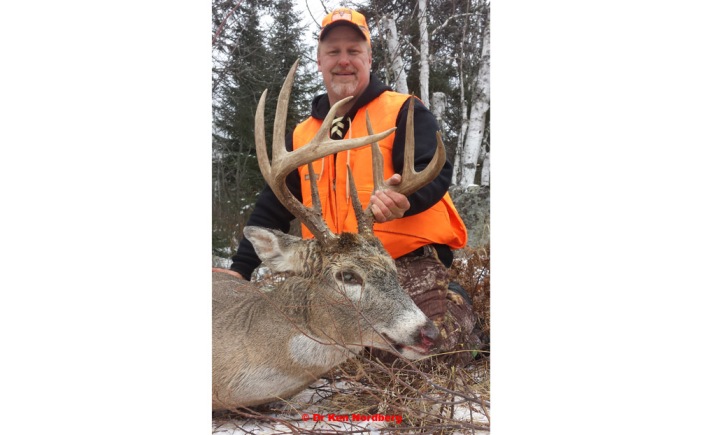
Scouting before a Hunting Season Begins

Scouting is meant to take the guesswork out of whitetail hunting: finding what kinds of deer live where so you don’t waste time hunting where there are no intended quarries. To be productive, scouting should be thorough. If thorough enough, however, while scouting you will alarm many deer in your hunting area, most of which will temporarily abandon their home ranges. Does with young, yearlings and fawns, will likely be back in their accustomed home ranges within 1–3 days unless other hunters scout in the same area after you scouted. Upon returning, these does, yearlings and fawns will be extra alert up to 4 days. Upon being alarmed enough by you while scouting to make them raise their tails, snort and/or bound away at top speed, mature bucks (2-1/2 years of age or older) are likely to remain off range 1–2 weeks. Being experienced at surviving hunting seasons, upon returning, they will remain extra alert a week or more. Ideally, to ensure the whitetails of your hunting area will be doing predictable things at predictable sites (feeding areas or certain deer trails, for example) during predictable time periods (making them most vulnerable to hunting), you should complete your preseason scouting, stand site selections and other field preparations at least two weeks before a hunting season begins.

Scouting a day or two before the opener is one of the most ruinous things you can do. Afterwards, like one neighboring hunter said a few years ago, you’ll likely end up saying, “Hunting was disappointing. We didn’t see near as many deer in our hunting area as we saw while scouting the day before the opener.” If you can’t scout early enough, you’d be better off skipping preseason scouting all together.

Whitetails and Sounds Made by Hunters

A whitetail’s nose is only useful for detecting potential danger upwind. Though very sensitive to spotting movements, a whitetail’s eyes are not particularly effective for spotting motionless hunters at least 50% masked top to bottom by natural cover. The only sense that enables experienced whitetails (2-1/2 years of age or older) to identify and avoid danger 24/7 in every direction safe distances away is their excellent hearing. Ironically, most whitetail hunters spend considerable money on products intended to mask or eliminate human odors and on other products intended to mask or conceal their bodies, but few do little, if anything, to minimize or eliminate the enormous number of readily-heard, telltale sounds characteristic of humans hunting whitetails.

Many sounds unique to human hunters come from clothing — coarse-surfaced outer fabrics that create rasping or crackling sounds when brushed against tree trunks, branches, bark, foliage, tall grasses and shrubs. Some identifying sounds come from metallic objects carried in pockets such as jingling cartridges, a flashlight, knife, whistle, match safe and compass. In addition to squeaking sling swivels, their rifles frequently glance off or bang against tree trunks and branches. Their backpacked tree stands or metal-framed stools occasionally make distinctive, metallic sounds as well, and it is nearly impossible to install a portable stand in a tree without making identifying sounds. Hunters who speak out loud to partners while on the trail to a stand site, or sneeze, cough, clear their throats, blow their noses, spit and drag their heels on a quiet morning are soon pegged by every mature deer within up to 200 yards. Other identifying sounds include saplings slapping boot fronts and swishing branches snatching hunting caps. Much too often, branches break (snap) loudly when pushed through or stepped on by deer hunters. Meanwhile, deer hunter’s footsteps are characteristically heavy (loud) and frequently interrupted by periods of silence — the hunter often halting to scan ahead and listen — revealing to deer the hunter is hunting and therefore dangerous.

A common prelude to all these identifying sounds are sounds of approaching gas-powered vehicles — snowmobiles, ATVs or other off-road vehicles — easily heard while being off-loaded and running miles away. Most who use them drive them close to stand sites or trails leading to stand sites. Today, there is hardly a mature whitetail anywhere that fails to realize sounds made by any of these approaching machines means, “Here comes a hunter.” There is hardly a mature whitetail today that fails to realize when one suddenly becomes silent nearby, a crack of thunder may soon be heard or a hunter will soon be heard approaching on foot. There is hardly a mature whitetail today that fails to realize the familiar fumes of oil, gas and exhaust being carried on a breeze are coming from a hunter (clothing and boots) that recently used such a vehicle. Similarly, there is hardly a mature whitetail today that does not realize what to expect upon hearing an approaching truck or car halt nearby, typically followed by echoing slams of metal doors and human voices.

Isn’t it strange that the vast majority of the largest and best equipped army of whitetail hunters ever known continues to overlook the fact that sounds made by hunters are a main reason for a lack of hunting success?

Winds and Hunted Whitetails

There are quite a few elements that shorten morning and/or afternoon hours whitetails are active (most vulnerable) during hunting seasons. One of the most profound is wind. While winds exceed 15 mph, blowing steadily or gusting, few whitetails will be active during daylight hours (except, perhaps in west Texas where deer might consider a 15 mph wind to be relatively calm). While winds are 10–14 mph, daylight portions of morning and evening feeding periods will be reduced 60–90 minutes, about 30 minutes for winds 6–9 mph. While the wind is calm to light (5mph), whitetails are most active, not uncommonly active an hour longer than normally in the morning (until 11 AM) and beginning an hour earlier in the afternoon (2:30 to 3 PM). Why?

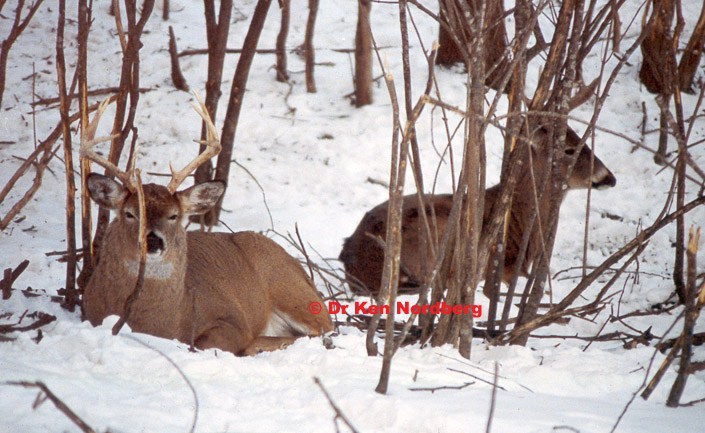
It’s because a whitetail’s most reliable means of detecting the approach of a predator or hunter from any direction, 24/7, its sense of hearing, is seriously handicapped by sounds caused by stronger winds. Winds that cause tree trunks and heavy branches to rock, scrape and screech against one another, cause branches to break, cause dead trees and branches or clumps of snow to fall to the ground or merely cause leaves, grasses and corn stalks to rustle loudly effectively mask sounds made by passing or approaching predators or hunters. Under such circumstances, the best way for a whitetail to avoid danger during daylight hours is to remain motionless and stubbornly bedded in the safest place it knows: its secluded bedding area.

Typically, however, winds strong enough to greatly alter periods whitetails are active in the morning do not ordinarily become strong enough until 9–10 AM — another good reason to be at your stand site 30 minutes before the first legal hunting minute of the day. Unfortunately, strong winds, steady or gusting, late in the day do not ordinarily abate until the onset of darkness (dusk). Once a strong wind, steady or gusting, becomes light or calm, however, whatever the time of the day, within minutes every whitetail in the woods is going to be up and about, feeding.

To be ready to take full advantage of periods whitetails will be predictably active (or not), keep track of local weather reports daily while hunting, beginning upon rising from bed in the morning. Then, despite predicted ruinous winds, hunt anyway. Endure the mild nausea (motion sickness) caused by your rocking stand tree because you never know, old mossy horns might show up regardless. Though uncommon, this has been proven in my deer camp several times (mostly by my son, Ken).

Scouting: the Actual Hunt

This may seem ridiculous, but in preparation for whitetail (buck) hunting I scout up to 31 times per year.

In spring just before leaves begin sprouting I scout 2–3 days, mainly searching for fresh mature-buck-sized tracks 3-1/2 inches or more in length and fresh mature-buck-sized droppings ¾-inch or more in length to determine where bucks 3-1/2 years of age or older are living in my hunting area, making later scouting easier. At this time I also search for browse areas (made evident by lots of ragged white tips on branches of woody shrubs and saplings) where my deer will begin feeding beginning the second week in November.

At least 2–3 weeks before a hunting season, I scout during one or two 3–4 day periods, mainly to check for evidences of feeding in graze areas (current grassy and acorn feeding areas), select and minimally prepare, if necessary, five stand sites and approach trails for the first 2-1/2 days of the hunting season (primarily around feeding areas with access from two wind directions) and check cruise trails, used beginning day three of the hunting season to search for very fresh buck signs (next stand sites).

Beginning on day three of a hunting season, until I take a buck I scout non-stop four times per day: 1) on the way to an intended stand site in the morning, sometimes changing stand sites upon discovering new fresh deer signs, 2) on the way back to camp via cruise trails between 11 AM and noon (most important), 3) on the way to a stand site in the afternoon and 4) on the way back to camp after dusk in the evening.

The rest of the time I hunt: sitting on my backpacked stool, using new (previously unused) ground level stand sites almost every half day and occasionally watching unsuspecting antlerless deer (great decoys), yearling bucks and 2-1/2 year-old bucks (sometimes taking one) while waiting for a big buck to appear, which generally happens sooner or later.

The Bear That Changed Whitetail Hunting Forever

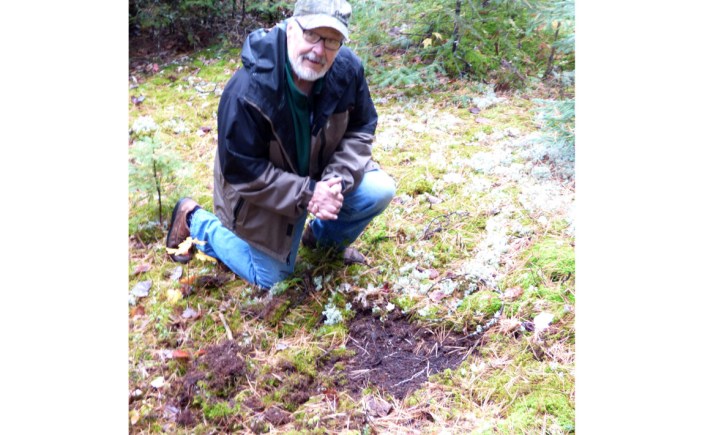
My son Dave’s routine upon arriving at 1 PM at his black bear stand/bait site 40-some years ago was fairly standard for us Nordbergs. Though his bait crib had been torn apart by a bear during the previous 24 hours, it still contained plenty of bait so Dave went straight to the base of the tree trunk at the edge of his 7-yard-diameter bait site opening opposite his stand tree and poured half of the honey from a jar into an empty bowl-like watermelon rind (previously cleaned out by a bear) and placed it on the ground between the tree trunk and the brush stacked behind it where one-half of the bowl would be visible from his portable tree stand. Then, using a short stick, he removed six limp-fried slices of bacon from a plastic bag and hung them on limbs in the brush pile. His “positioning baits” were then ready to ensure a bear would be standing quartering away when he released an arrow at it from his stand nine feet above the ground — setting up a deadly heart/lung shot with an easy to trail exit wound. Minutes later, Dave was seated in his stand, face covered with a camo headnet, arrow nocked and resting across his bow, his half full jar of honey stored out of the way on his stand platform beneath his seat.

About four hours later, his stand tree began to tremble. Turning his head a bit, he discovered a bear weighing about 250 pounds (not the 350+ pounder he was expecting) was climbing his tree. Figuring it would flee the moment it realized a human was perched above it, Dave froze. This realization didn’t occur until the beat was reaching for the jar of honey. After bear and hunter stared at one another a few long seconds, the bear backed down, sans honey, and quickly departed.

What that bear had just proven, black bears readily smell food and therefore humans as well in trees nine or more feet above the ground. That bear did not react to Dave’s odors accompanying the sweet odor of honey because it had become accustomed to smelling them during the two weeks before the opener when Dave had been regularly hauling (on a plastic toboggan) more bait to the site midday.

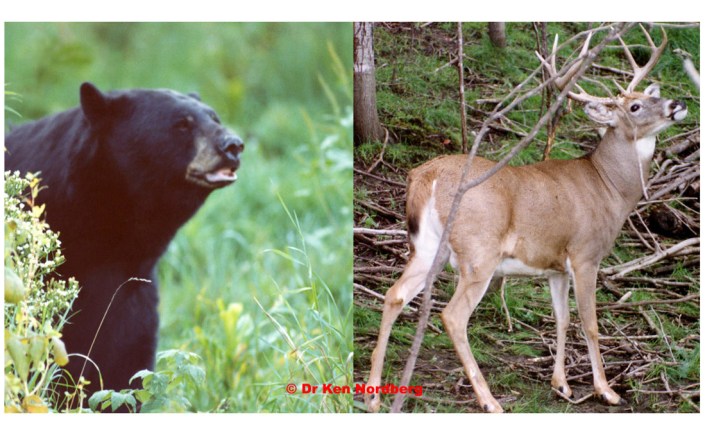
Having often watched mature whitetails halt upon discovering human trail scents and then stare in the direction taken by the humans, it is certain whitetails have a greater sense of smell than black bears, meaning, whitetails can also readily smell humans using elevated stands (contrary to popular belief decades ago). Since the 1970s, via magazine articles (nearly 800 of them), books (15), videos, and hundreds of nationwide seminars, I’ve been regularly warning hunters about this. Considering the great number products now available that claim to eliminate scents of deer hunters, most hunters now realize this is true.

The trouble is, most odor eliminating products have distinctive odors of their own, their effectiveness (those I’ve tested) is short-lived and some odors common to deer hunters such human breath and rubber boot soles cannot be eliminated. The only sure way to be completely certain you cannot be smelled by intended quarries is 1) approach them from downwind or crosswind (with the crosswind angling toward your right or left cheek) and then 2) stand hunt downwind or crosswind of where you expect to see a deer.

Keep in mind, while hunting, many deer will pass downwind of you and responses of downwind whitetails to your airborne human odors will be far less ruinous to hunting when not strong, meaning, while hunting whitetails, it is still a good idea to be as odor-free as possible.

Moonlight and Hunted Whitetails

Being equally active in darkness and sunlight, the degree to which whitetails begin to favor being most active in darkness during hunting seasons depends on how often they must raise their tails and flee and moonlight. For hunted whitetails that have survived two or more previous hunting seasons, moonlight at night is the clincher (a no-brainer) for mostly limiting activities to nighttime hours only — the period during which they are not normally threatened by aggressive (roaming) hunters and/or alarmed by nearby gunshots. When there is moonlight before sunrise in the morning, even when provided by a mere sliver of a moon, where hunting pressure is moderate-to-great (including hunting pressure attributable to wolves), hunted mature whitetails are typically on their way to bedding areas when the first rays of sunlight begin to stream from the eastern horizon. When there is moonlight in the evening, hunted mature whitetails generally wait until dusk to stir from their bedding areas. When there is moonlight all night, few whitetails are likely to be seen on the move throughout the following day.

The moonlight effect may cancelled by dark, heavy clouds, moderate-to-heavy precipitation and/or winds exceeding 15 mph at night; occasionally by does in heat. Bright northern lights can have the same affect as moonlight.

By no means should you forgo hunting in a morning or evening because of moonlight. Most mature whitetails are rarely completely nocturnal. To improve your odds for stand hunting success, don’t miss a minute of legal shooting time during the first and/or last hour of the day. On a moonlit morning make it point to get to your stand site 30 minutes before first light so there will be complete silence and no discernable movements made by you during the 30 minutes between your arrival and the first legal shooting minute of the day. If you arrive at first light, you will have wasted half of that first hour. If you arrive at sunrise, you probably will have wasted the entire morning. On a moonlit evening, remain at your stand site until 30 minutes after sunset.

p1000799c

Ordinarily, skilled stand hunting is most rewarding during the weeklong period each 28 days when there is no moonlight at night. By skillfully keying on the first and last hours of the day during periods of moonlight, your odds for success can be nearly as favorable. Keep in mind, too, despite moonlight, lone yearlings and fawns (not being led by older experienced does) are likely to be active throughout hours whitetails normally feed in daylight.

Beware the Whitetail’s 200-Yard Rule

Whereas whitetail fawns and yearlings do not think about it much and many 2-1/2 year-old bucks consider merely being out of sight of a hunter to be safe enough, while not bedded most bucks 3-1/2 to 6-1/2 years of age (few live longer) and many does 2-1/2 years of age or older are firm advocates of “the 200 yard rule” — responding in some way to avoid discovery by an approaching hunter currently about 200 yards away. It’s not a 100% effective rule because hunting humans cannot always be heard, seen or smelled that far away. Whenever possible, however, an older, experienced whitetail will always somehow react upon detecting and identifying a hunter about 200 yards away. If not moving toward the deer, it will generally ignore the hunter. If the hunter is drawing nearer (typically made evident by sounds characteristic of big-footed human hunters moving on foot), however, an older experienced whitetail will become prepared to do something to avoid discovery by the hunter. At first it may merely remain where it is and continue whatever it was doing, feeding for example, but during the following 15–30 minutes it keep extra alert in order to monitor the progress of the hunter. Once it appears the hunter will definitely close within 100 yards, the deer will begin moving away. If sounds indicate the hunter is moving non-stop, therefore not currently hunting, the deer will not usually move far, merely moving to nearby cover out of the approaching hunter’s path where it can watch the hunter pass. If sounds made by the hunter are often interrupted by short periods of silence, indicating the human is often halting, therefore hunting, the deer will silently vacate the area before the hunter is near enough to realize it, after which it will not likely return to the same area four or more days. The 200 yard rule thus enables mature whitetails to regularly out-maneuver unsuspecting hunters without the need for haste or the need to abandon their home ranges (a hunt-ruining response).

First Rule for Successful Buck Hunting

My family of whitetail hunters and I became addicted to hunting mature bucks after using primitive platforms nailed six feet above the ground between adjacent tree trunks in the early 1970s and using doe-in-heat lure scents introduced in the early 1980s, making buck hunting remarkably easy. By the late 1980s, however, mature bucks were beginning to prove they were learning to identify and avoid hunters using both of these hunting aids. It was then that we began searching for new and improved hunting methods, the relative effectiveness of each tried determined only by numbers of unsuspecting mature bucks seen within 50 yards during a specific (multi-year) period of time. It was then that we discovered about 85% of the mature bucks we were taking were spotted during the first three legal shooting hours of the day beginning one-half hour before sunrise, half during the first hour. We also then discovered it takes about a half hour for unseen upwind whitetails within hearing distance of our stands (50–200 yards away) to quit being especially alert and cautious after we sit down at our stands (then becoming completely silent). To avoid missing a minute of effective hunting time during those first three hours, in 1991 we made it a rule to arrive at our stands (in trees or at ground level) one-half hour before legal shooting time begins (one hour before sunrise). To facilitate unerring travel on foot in darkness, we mark our stand trails with fluorescent tacks that light up like Christmas tree bulbs in the beam of a flashlight. Today, this precaution remains our first rule for earning opportunities to take mature bucks.

Give Whitetails a Chance to be Predictable

Normally, whitetails are 50% nocturnal. At least half what they do when not bedded takes place in darkness before first light in the morning and in darkness after dusk in the evening. When hunters make it too dangerous for them to be up and about during daylight hours, they are not in the least handicapped upon deciding it is necessary to become 100% nocturnal (move about during nighttime hours only). Actually, their eyes are evolved for this, enabling them to see as well at night as by day. Hunting success, then, has everything to do with how dangerous it is for whitetails to move about during daylight hours during hunting seasons.

How dangerous is it where you hunt? Do you and your hunting partners make drives? Do you prefer moving about throughout the day, still-hunting or seeking deer to stalk? If your answer is “yes,” whitetails in your hunting area are finding it extremely dangerous to move about during daylight hours. Moreover it is certain most of them cannot find safe places to bed during daylight hours within their home ranges. To survive under such circumstances, mature (experienced) whitetails fully realize their only safe alternative is to quickly abandon their home ranges, seeking refuge in long familiar places seldom invaded by hunters such as posted lands and swamps and bogs (which can be miles away).

You are probably thinking this can’t be helped because hunting humans are in fact dangerous predators of whitetails. However, what you probably don’t realize is, like traditional prey of large predators throughout the world, our mature whitetails are capable of living fairly normal, predictable lives during hunting seasons if given the chance. You probably don’t realize, when whitetails are given the chance, your hunting success can improve dramatically. How is this possible? The answer has long been known by modern bowhunters who often change stand sites. It’s called “stand hunting,” Where all or most hunters are stand hunters and where those who are not stand hunters are respectful of areas where hunters are stand hunting, all classes of whitetails including the largest of bucks rarely find it necessary to become 100% nocturnal or abandon their ranges. Best for them, whitetails then have safe bedding areas during daylight hours. As preferred, they can thus remain in their home ranges during hunting seasons, free to feed at predictable places during predictable hours almost anywhere they want, at least until some unknowingly wander into easy shooting range of skilled stand hunters.

Fresh Deer Tracks With Great Hunting Value

Fresh tracks of a trotting deer (tracks three or more feet apart along a fairly straight line) or a bounding deer (elongated C- or J-shaped track patterns 15–25 feet apart) have no hunting value. They were made by a highly alarmed deer abandoning the area, perhaps its entire home range. It will not likely be seen in the same vicinity for a considerable number of days, if at all.

Fresh tracks of a walking deer (12–18 inches apart) or a feeding deer (tracks close together and randomly zigzagging) indicate the deer was not alarmed. If discovered early or late in the day, whether the deer is currently visible or not, it is likely fairly near. If the fresh tracks are found midday, though it is unlikely that deer is currently near, it will likely return to the same vicinity later the same day or early the following morning (unlikely after that).

What should you do? If early or late in the day, rather than attempt to stalk that deer, cautiously move 20 yards or more to a downwind site where you will be well hidden, sit down on your backpacked stool and wait patiently for the deer to appear — until 10–11 AM in the morning or 30 minutes after sunset in the evening. If midday, leave the area. After lunch, cautiously return to an appropriate stand site site from downwind or crosswind or before sunrise he following morning.

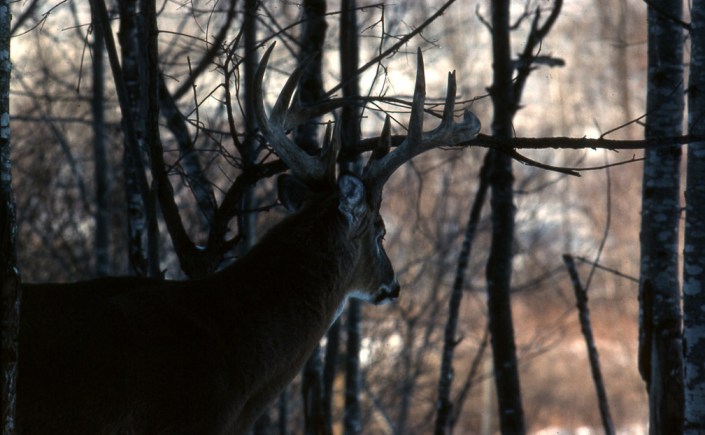
If the fresh tracks of the unalarmed deer are 3-3/4 to 4 inches long (not including imprints made by dewclaws), I never hesitate to hunt that deer as described above because the deer that made those tracks is an enormous buck. I have taken quite a few mature bucks, some of them dominant breeding bucks, within 15–30 minutes after sitting down on a nearby log or my stool.

You don’t own such a stool? Think about what you are missing.