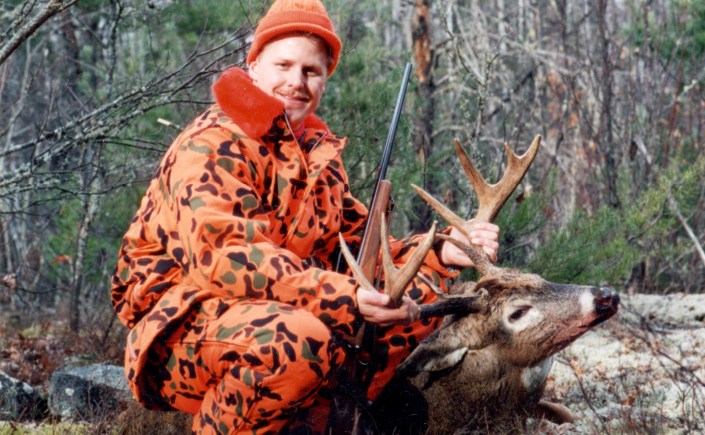
How to Become Regularly Successful at Hunting Mature Bucks

The biggest bucks in your hunting area are dominant breeding bucks, meaning they are dominant over all other bucks living within their ranges and while does are in heat, they breed all mature and yearling does living within their ranges. Most are 4-1/2 to 6-1/2 years of age. Their home or breeding ranges are generally about a square-mile in size. A few particularly aggressive bucks have home/breeding ranges up to two square miles in size. Within a square mile dominant breeding buck range live 14–29 other deer, depending on deer numbers and habitat. Four or five are mature does with young, fawns and yearlings, living in separate home ranges averaging about 125 acres. Three to five are other mature bucks, 2-1/2 to 6-1/2 years of age. Very few live longer, though rarely taken by hunters. These other bucks have home ranges that overlap with other buck ranges, each encompassing 2–4 doe ranges, generally 250 acres (typical of 2-1/2 year-old bucks) to roughly 500 acres in size. The one deer that best knows and utilizes the entire square mile, then, is the dominant breeding buck, typically claiming the most secure bedding area and using all other deer in its range like radar to avoid danger.

Now then, let’s assume you are a skilled and knowledgeable buck hunter (though you might not realize it yet), meaning you stand hunt only at sites in vicinities where signs such as fresh mature-buck-sized tracks, droppings and/or freshly made or renewed ground scrapes are currently found. This is a good first step because dominant breeding bucks do not utilize all deer trails, watering spots and feeding areas within their square mile every day. Stand hunting where one is active right now logically improves your odds of taking such a buck.

 The trouble is, dominant breeding bucks survive to their typical ages by being  superior to all other whitetails at locating, identifying and avoiding hunters. The easiest of hunters for them to avoid are those who continuously move about on  foot. Such bucks typically find and begin avoiding stand hunters located anywhere within their ranges within the first three feeding periods of a hunting season, usually without the hunter realizing it. As long as they keep safe distances away from typically stationary, non-aggressive stand hunters during hunting seasons, they obviously know it is safe to maintain normal habits elsewhere within their ranges. When determined to take a dominant breeding buck or any other mature buck 3-1/2 to 6-1/2 years of age, therefore, unless you take the buck at your original stand site by noon of the second day of a hunting season, you are generally wasting time hunting at the same stand site.

More trouble is, when a stand hunter is knowledgeable and skilled enough to actually be at a location where a buck one of these ages is near right now, the odds of being discovered and avoided by that buck before the hunter realizes that buck is near favor the buck. During the rest of a hunting season, therefore, to keep close to that buck or any other mature buck (by then they are fully aware it is being again hunted by you), you must skillfully switch to another previously unused stand site within easy shooting range downwind or crosswind of other very fresh tracks and or droppings made by the same or another buck (or a freshly made or renewed ground scrape) 100 yards or more from any previously used stand site every day or half day — the basic recipe for becoming regularly successful at hunting mature bucks. Sooner or later, you will then spot a mature buck within easy shooting range before it realizes you are near.

Yes, it can be done routinely. To learn how, keep tuned.

A Midsummer Task That can Greatly Improve Fall Deer Hunting

The area in which I have been hunting whitetails since 1990 is a large, heavily wooded wilderness area with lots of rocky ridges and hills and only one logging trail. Having long ago discovered stand sites never used before (100 yards or more from any recently used stand site) near very fresh signs made by a mature buck are by far the most productive for taking a mature bucks, I often deliberately spend an hour or so during summer to study an aerial map on my computer screen of my hunting area (usually a Bing map), searching for sites I have never hunted before and/or sites I haven’t hunting for several years.

To illustrate how productive such a map study can be, just a few minutes ago I discovered a spot about a half-mile in diameter that neither me nor anyone else in my hunting gang has never hunted before. I also found a remarkably short tentative route (no specific deer trail yet selected) to get there from crosswind while the wind is blowing from about the south or north that connects with my previously established cruise trail — a series of connecting deer trails that circles widely throughout about a square mile. This trail is used to hike to and from other connecting stand site approach trails and is the only trail I use when scouting for fresh signs made by mature bucks in that square mile during a hunting season.

Now that I’ve discovered this new area, I can’t wait to scout it thoroughly in mid-October, then selecting 2–3 stand sites, and approach trails (existing deer trails), 100 yards or more apart in that same area that need little or no preparation for use with my backpacked stool. Having done this many time before, I know if I find fresh tracks and droppings made by a mature buck in that never-hunted area (almost certain—see above photo), my odds of taking that buck it will be much better than odds of taking a mature buck almost anywhere else in my hunting area.

Experience has also taught me it would now be prudent find 1–2 other promising spots to scout a up to a mile or more away on my map—backups in case something goes awry during my first encounter or two with mature bucks in November, which when hunting older bucks is not altogether uncommon.

Before scouting, I will download and print an enlarged copy of my map, likely taping to it copies of surrounding areas. After scouting, my computer wizard son, John, will superimpose trails and locations of my stand sites, info taken from his GPS, on a similar map, providing a day-to-day means of determining best routes to take and stand sites to use during current wind directions during the following hunting season. You can’t know how amazingly valuable such a map can be until you have one and make use of it yourself. If you haven’t taken advantage of free aerial photographs on the internet before, give it a try. Get help if needed. It’s worth it. If you do, next winter you will probably feel prompted to send me an email to tell me how great this tip was.

It’s a Wonder Anything is Left of Whitetails by the Time Hunting Begins

Right now hordes of flying insects are hounding whitetails for blood 24/7. Crawly things too, especially ticks. Even while brisk winds, rain or cool nighttime temperatures provide some relief, these deer find little comfort because bot fly larva, which cannot be dislodged by frequent sneezing or rubbing of noses with hind hooves until they are bloody, are crawling around in their sinuses and nasal passages, dining on tender tissues. If during a rush to escape flying tormentors a buck accidently injures the sensitive velvet enveloping its growing antlers on a tree branch, various meat-eating wasps such as yellow jackets join the chase, determined to carve off chunks of exposed velvet flesh for hungry larvae waiting in hanging paper nests.

Shorty before the end of August when antlers are finally fully developed, blood flow to velvet shuts down and these yet sensitive tissues begin to rot and smell, attracting a new wave of vicious flies and wasps. Typically sometime while attempting to rest, a buck won’t be able to stand it any longer. Upon leaping from its bed, it will rush to a nearby small-diameter tree trunk or woody shrub to rub off on it as much of its deteriorating velvet as quickly as possible, followed by some vigorous side-to-side thrashing of its antlers through deep grasses or leaf-covered branches in an effort to wipe off remaining tatters of velvet and blood. Generally, however, it will take 2–3 days of repeated rubbing and thrashing before the buck will finally find some relief.

Note: while driving during thunderstorms in deer country, keep an eye out for crossing fawns, many of which run without caution in such weather because they are still terrified by thunder. Two were killed near my home while trying to get past a concrete median barrier during our last storm.


Yes, There are Deer Signs That Ensure Hunting Success

Where do you like to stand hunt? Anywhere in the woods? Where you have a great field of view? Next to a deer trail? In the middle of a large patch of brush? At the edge of a cornfield? Where you got a picture of a big buck with your trail cam? Next to a corn feeder or food/bait plot? At sites where you and your hunting partners have been stand hunting for years? Sure, every now and then someone takes a deer at one of these sites. What about mature bucks? Hardly see any of those? That’s typical. Do you know about 40% of the 15–30 deer per square-mile in your hunting area are antlered?

“No way,” you say? This answer alone reveals you have much to learn.

Do you know there are deer signs than practically guarantee hunting success? If you knew what they look like, where to find them and how to take advantage of them, you can actually take a mature whitetail (not a mere fawn or yearling) or even a mature buck every hunting season.

One of the most productive of such deer signs are “fresh tracks of a walking deer in or next to a whitetail feeding area.” A walking deer is an unalarmed deer. If it remained unalarmed during the last period it fed there, it is almost certain to return to the same feeding area during the next period whitetails normally feed. If such tracks are discovered without nearby deer realizing it before 9–10 AM in the morning or after 3–4 PM in the afternoon, the deer that made them and probably others are in or very near that feeding area right now. If found after 9–10 AM or before 3–4 PM, that deer is currently bedded somewhere near or far from that feeding area. If not alarmed by a hunter meanwhile or if it has not yet discovered you waiting in ambush there, it is practically guaranteed that deer will return to that same feeding area during the next 1–3 successive periods whitetails normally feed, (the number depending on how skilled you are at stand hunting)—practically guaranteeing you will have an opportunity to take that deer (if you properly stand hunt there). If you key on such deer signs in or near one or more current favorite whitetail feeding areas every hunting season, you can actually be a regularly successful whitetail hunter, or if you prefer, a regularly successful buck hunter (accomplished by keying on fresh mature-buck-sized tracks and droppings).

Keep in mind, no matter how skilled you believe you are at approaching a stand site and stand hunting, following 1–3 successive visits to one or more stand sites adjacent to any whitetail feeding area (or any other site), few if any mature whitetails will thereafter be seen there, meaning the deer that fed there now know you are there and it’s time to move to another feeding area. Never begin a hunting season without being prepared to hunt two or more feeding areas.

This means, of course, you must be able to identify whitetail feeding areas while scouting preseason. Certain farm fields and forest clearcuts likely to be feeding areas are easy to identify. If other hunters plan to hunt them too, however, their periods of productiveness will likely be short-lived, lasting only an hour or two. To be produtive, a feeding area must contain lots of fresh and old deer tracks and droppings. Typically, there are 4–5 other whitetail feeding areas in a square mile of forested whitetail habitat that are not as easy to identify, some of which may not be visited by deer until after a hunting season begins. Learning how to identify and properly hunt feeding areas is crucial to becoming regularly successful at taking mature whitetails.