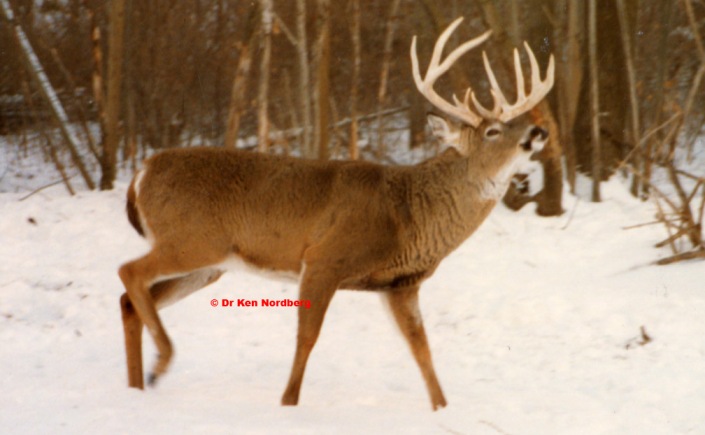
What Northern Whitetails Really Need During Severe Winters

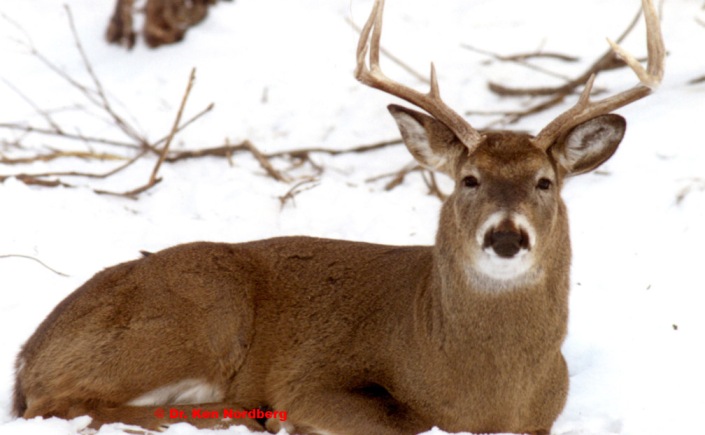
Northern whitetails are never in danger of suffering from starvation or a lack of adequate nutrition during spring, summer and fall. Winter is another matter. When snow is belly-deep or deeper to whitetails (see trail of desperately plunging deer in three feet of snow in above photo), while winds are strong, temperatures are far below zero over extended periods and where deep snow lasts well into March or April, many northern whitetails perish as a result of starvation.

In my far-north study area, whether snow covers the ground or not, whitetails suddenly quit feeding on grasses and such about the beginning of the second week in November and begin feeding on thin stems of woody shrubs and certain tree saplings. By this time buds, the most nutritious part of woody stems, have become prominent, such as on red osiers and mountain maples, much relished by whitetails. Red sugar maple saplings bristling from stumps in clearcuts are also much favored. Certain dried leaves, especially those of red oaks which are retained on branches throughout winter, are another favorite winter food. About the end of the third week in December, (earlier if snow is especially deep) all whitetails in my study area migrate to two traditional wintering areas where evergreen cover and favorite browse plants are abundant. About half migrate to a lakeside wintering area where white cedar trees crowd the shoreline. The greenery of these trees has enough nutrition to keep most mature whitetails healthy and fleet enough to survive unending predation by a pack of gray wolves. Once snow is belly deep, whitetails are forced to regularly use a maze of trails within a reduced area (deer yard) so they can be used to outrun pursuing wolves whenever necessary. From this time until snowmelt in spring they are locked in. Older bucks, still weakened by the rut—having used up much of their accumulated fat stores while battling other bucks and because they did not eat regularly while does were in heat—generally become easy deer yard prey for wolves during their seventh winter. Within a deer yard remaining browse stems poking above the snow are soon completely consumed, forcing deer to stand on hind legs to subsist on thin branches of various deciduous trees and remaining reachable greenery in cedars. This is a time when mature whitetails commonly have blood-red chins, caused by using their chins to help maintain their balance while standing on hind legs to feed on branches that can barely be reached. At this point, smaller deer such as fawns and yearling does find it difficult, if not impossible, to reach high enough to feed on remaining edible browse. Each fall, whitetails accumulate thick layers of fat on their bodies, needed to sustain themselves while winter winds are too strong, temperatures are too frigid and/or or snow is too deep and exhausting to plow through to consider leaving their beds to feed. This fat can only keep whitetails alive without feeding through about three weeks of such weather.

 Back in the 1960s, my brother, Bob, and I did our best to feed starving whitetails (with ribs showing) in our hunting area that were locked in deeryards by 4–5 feet of snow.  It was tough snowshoe work, using bow saws. Whitetails were so desperate for food that they gave up their fear of humans and flocked around us on usable trails as we cut boughs from white cedar trees for them. During one of our many weekends of doing this, we discovered seven dead deer in a yard that had been killed (but not eaten) by a marauding wolf pack. Though furious at first, we eventually realized this gave the remaining deer a much better chance of surviving until spring.

 Now then, here’s something for all you hunters who toil to create food plots to benefit whitetails to think about. How much do food plots buried under two or more feet of snow benefit starving whitetails in winter? How much do food plots with plants containing higher amounts of protein (the latest rage) buried under two or more feet of snow benefit starving whitetails in winter? If you really want to grow food that benefits whitetails when they need it most, grow something whitetails normally eat in winter, preferably something tall enough to poke up through deep snow. Red osiers (red bark dogwoods) are a good choice in forest areas. Wild osiers are easy to propagate. All you have to do is prune 1-2 foot long stems from existing wild osiers in spring, which doesn’t harm them in the least, keep your stems in a pail of water until planted and then poke the cut ends into damp soil (preferably in a damp or wet lowland) where they’ll get full sun or partial sun. They’ll all take root and grow and continue growing for many years, feeding lots of grateful deer in winter as long as they are not smothered by second growth quaking aspens (popples).
A Great Way to Introduce Whitetail Hunting to First-Timers

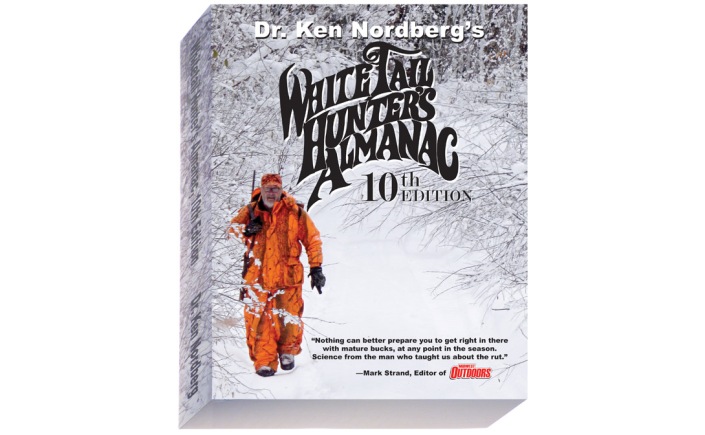
America has been a nation of deer hunters for about 400 years, beginning in the early 1600s. Because of our fast-growing human population, in the 1930s subsistence deer hunting (living off the land to put meat on the table) had to give way to sport hunting and being limited to taking one deer a year during short hunting seasons. Throughout the history of American deer hunting, hunting instructions have been passed on primarily by word of mouth—in the beginning from American Indians to European colonists and since then from experienced hunters to beginners—fathers to sons or daughters, for example. Other than learning how to safely use a firearm, my own first instructions for deer hunting (1940s) were rather sketchy, my most important instruction being, “Walk straight north (or south, east or west), keeping an eye on your compass, until you come to the road (or trail, stream or opening) where the standers will be.” Back then, those I hunted with only made drives. After that, I was largely on my own to figure out how to hunt deer other ways (mature bucks preferred), often ending days afield muttering, “There’s got to be a better way.” After eight years of college, earning three degrees and being engaged in some kind of research during most of those years, I decided the only practical way to become a more successful whitetail hunter was use the scientific approach to study habits, behavior and range utilization of wild deer and use information thus attained to develop more effective ways to hunt deer. I’ve been doing this for nearly sixty years, full time beginning in 1980. Based on my research are my ten editions of Whitetail Hunters Almanac, each covering different subjects. My first edition was published in1988. My 10th Edition (likely my last), published in 2018, covers all the best of what was learned in my two primary whitetail study areas and other areas in our country since my 9th Edition was published in 1997. In this 10th Edition are detailed instructions for using six new, extraordinarily-productive, mature-buck-effective stand hunting methods, developed and honed since 1990. If you’d like your son, daughter, nephew, niece or a friend who has expressed a desire to hunt deer to be regularly successful from the outset, my 518 page, 8 x 10 inch 10th Edition is arguably the best new written source of advanced deer hunting instruction today. Anyone who receives it as a gift from you will be forever appreciative. Based on all the thank you letters and photos of big bucks I regularly receive, I can guarantee it.

Why My Sons and I Change Stand Sites Twice Daily—Part III

Back in the early 1990s, my sons and I rediscovered stand hunting at ground level. No longer content to find lumpy and damp stumps and logs to sit on, we began using folding backpacked stools and existing natural cover as blinds. Surprisingly, it turned out to be as productive as our best tree stand hunting, often more so. The reason is, stools have several big advantages over tree stands. They can be moved and set up at new, never-used stand sites (most productive for taking mature bucks) much more quickly, easily and silently during a hunting season. Unlike tree stand sites, sites where our stools are used have no obvious physical changes and far less trail scent to attract the attention of today’s stand smart deer. Stools make it easy to sit downwind or crosswind of very fresh tracks, droppings or ground scrapes made by mature bucks and/or their current favorite feeding areas every time, twice daily. This keeps us close to mature unsuspecting (standing or slowly moving) bucks every half-day of a hunting season. What other hunting method can do this?

Fresh 3-1/2 to 4 inch long hoof prints of a walking (unalarmed) deer, fresh (shiny) 5/8th to 1-inch clumped droppings or a freshly renewed ground scrape more than two feet in diameter next to a well-used deer trail with damp soil, moss, leaves or turf pawed widely to one side and with one or more overhanging branches ravaged by antlers mean a big buck is very likely near. It means you might see that buck in a few minutes (if you do things properly). If discovered midday, that buck is very likely to be seen in the same vicinity in that afternoon or evening or even noon following certain weather events. If discovered while heading back to camp at the end of the day, that buck is very likely to be seen in the same vicinity during the first two legal shooting hours the following morning. A stool makes it easy to quickly take advantage of such knowledge.

An important point to keep in mind is, especially while breeding is in progress, the biggest buck in each square mile of your hunting area will likely be accompanying a doe in heat in one limited area in its home range one day and a another doe in heat in another limited area in its home range up to a mile away the next day. Individual does are only in heat 24-26 hours and only about 10% are in heat on any one day during a two week period of breeding (there are three two weeks of breeding each fall and early winter). This means, on the average only about one doe witll be in heat per day in a square-mile. If you wait a day or two to take advantage very fresh deer signs made by a big buck any time during a hunting season, your odds of seeing that buck won’t be good. This is because there are also a host of other reasons mature bucks often change portions of their home ranges they use from day to day, including, of course, hunting. During a hunting season, therefore, never be slow to take advantage of deer signs made by mature bucks that appear to have been made minutes earlier.

With my stool always on my back , I rarely pass up very fresh signs made by a mature buck while on my way to a stand site in early morning unless I have a very good reason, such as, the buck was obviously heading to the feeding area where I had intended to stand hunt. Upon discovering a freshly renewed ground scrape, black dirt scattered widely to one side across the snow in my flashlight beam ahead, an uncommon find while breeding is in progress, I rarely hesitate to back off downwind or crosswind to dense cover or a natural blind such as a fallen evergreen 20–50 yards away and then wait patiently. I have taken many fine bucks by doing this, several now on walls in my home. Some of them appeared within 15-30 minutes after I sat down (during daylight hours) and some showed up up to four hours later.

Back in the early 1990s, my sons and I began devoting more time to preseason scouting, our goal being to select about 3–6 promising mature-buck-effective stand sites per hunter (another big subject covered in great detail in my recently published 10th Edition of Whitetail Hunters Almanac) — half for tree stands and half for ground level stands — primarily intended to be used during the first three days of the hunting season when mature bucks are most vulnerable. Most stand sites we use after that are selected daily along widely looping trails we call “cruise trails” (connecting deer trails), one in each square mile we hunt. Some bucks adopt these trails because they are cleared of dead brush and branches and silent to use but most don’t like them because lasting human trail scents are deposited on them, or portions of them fairly regularly. Mature bucks and other deer nonetheless often cross them, providing us with all the evidence we need to decide where to hunt them next, the nearest feeding (graze, browse or acorn) area, for example. All of our stand site approach trails branch from our cruise trails and these two kinds of trails are the only trails we use during hunting seasons, giving our deer lots of room in which to live during hunting seasons not tainted by threatening human trail scents—thus encouraging deer to stay in their home ranges rather than abandon them. We are therefore rewarded with many more deer sightings right up to the last days of our hunts.

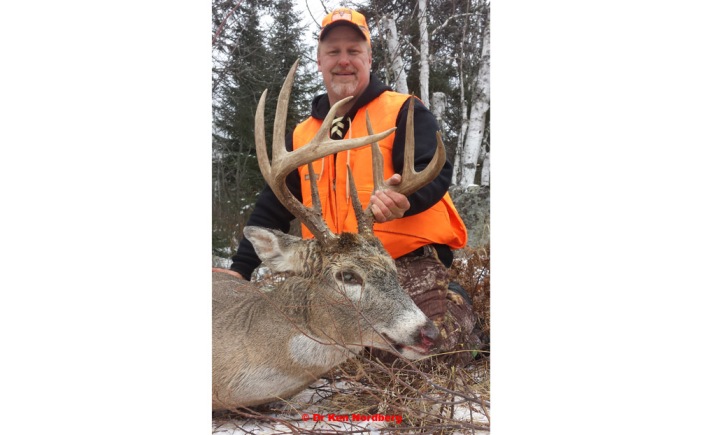
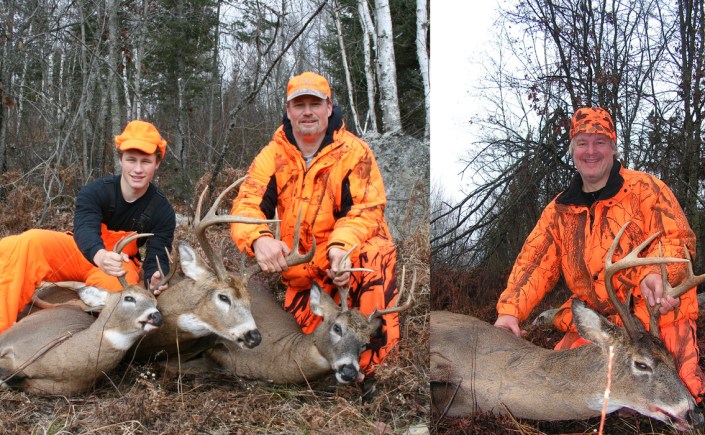
Though fresh deer signs made by mature bucks have short term hunting value, forcing us to change stand sites twice daily, our deciding factor, always, for selecting new stand sites is very fresh deer signs made by mature bucks. We hunt practiculy nowhere else. Such signs found in or adjacent to a feeding area are our most productive. More than anything, fresh deer signs keep us close to mature bucks, greatly improving our odds of taking our self-imposed limit of 4, sometimes 5 mature bucks annually (four typical bucks taken during a recent hunt in photos above).

Why My Sons and I Change Stand Sites Twice Daily—Part II

During the early 1990s, tracks in snow revealed mature bucks in my study/hunting area were going out of their way to avoid many of our previously used tree stands and ground level blinds, whether in use or not, including those many used only once for a half-day. Because my sons and I routinely take special care to ensure we are well hidden and downwind or crosswind of trails or sites where we expected to see a buck, it was difficult to imagine why this was happening. Deer tracks in snow finally provided a long ignored reason. During a day of stand hunting, bucks are as likely to pass downwind as upwind without the hunter realizing it. When they pass unseen within 200 yards downwind, upwind hunters are readily identified and easily avoided. Via airborne scents alone, mature whitetails can also accurately determine the hunter’s location, whether or not the hunter is moving and in which direction. Experienced whitetails today apparently realize a hunter whose source of airborne scents is not moving is a “stand hunter,” therefore harmless as long as a safe distance is maintained. Tracks in snow in my study area have often revealed some young and older downwind bucks and does will sneak near enough to take a look at what the hunter is doing. I’ve known several bucks that went out of their way to pass downwind of stand sites I had used before, doubtless to determine whether or not I had returned. Some even bedded downwind where they could monitor any move I made from my stand and the direction I took when I departed. The point is, in addition to any seen or unseen upwind or crosswind deer that may have identified us because our dark silhouettes were clearly visible against the sky or a background of snow or because of because of motions or sounds inadvertently made, lots of downwind deer that lived within the surrounding square-mile had learned all they needed to know to avoid us and our stands for the rest of the current hunting season and more. To minimize wasting time at stand sites soon avoided by intended quarries, my sons, grandsons and I began switching to new stand sites, always in sight of very fresh deer signs made by the same or other mature bucks near locations where they normally spend most of each day, namely 1) current favorite doe feeding areas and buck scrape routes along which scrapes are renewed every 24–48 hours during the 2–3 weeks before breeding begins in early November, 2) current favorite doe feeding areas early and late in the day and doe bedding areas midday during the two weeks does are in heat and 3) current favorite feeding areas of mature bucks and sometimes bedding areas of older bucks beginning mid-November. All stand sites we use are 100 yards or more apart from previously used stand sites.

Why My Sons and I Have Long Changed Stand Sites Twice Daily—Part I

A few older bucks recognize preludes to hunting seasons —shots taken by waterfowl and upland game hunters, for example — after which they disappear for the entire firearm deer hunting season. Generally, however, it takes 1–3 days — one for still-hunters and hunters who make drives and 2–3 for stand hunters — for all other mature whitetails (2-1/2 years of age or older) to realize they are again being hunted by human hunters. Inexperienced yearlings (including bucks) and fawns not led by mature maternal does are slow to realize this, making them the most vulnerable to skilled hunting. By day three, many mature does and all bucks 3-1/2 – 6-1/2 years of age will be using the tactics that enabled them to survive previous hunting seasons: traveling off-trail more than 50% of the time, for example, becoming less active during daylight hours and becoming more apt to abandon their ranges for the rest of a hunting season. Following nearly a half-century of widespread stand hunting, older bucks everywhere have become proficient at avoiding ambushing stand hunters, typically discovering and beginning to avoid stands with hunters in them within the first 1–30 hours they are used. Today, if stand hunting close to a trail or site currently frequented by an older buck, you’ll either get the buck within 1–4 hours or it will begin avoiding your stand site within 1-4 hours. The latter is most common.

More on Getting to a Stand One Hour Before Sunrise

Though some hunters strongly disagree (to put it mildly) when I recommend getting to a stand site one hour before sunrise in the morning, my three sons, three grandsons and I consider this precaution to be one of our most rewarding buck hunting practices. The reason is, about 80% of the 101 mature bucks we have taken since 1990, including three we took last November, were all shot near edges of feeding areas early during the first legal shooting hour of the day (beginning 30 minutes before sunrise). They were all taken on public land in a region inhabited by overabundant gray wolves and where where only one deer has been taken per 10 square miles for quite a few years. Our mature, especially wary, wolf country bucks generally head back to their bedding areas by 9:00–9:30 AM in the morning, but getting to our stands early is important for another reason. Mature bucks and other deer feeding near our stands are almost certain to hear one or more indistinct sounds or spot one or more indistinct motions made by us as we approach our stands in darkness (through dense cover downwind or crosswind). This arouses their curiosity, but as long as those deer are unable to positively identify us, they will not abandon the area. They will be especially alert and cautious for about thirty minutes, however, sometimes longer. They often move to nearby cover to hide their presence, but if nothing more is seen or heard from us after we are settled at our stands, they will usually resume what they were doing a half hour or so later, feeding, for example, and becoming visible, just about the time it becomes legal to fire at them.

Getting to a stand without seriously alarming deer along the way is not easy. It took many years of trial and error and some lessons provided by wolves to learn how to do it. To make it work today, we routinely use about 30 special precautions. It doesn’t work every time, but it works often enough to provide most or all of us with one or more opportunities to take an older buck almost every year. Not all hunters are capable of doing this, being unable to sit still 4-5 hours or being unable to hike to a distant stand in early morning darkness without seriously alarming deer along the way, for example.

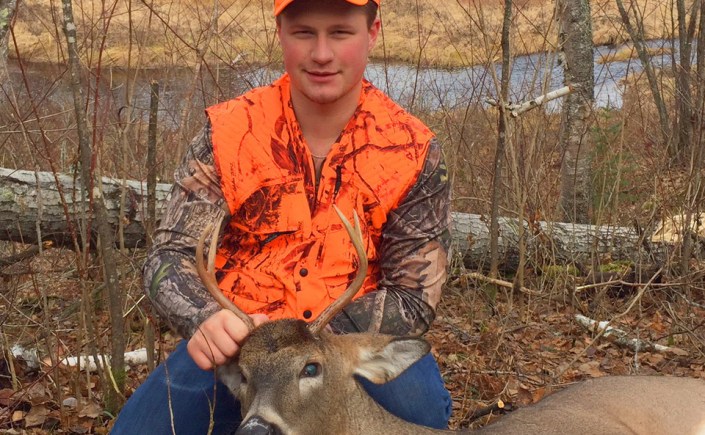
No, we do not take mature bucks every half-day we hunt. On the average we take one, sometimes two on opening morning (in photo above is grandson Ryan with the buck he took 20 minutes before sunrise on opening morning, 2018), but by the end of a week, we usually have our self-imposed limit of four mature bucks. Yes, we have taken bucks during all hours of the day, so we are usually out there hunting them during all hours of the day. Yes, we have also taken quite few between 11 AM and 3 PM as well, particularly when a certain recognized sequence of weather events triggers brief but massive midday feeding…but no one in the world is ever going convince my sons and me, and now my grandsons, to quit making the effort to get to our stands one hour before sunrise.

Watch for explamaions about tho 30 precautions mentioned above in my fuure blogs, YouTube presentatios, Midwest Outdoors Magazine articles and my website.

Catch ‘em by Surprise

There is not a stand hunter in America who can’t wait to return to a stand site where he or she took or saw a mature buck last year, or the year before or the year before that. I do it myself, even though my many years of hunting related studies have taught me there is a better, more sure way to take another mature buck.

 The most productive buck stand site provides great downwind or crosswind silhouette-hiding cover for the hunter, means of getting there without being positively identified by nearby whitetails and fresh nearby tracks and/or droppings or a freshly made or renewed ground scrape made by a mature buck. Nonetheless, if it is located where mature bucks living in the surrounding square mile have discovered a hunter stand hunting one or more times, typically happening without the hunter realizing it during the first 1-30 hours of stand hunting there each year, the odds of thereafter taking a mature buck at that site won’t be particularly favorable.

There is a reason. Mature whitetail bucks and does have excellent memories. Wherever you have hunted two or more years, all mature deer (not including a few possible mature newcomers and lone fawns or yearlings) will remember what you smell like, look like and sound like (including your unique footsteps) from hunting season to hunting season. They’ll even remember the trails and stand sites you commonly frequented, making it easy for them to avoid you right from the outset of a subsequent hunting season, doing the things that enabled them to survive past hunting seasons.

 The best way to overcome this mature-buck-hunting handicap is use a new (never used before) stand site often during a hunting season, each at least 100 yards away from any previously used stand site. Catch big bucks by surprise at stand sites where they have never discovered you before. They have no defense for this. As long as each new stand site has all of the above characteristics, each time you move your odds of taking a mature buck will again be usually favorable, but remember, only for a short time, not day after day for an entire hunting season or year after year. Older bucks are too smart to fall victim to that.

To Take a Buck

At age ten (1945) I asked my uncle Jack how to hunt a big buck. “You have to be at the right place at the right time,” he said. Though confusing at first, early in my later whitetail studies I discovered this was a very good answer no matter what class of whitetail you wish to take.

It’s simple. The “right place” is a trail or site being used by a big buck (or other deer) during any day of a hunting season, which will very likely be same trail, site or vicinity the deer will pass through or spend time in during the next three whitetail feeding periods—unless alarmed by a hunter, including you, in the vicinity meanwhile. The right place” will be made evident by very fresh tracks and/or droppings of a walking deer (differing sizes of tracks and droppings reveal classes of deer that made them).

 The “right time” is simple too. Whitetails are most active (during hours they can be hunted), doing almost everything they do in addition to feeding and drinking water, in the morning between first light and ten AM and in the evening between two hours before sunset until dark. If you know how various factors such as differing weather and the five phases of the rut alter these hours, you can narrow it down further.

 The problem is, how can you get close enough to the right spot at the right time for an easy shot before the deer there realizes you are approaching and sneaks away unseen and unheard or bounds noisily away with all possible speed, thereafter avoiding the site? This is the part of deer hunting that requires knowledge of whitetail habits and behavior during hunting seasons, special (wolf-like) hunting skills afoot, alertness, patience and the ability to make it very difficult for nearby whitetails to discover and identify you via airborne and trail  scents, sounds characteristic of hunting humans, motions and your unique human silhouette. Sometimes you get lucky, but over the long run you generally get what you earn via your application of your level of knowlwedge and skills in whitetail hunting.

Get a Big Buck This Year, Next Year Too & Every year After That!

Get a big buck this year, next year too and practically year after that using one of Dr. Ken Nordberg’s six new, mature-buck-effective hunting methods. Learn how in his new Whitetail Hunters Almanac, 10th Edition. To review and order this remarkable 518 page, 8” x 10” hunting manual with 400 instructive photos and diagrams, based on 55 years of unique, hunting-related studies of wild whitetails over much of America, go to www.drnordbergondeerhunting.com and click on “store” today for quick delivery.

On Walking Like a Deer

The very first morning I hunted whitetails (at age ten), my father said (like many fathers yet advise their kids today), “Walk like a deer. Take a few steps, stop for a few seconds, take a few steps, stop for a few seconds (and so forth). Nearby deer will then think you are a feeding deer and your chances of seeing one up close  (an easy shot) will be much better.”

Some years later after beginning my scientifically-based, hunting–related studies of wild whitetails, I learned this wasn’t true, at least when it came to mature, much-experienced whitetails—proven many times by various mature deer in my first whitetail study area over a period of twenty years. After certain deer and I finally became well acquainted with one another during periods they weren’t being hunted, I discovered I could approach within 25 yards of them from the opposite sides of downwind ridges without alarming them. After crossing the crest of the ridge (not moving directly toward them), they calmly continued whatever they were doing, feeding or chewing their cuds while bedded. When any of my sons who rarely accompanied me except while scouting and hunting tried this, those deer always disappeared before they reached the crest of those ridges, proving mature whitetails can distinguish different humans via sounds characteristic of their individual footsteps alone.

 Having booted, insensitive feet about ten times larger than sensitive whitetail feet (hooves), human footsteps are necessaily much noisier and different than whitetail footsteps, crushing greater numbers of dried leaves beneath each step, greater expanses of crunchy snow and many more twigs and branches that snap much more often and much more loudly underfoot than whitetails. Humans also characteristically drag their boots (heels) through dried leaves and across coarse surfaces (gravel, for example). Having ears that can hear footsteps of average hunters more than 100 yards away on a quiet morning, it is therefore difficult to imagine experienced whitetails cannot also easily distinguish nuances of footsteps that are characteristic of footsteps made by approaching hunters.

 On many occasions I have observed feeding whitetails growing increasingly alarmed while an unseen, downwind hunter was stalking toward them. Ordinarily, if mature whitetails (not 100% true of fawns and yearlings) cannot identify whatever is approaching via its footsteps, and it is not hunting or stalking (sneaking and often halting), they will not abandon the area. Instead, if not in the path of whatever is approaching, they’ll simply freeze where they are or move to nearby cover and freeze there until they can determine via additional sounds, sights and airborne odors whether to remain in the vicinity or abandon it, noisy and quickly or cautiously with stealth.

Obviously realizing whitetails do this, while cruising in search of vulnerable prey, singly or as a pack, the grey wolves of my study area typically march nonstop past selected prey (unless very near) without turning their heads until out of sight and hearing and downwind or crosswind. Mature whitetails hearing or seeing wolves marching past in this manner—seeming to be not hunting and therefore currently harmless—simply watch the wolves pass, thereafter resuming whatever they were doing before the wolves were discovered. This wolf ruse thus ensures their unsuspecting chosen prey will be close to where it was initially detected when the the wolves begin their actual hunt.

Following this discovery, My sons and I began regularly using this wolf ruse while hiking to and from stand sites and while hiking along our human “cruise trails (long series of selected connecting deer trails)” in search of fresh tracks and other signs made by mature bucks (next stand sites) during hunting seasons—contributing greatly to taking the 98 mature bucks my three sons and I have tagged since 1990. After discovering the wolf ruse and its benefits, I’ve long encouraged hunters to use it. Yet almost daily I still receive at least one message from a deer hunter determined to continue “walking like a deer,” Old deer hunting traditions, productive or not, are hard to change. See the complete details for using this ruse in my new Whitetail Hunters Almanac, 10th Edition, easily ordered by going to my website, http://www.drnordbergondeerhunting.com and clicking on “store.”