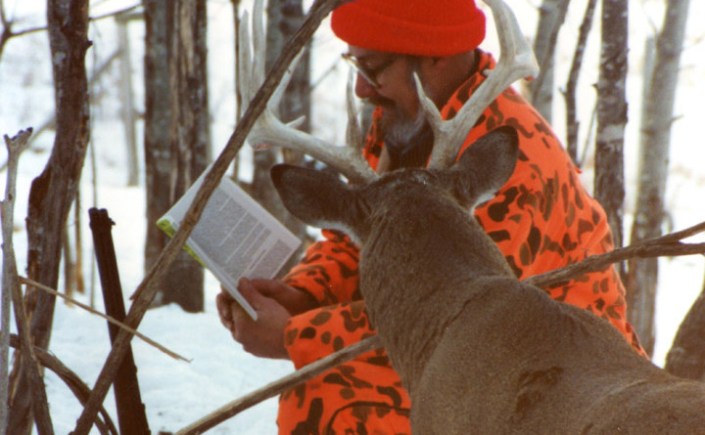
No. 2 Best Tip for Whitetail Hunting Today

Stand hunt only within easy shooting distance of very fresh tracks and/or droppings made by unalarmed whitetails (not trotting or bounding), especially those located in or adjacent to feeding areas. Why feeding areas? Because whitetails are most visible and most predictable time-wise and location-wise during hours they feed. All deer trails funnel down to feeding areas. Fresh tracks and droppings reveal locations of sites and trails being used by whitetails today—earlier, right now, later or tomorrow morning. Don’t count on seeing mature whitetails after you have stand hunted three consecutive feeding periods or more near any site or trail previously frequented by whitetails. To keep close to whitetails every day you hunt, move to a new stand site 100 yards or more away near very fresh tracks and or droppings every day or two. To key on mature bucks, key on fresh tracks and droppings made by mature bucks,


No. 1 Best Tip for Whitetail Hunting Today

The number one best tip for whitetail hunting today is, be a mobile stand hunter.

Stand hunting is still the best way to hunt mature whitetails, especially trophy bucks, but if you’ve been stand hunting during the past 20–30 years, you’ve doubtless noticed stand hunting isn’t as near as productive as it once was. Nowadays, you mostly see younger does, fawns and yearlings. Why? Because during the past 20–30 years stand hunting became so popular that today there is hardly a whitetail that has survived two or more hunting seasons anywhere in America that has not learned how to quickly find, identify and avoid stand hunters without abandoning their ranges. Climbing higher into trees hasn’t improved matters and using bait only provides temporary improvement (about two hunting seasons) because today’s mature stand-smart whitetails soon realize it is dangerous to approach bait sites in daylight hours during hunting seasons (fresh human airborne scents and trail scents being the primary tip-off). Despite all this, the addition of the word “mobile” to “stand hunting” can make stand hunting method as productive as ever, if not more so.

The word “mobile” in “stand hunting” means you should quit being the permanent, long-familiar, hunting season fixture known by every mature whitetail living within the square-mile or more surrounding your stand site. Mature stand-smart bucks living within that square that do not know you yet, being new residents, will generally discover you very soon, usually without your knowledge, during some brief moment in the first 1–30 hours after you once again begin using your stand, thereafter becoming another mature buck in the area that regularly detours widely around you.

The only practical way to stop this from happening is to quit stand hunting at the same site longer than 1–2 days per hunting season. Even better, change to a new, yet unused stand site 100 yards or more away every day or half-day. When you do this, every mature whitetail, including every mature buck, in the surrounding square-mile must find you all over again to be safe from you. Sooner or later, if you are well hidden by natural cover or man-made cover that closely blends with surrounding natural cover and downwind or crosswind of where you expect a deer to appear at each new stand site (absolute necessities when hunting older bucks these days), one or more mature bucks and other deer will approach within easy shooting range before they realize you are near.

Watch for best tip No. 2

In Praise of Stand Hunters

Suffering through endless attacks by hordes of blood-crazed insects and ticks, one more hour, and then another, and then another of motion sickness in a wind tossed tree stand, soaked clothing, shivering and frozen noses, fingers and toes in winter, urinary bladder and intestinal distress, muscles and joints aching for relief, thirst, hunger, incredible boredom, withering patience and a growing danger of falling asleep sixteen feet above the ground are characteristic of just another ordinary day of stand hunting. The amazing thing is, millions of American deer hunters talk about it as if they have been having the time of their lives and can’t wait to do it again.

When I began hunting deer in 1945, standard hunting clothing included cotton or itchy wool long underwear and socks that refused to dry after being soaked by perspiration, wet snow or rain and laced up leather boots that wouldn’t dry until a week or so after a hunting season ended. Our red or buffalo plaid heavy wool outer clothing became water logged and heavier and heavier because of the same refusal to dry, making stand hunting in winter weather a form of hunting during which a hunter could not bear to remain in one place very long.

To an inexperienced hunter or non-hunter today, recent inovations such wicking and quick-drying polypropylene underwear and socks, synthetic insulation and lightweight waterproof fabrics in outer clothing and boots plus padded seats on portable tree stands with railings might make it seem as if stand hunting has become akin to lounging in complete comfort on a featherbed. It ain’t so. A stand hunter today must still be a special breed of hunter, necessarily tough and enduring mentally and physically, able to endure anything nature unleashes during a half or entire day of hunting, ever determined  to finally outfox a cunning mossy-horned buck.