Hunting Whitetail Bucks in Feeding Areas — Part I

Texas doe-family whitetails, three taking their turns as sentinels while the others feed.

With a few exceptions, unless it is unseasonably warm, very cold, stormy or very windy whitetails spend half of each 24-hour day feeding, about six hours in the morning beginning about 4 AM and about six hours in the evening beginning about 4 PM. Half or more of their AM or PM feeding occurs in darkness. When hunting pressure is great — where numbers of hunters are roughly equal to numbers of deer, where any number of hunters aggressively hunting whitetails on foot, still-hunting or making drives, or where deer are hunted year around by large predators such as grey wolves — daylight portions of feeding hours are shortened, nighttime portions lengthened. In wolf country where I hunt, mature bucks and many does begin heading back to their bedding areas at sunrise and don’t move again until about thirty minutes before sunset. Our best hunting times are the first 2–3 legal hours and the last legal hour of the day.

While whitetails are feeding, they move slowly from place to place, often lowering their heads to rip off mouthfuls of green vegetation (lacking upper front teeth) or tear off tender woody tips of browse. Whitetails are most visible then and most vulnerable to skilled stand hunting. In no other place during the course of a hunting season are whitetails as apt to be seen and as apt to be unsuspecting of danger as in a feeding area. For these reasons, hours whitetails feed are the most productive for skilled stand hunting — up to a certain point.  

With few exceptions whitetails bed between hours of feeding, moving little where they bed except for chewing cud. They typically bed where their bodies are well hidden and where they can see, hear and/or smell approaching hunters before they are near enough to be a serious threat. While slumbering, their senses of hearing and smelling remain alert and they awake about every fifteen minutes to briefly assess their surroundings visually. Their bedding areas are generally located adjacent to proven escape areas where they can quickly disappear when necessary — areas where hunters are not inclined to follow, or can’t, being posted for example. Whenever a mature whitetail, especially an older buck, is forced by a hunter to flee from its bedding area, it is likely to abandon its entire home range for the rest of the hunting season. For these reasons midday hours are not particularly productive for stand hunting whitetails.
Stand Sites for Mature Bucks — Watering Sites

Ordinarily, whitetail watering spots — sites with a deer trail leading to water and fresh deer tracks at the water’s edge — are not notably great stand sites. One reason is, whitetails mostly water in darkness before they begin feeding in the morning and again after dark in the evening. Perhaps it’s because they feel vulnerable while their heads are down, drinking, while human hunters are afoot. After mid-October when mature bucks are normally most active during daylight hours — feeding, making or renewing ground scrapes and antler rubs, dominant bucks are searching for and chasing lesser bucks from their breeding ranges and searching for and accompanying does in heat — whitetails frequently make use of multiple and previously ignored sources of water, including secluded springs, mere puddles of water and snow. For these reasons my sons and I normally pay little attention to spots where whitetails have obviously been drinking.

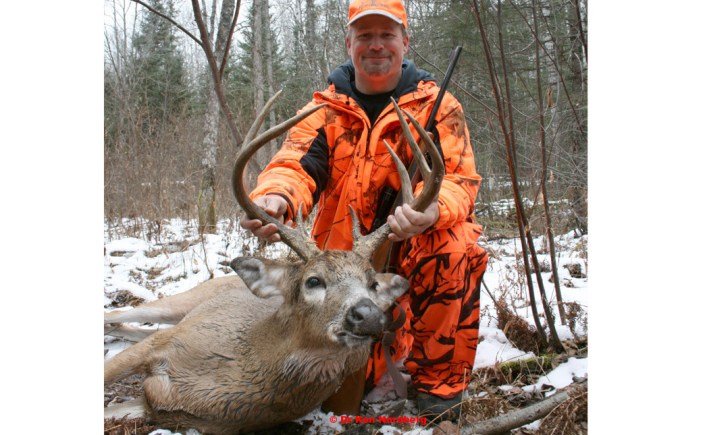
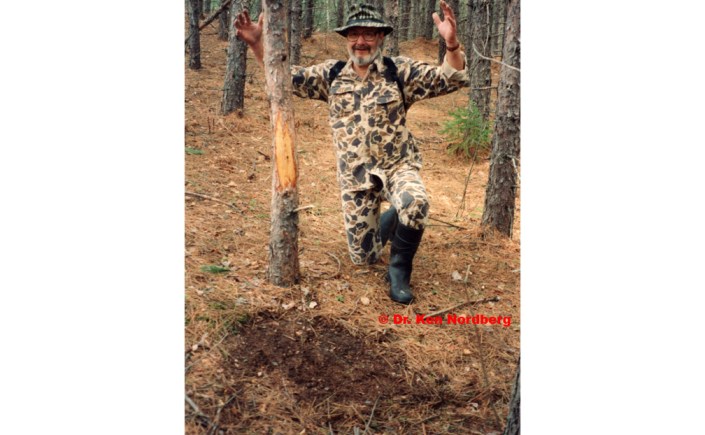
While scouting in October four years ago, however, my son, Ken, discovered a streamside watering spot that could not be ignored. The edge of the water was loaded with very fresh (sharply-edged) tracks four inches long, making it obvious a very large buck had been drinking there. Moreover, because the stream was unusually shallow at this site with a gravel bottom, as the buck’s tracks further revealed, it often crossed the stream here from a high, adjacent hill with steep slopes (some older bucks prefer to bed near crests of high steep hills) to feed in a narrow section of a recently logged clearcut (narrow clearcuts are much preferred by whitetails over wide clearcuts) beginning about fifty yards from the stream. Furthermore, that clearcut was virtually red with the favorite browse plants of our northern whitetails beginning in early November — red-bark dogwoods and red sugar maple saplings. Never in his life had Ken discovered a spot with as many visible reasons to believe he would take a big buck there during a coming firearm deer hunting season. Imagine, then, Ken’s disappointment when he awoke in deer camp on opening day to discover the wind would be blowing on his back if he hiked to that stand site. Imagine his joy the second morning when he discovered the wind would be blowing on his face instead. Imagine how he felt when he spotted a huge buck coming down that steep slope toward the stream 20 yards beyond his well-hidden stand, just as he had daily imagined would happened during the three weeks before the hunting season began. My accompanying photo says it all.

Stand Sites for Mature Bucks — Stand Site Approach Trails

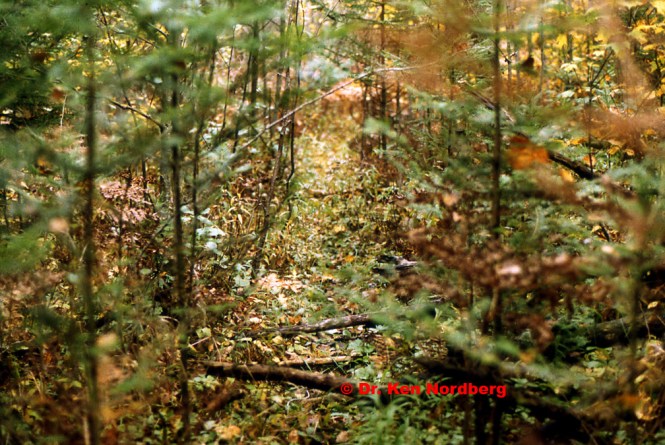
Some older bucks I have taken during the past two decades were walking past or approaching on one of my stand site approach trails — always originally pre-existing deer trails. Before a hunting season begins, older bucks and other whitetails don’t seem to mind sharing their trails with me, especially trails I have altered a certain way 2-3 weeks before a hunting season begins. My altering merely consists of removing from my trails fallen twigs and branches that are likely to snap loudly when stepped on. This plus my habit of bending my knees, lifting my boots well off the ground and then putting my boots down lightly beginning 100-200 yards from a stand site makes it difficult for whitetails near my stand (feeding) to recognize any softened footsteps they might hear as being those of a human hunter. If they can’t positively identify me as I approach through dense cover, they won’t abandon the area.

As I subsequently discovered, older bucks quickly adopt deer trails I have cleaned, likely pleased to find a trail that enables them to move with relative silence too. Upon discovering a buck is doing this (via its fresh tracks), before or after a hunting season begins or upon discovering its tracks in the beam of my flashlight in the snow ahead while heading to another stand site early in the morning), I will usually continue past the site without pause, planning to approach it from a different direction, downwind or crosswind, and sit where well hidden by intervening cover 20–50 yards away. The first two times I tried this, I was caught by complete surprise, suddenly finding myself staring into the eyes of huge, astonished bucks 10-15 yards away, which immediately whirled and disappeared into dense evergreens before I could fire. Today, several very nice bucks now stare at me from the walls of my office because I was ready for them the moment they appeared under the same circumstances.

The unusual tactics my sons and I use while stand hunting near trails used by mature bucks contribute greatly to our hunting success. We change stand sites every half day unless we have a compelling reason for hunting at the same site an additional half day. Bucks we hunt must therefore search for us again, which they do, sometimes fatally, every half day. Sometimes we take a buck by returning to a promising, previously hunted stand site after keeping well away from it for a week or more. Beginning one hour before sunrise every morning, we sit waiting for first light and legal shooting time (seated on our backpacked stools — something you can’t do with tree stands) well hidden by natural, unaltered cover within easy shooting distance downwind or crosswind of a deer trail marked with very fresh tracks and/or droppings made by an unalarmed (not trotting or bounding) mature buck. Though all this makes it possible for us to take one or more mature bucks every hunting season, many bucks we take come from a different, more productive location.

Stand Sites for Mature Bucks — Scrape Trails & More

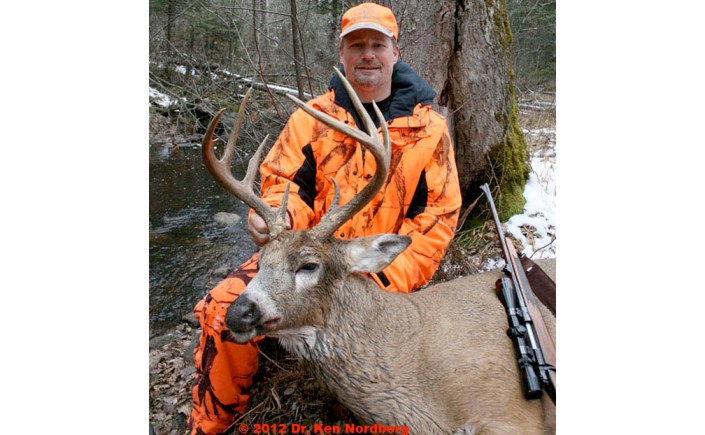
A difficult to hunt dominant buck finally taken on a trail leading from its favorite feeding area. (Son Ken 8-pointer 2012)

Hunters who hunt within sight of ground scrapes made by bucks 4-1/2 years of age or older are pitted against the most cunning and elusive of whitetails. Those who use grunt calls or rattling antlers without knowing what buck grunts and battles actually sound like are very unlikely to fool many bucks of such ages into believing they are actually hearing another buck or two they should investigate. Regardless, while accompanying a doe in heat, dominant breeding bucks are unlikely to move far from the doe for any reason other than suddenly discovering a hunter is dangerously near. Doe-in-heat buck lures have been used to attract bucks beginning in the early 1980s. Since then, mature whitetail bucks almost everywhere have learned it is dangerous to approach a site where doe-in-estrus pheromone is accompanied by fresh human odors emitted by a hunter (including impossible to suppress odors from human breaths and rubber boot soles).

Another fact that makes it difficult to hunt older bucks on deer trails is, they rarely use same trail twice in a row, especially during hunting seasons. The first time a buck uses a certain trail in the morning to get somewhere, a feeding area frequented by one or more does, for example, it will be heading into the wind to avoid ambushing hunters and locate the does. To use the same trail hours later, then traveling downwind, would be a mistake all whitetails older than fawns recognize. Nonetheless, all whitetails regularly find it necessary to travel downwind, while returning to a bedding area, for example. They do this safely by sticking to dense cover, widely detouring around sites and trails previously discovered to be frequented by hunters, often traveling crosswind, and by listening and watching ahead for movements made other deer and hunters until downwind of their intended bedding areas.

Despite all the reasons mature bucks are difficult to hunt on trails, about 40% of such bucks I have taken during my 72 years of whitetail hunting were unalarmed and walking slowly or standing on deer trails when I took aim at them and fired (using gun or bow). The deer trails on which I have taken most of these bucks were selected for stand hunting while scouting pre-season (mostly for opening weekend hunting) or scouting mid-season in a special way for the rest of the hunting season. Virtually all of those trails were very recently used by older bucks, as revealed by their fresh, buck-sized tracks and/or droppings. Many bucks were taken opening morning before they had a chance to discover my stand sites. Many others were taken after opening weekend within minutes to less than four hours after I began hunting downwind or crosswind of their fresh tracks, droppings or ground scrapes near stand sites never used before, taking them before they found my new spots. All but three were taken during the first 2–3 legal shooting hours of the day, most often near feeding areas.

Stand Sites for Mature Bucks — Scrape Trails

While hunters are afoot, older bucks are less inclined to use doe trails. Bucks 4-1/2 to 6-1/2 years of age are up to twice as large (heavy) as mature does and yearling bucks.

034a

Doe family trails (tunnels through cover) tend to be too narrow and too low for mature bucks to use without making sounds easily heard by nearby hunters, especially troublesome for bucks with antlers wider than their bodies. Soon during hunting seasons, then, these bucks begin often traveling off-trail (50% or more).

While northern bucks are making and renewing ground scrapes at traditional sites (during the latter half of October and the first days of November in northern states), a period during which they are vulnerable to skilled stand hunting, they spend little time on doe trails that are not established scrape trails. The few well-used deer trails within doe ranges along which dominant breeding bucks make and renew up to 30 ground scrapes annually tend to be traditional — the same trails and scrape sites used by succeeding dominant bucks for decades (or until the area is logged). Whenever a hunter has been discovered to be waiting in ambush in the vicinity of a dominant breeding buck’s ground scrape, having been identified via sounds, sight and/or fresh trail or airborne scents, though some older bucks may approach a nearby scrape regardless but with extra caution from off-trail and downwind, most older bucks will abandon the scrape and others nearby for the rest of the hunting season.

Stand Sites for Hunting Mature Bucks – Deer Trails

Most stand hunters agree deer trails are great sites for hunting whitetails. Deer trails are easy to identify and their mere existence implies they are being used by whitetails, at least some of which are likely to be big bucks. All the hunter has to do to take a big buck, then, is patiently wait near a trail until one comes along. Right? Well, maybe. Certain trails are better than most. There’s a lot to know about deer trails.

To begin with, a deer trail is more than a path. Much of most of them are tunnels through forest cover created by repeated passages of deer. Typically, a deer trail is clear enough of obstacles to enable whitetails to travel from place to place with relative silence. The ground of most that are recognized as deer trails are typically well-eroded by the sharp-edged hooves of whitetails, turf flattened, chopped up or completely destroyed by long use, and covered with deer tracks (and occasional droppings), most visible visible in snow or soft soils. Most deer trails are made and more regularly used by does with one or more trailing fawns and one or more yearlings — small doe family deer herds. Yearling does without young and yearling bucks remain on ranges of their mothers, under her tutelage and leadership throughout most of their yearling year. Doe home ranges are dense mazes of deer trails (a distinguishing characteristic) that provide a dozen or more ways to travel to any destination such as a feeding area, watering spot or bedding area. Few deer trails cross buffer zones separating doe home ranges. During hunting seasons, trails used by whitetails change as often as every half-day to take advantage of current wind directions (to avoid ambushes), currently available foods (various greens, browse, nuts or other foods while in season), cover needed to hide travels (before or after leaves have fallen) and to avoid recently discovered locations of trails and stand sites used by hunters.

Mature bucks are loners much of their lives. As such, they create few trails. Many they use are inconspicuous, unlikely to draw the attention of hunters. Because 2–6 doe home ranges are located within larger home ranges of mature bucks, they often make use of trails currently favored by does and their young, trails thus proven currently safe. While mature bucks travel along doe trails, their noses constantly search for traces of the ammonia-like odor emitted by the tarsal glands of alarmed whitetails that passed before them, their ears constantly alert to detect snorts and/or pounding hoof beats of deer fleeing from danger and their eyes constantly scan ahead for rapid movements and fanned white fur of tails and rumps of alarmed deer. Such precautions are characteristic of mature bucks: using other deer ahead like radar to avoid danger.

Warm Weather Ground Scrape Hunting

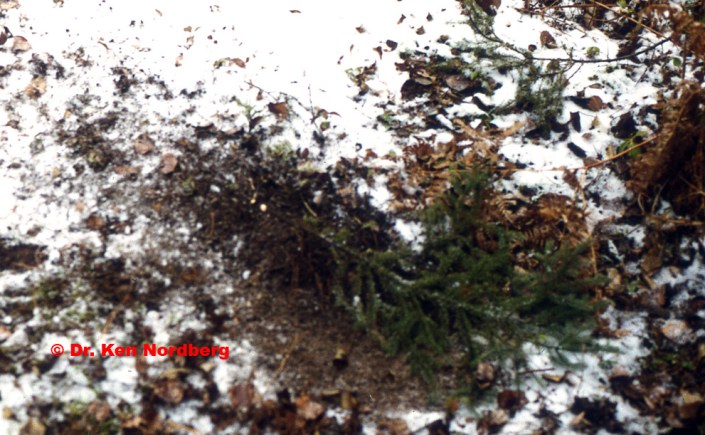
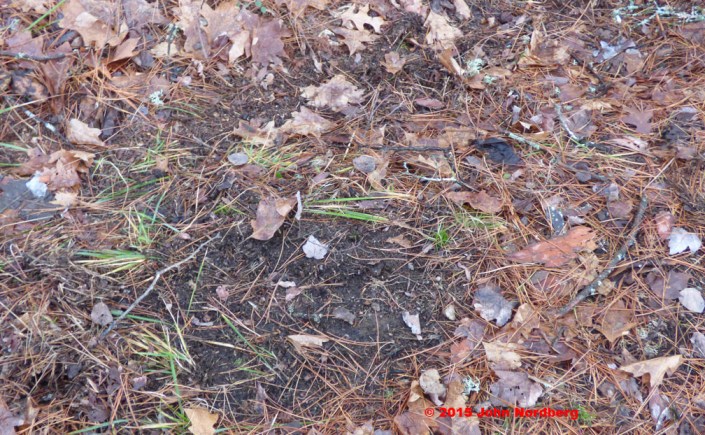
A dominant buck ground scrape not recently renewed due to unseasonably warm weather.

The unusually warm weather we experienced last October and November greatly impacted ground scrape hunting in northern U.S. states. It might even become the norm in future years. If this is true, us northern deer hunters need to know more about what to expect.

Ordinarily, a frenzy of making ground scrapes by all antlered bucks, visual and musk laden signs of intended breeding rages, begins in mid-October when nighttime temperatures customarily begin dipping below freezing. When the daytime temperatures are in the 70s, 60s or even the 50s, however, most northern bucks are not inclined to make or renew ground scrapes (or antler rubs), it then being too uncomfortable to exert themselves physically because their bodes are by then covered with winter fur that will keep them comfortable at 30–40 below zero in winter. Ordinarily, during the 2-3 weeks before November breeding begins (November third in northern Minnesota) rampaging dominant bucks also force all antlered bucks lower in their 1–2 square-mile buck pecking orders to temporarily move off-range until the two-week period of November breeding ends. Unseasonably warm weather brings a halt to this as well, meaning, unless you are an aggressive hunter, making drives or still-hunting, more antlered bucks than usual are likely to be in your hunting area during the first two weeks of November. The trouble is, few deer will move about during warmer daylight hours after about 9AM. Even breeding-related activities will then be mostly limited to nighttime hours only.

What this means is, while temperatures are unseasonably warm, even if you manage to find a freshly made or renewed ground scrape to stand hunt near, you are unlikely to see a buck at the site during daylight hours after 9 AM. This means you should try not to miss a minute of legal, cool, early morning hunting. It means you should get up at 4 AM and hike softly and non-stop in darkness to your stand (guided by fluorescent tacks previously placed on tree trunks) — the only way to avoid alarming deer you can’t see along the way. It means you should remove dead branches and twigs from your approach trail to enhance silent footing two or more weeks before opening day. It means you should arrive at your stand an hour before sunrise (a half hour before legal shooting time begins) so the thirty minutes of complete silence and lack of discernable movements (on your part) needed to allow nearby whitetails to settle down after your arrival and begin moving in your direction is over when legal shooting begins. Why will they be unsettled? Because no matter how skilled you are afoot, though deer near your stand site may not be able to positively identify you as you approach quietly and non-stop (making non-hunting footsteps) and therefore will not abandon the area, they will nonetheless hear some of your light footsteps and therefore be extra alert and curious for the next thirty minutes. You need to get that thirty minutes over with when it finally becomes light and legal to fire at a deer, thereby not wasting a minute of the most productive hunting hours of the day: the first two hours.

For you who still insist on using a doe-in-heat lure scent when hunting bucks, it doesn’t really matter where you put it (a scrape, buck made or man-made is totally unnecessary) as long as you place where you can see where it is up to 50 yards away, crosswind-only.

Reasons to Understand Antler rubs — Part III

A good argument for Spring Scouting — notice how both antler rubs and ground scrapes are November fresh in early May — this combo is a dream maker!

Whereas most whitetail hunters consider antler rubs to be prime buck signs, along with ground scrapes, few consider their locations to be worthwhile stand sites. Perhaps rightfully so. During the latter half of November when most firearm deer hunting seasons are in progress, few bucks are interested in making or renewing previously made antler rubs, or for that matter, making or renewing previously made ground scrapes. The best period for hunting near such deer signs is the 2–3 weeks before breeding begins, during the latter half of October and the first few days of November, i.e., archery hunting season. The last time I deliberately stand hunted near a freshly renewed antler rub (with shredded bark on top of the snow at its base), it was late November (archery season) when the temperature was 27-below zero and a 20–40 mph wind was blowing. When I could stand it no longer and stood up to head to an adjacent wooded ravine to build a life-restoring bonfire, a big 10-pointer jumped from the trail I had been watching and disappeared into the ravine with a single bound, after which it snorted at least ten times as it raced away unseen (a very alarmed buck). If I had taken that buck, I’d probably be more interested in hunting near rubs yet today.

Today, however, antler rubs are mostly my starting points when scouting in early spring (right after snow melt and before leaves begin to grow), a time when rubs made during the previous fall are still brightly colored and easy to spot great distances away. Along deer trails where single rubs are found, especially those close to known feeding areas, or in buck bedding areas where clusters are found, I search for also easily spotted fresh tracks and droppings of sizes made by mature bucks. Before long, I’ll know how many mature bucks my hunting partners and I will have to hunt in fall and where they live. Trails favored by mature bucks at this time of the year will generally be the same trails they will favor after leaves have fallen in autumn, making them good starting places for final scouting 2–3 weeks before archery hunting in October or firearm hunting in November. When used for this purpose, antler rubs have great hunting value, enabling my sons, grandsons and me to quickly discover what we need to know to ensure another successful season of hunting mature bucks.

Reasons to Understand Antler rubs – Part II

The dominant breeding buck in the photo above made one of the largest antler rubs I have ever seen. However — this size is not typical. The size antler rubs — on average — relate to specific classes of bucks.

Diameters of antler rubs are related to sizes or ages of the bucks that made them. The reason is, with testosterone beginning to peak during the season antler rubs are made, increasing aggressiveness, the creation of a rub on a tree soon becomes a mock battle. A battle between two bucks is a shoving match with antlers engaged, the loser being the buck that is forced to give significant ground (back up) and finally jump away to avoid being seriously wounded by the victor’s antlers. When battling a tree trunk, then, a buck wants to win. It wins when the tree trunk yields (bends away). Because the purpose of making a rub would be lost if the tree trunk breaks, bucks generally select trees to rub on that will yield but not break when attacked with fury. Thus diameters of tree trunks upon which antler rubs are made reflect the sizes (ages) of the bucks that made them.

06c

Yearling bucks, for example, characteristically make rubs on ¾ to 1-inch diameter tree trunks, usually off-trail in feeding areas and often next to ground scrapes a foot or less in diameter.

340-with-antler-rub-2

Bucks 2-1/2 years of age prefer tree trunks 2–2-1/2 inches in diameter adjacent to well-used deer trails.

42a

Bucks 3-1/2 to 6-1/2 years of age prefer tree trunks 3-6 inches in diameter, sometime more and sometimes less in their bedding areas, and adjacent to major deer trails within doe home ranges located within their much larger buck home ranges.

Reasons to Understand Antlered Rubs – Part I

A brightly colored (newly made) antler rub unequivocally means, “An antlered buck, yearling to 6-1/2 year-old, lives here.”

And more. As intended by bucks, antler rubs are easy for other whitetails to smell, being laden with scalp musk, and spot. They are signposts of intended breeding ranges of bucks. A rub is easy to spot because bucks spend considerable time scraping bark from tree trunks with their antlers to expose the brightly colored wood beneath. Depending on when they are made and where, antler rubs have different meanings.

183b

A nice buck. He is almost finished removing his velvet. He just swished his rack through some milkweed.

The first new rubs of the year are made about the first of September by bucks rubbing deteriorating velvet from their then fully developed antlers, usually on small diameter tree trunks or woody multi-stemmed shrubs, within or very near their spring and summer-long bedding areas. About 90% of rubs of larger sizes are made during the 2–3 week period before the first of the three 2-week periods of breeding begins in November (during which lesser antlered bucks are chased from their ranges by dominant bucks). While testosterone and resulting aggressiveness is peaking in bloodstreams of antlered bucks at this time, many older bucks also make 6–30 rubs within their bedding areas. Some rubs, especially those made by dominant breeding bucks, are renewed repeatedly (made bright again by further rubbing and re-scented with scalp musk).

204a

Example of a Rage Rub

While breeding is in progress, enraged dominant breeding bucks commonly display threatening behavior (rage) in sight of lesser bucks that dared to return and shadow does in heat they are accompanying by quickly mangling with their antlers small trees, shrubs or branches overhanging their ground scrapes.