Attention Minnesota Deer Hunters

Attention MN deer hunters: March 13th is the deadline for telling our MDNR what you think about its plan to reduce deer numbers in NE Minnesota in an attempt to stop the current decline of moose in that region.

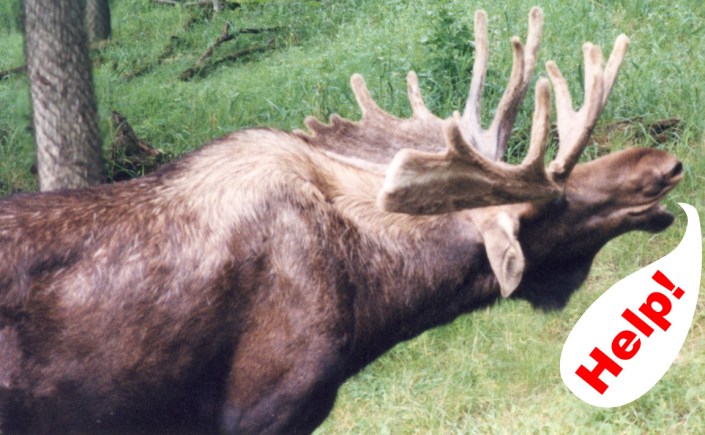
Our whitetails are being blamed for this decline because they are not affected by brain worms and are thus considered “carriers” of brain worms that are known to kill moose (not all of them). Brain worms have been passed back and forth between whitetails and moose via certain slugs and snails throughout the highs and lows of moose populations in recent decades and likely ever since moose migrated from Asia to North America 13,500 years ago. Moose researchers almost everywhere in North America today believe the current continent-wide decline of moose has multiple causes, including other parasites such as liver flukes and winter ticks, poor health related to insufficient moose habitat, climate change and wolf depredation. Underneath it all, especially following climate change, moose may simply be poorly adapted to living in North America today. Actually, the long-protected, increasingly-abundant gray wolves of northeastern Minnesota (now at a historic high just across the border in Ontario) kill more moose than anything else. Logically, our overabundant wolves have much if not most to do with low and declining numbers of remaining deer (which are unaffected by brain worms) and moose in the Arrowhead Region. No one disputes the fact that when and where wolf numbers are high, numbers of their primary prey, deer and moose, can be expected to be low and when wolf numbers are low, numbers of their primary prey can be expected to be high. Hunting by humans has had little effect in this region, as few as one deer taken per ten square-miles in recent years.

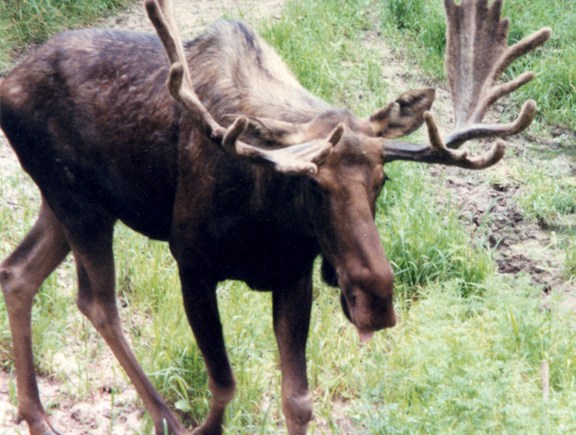
What our declining moose need most today is a drastic reduction of Minnesota wolves (seemingly impossible under current circumstances), an increase in numbers of easier-to-catch deer to reduce moose depredation by wolves and more improved moose habitat (including more of what moose eat to survive winters such as second-growth quaking aspens), long scarce in and around the heart of Minnesota’s Moose Management Area, the Boundary Waters Canoe Area.

Our DNR plans to reduce numbers of whitetails in northeastern Minnesota’s Moose Management area (almost all of Arrowhead Region east of a line from Duluth to International Falls), to reduce the passage of the larval form of brain worms from deer to moose. Deer numbers in this region have never recovered from massive losses due to severe winters in the 1960s, after wolves became protected by the Endangered Species Act in 1972, and recent severe winters have reduced deer numbers there again, an estimated 2–4 deer per square-mile now not uncommon in this region according to recent DNR surveys. Logically, this has forced wolves to increase their dependence on moose meat.

If deer numbers are further reduced in this region, the grey wolves will become almost wholly dependent on moose meat, exacerbating the moose decline. Our DNR’s plan will not only adversely affect moose and deer numbers in what was once one of Minnesota’s finest whitetail hunting regions, but adversely affect wolves as well, likely forcing them to migrate south into urban and farm regions in search of food throughout Minnesota and east into Wisconsin and Upper Michigan as well, which is already happening. Our DNR is asking for public input on this moose plan. Please inform our DNR you do not approve of it before the deadline of March 13th. Your input can have great influence on the outcome. Call 651-296-6157 or 1-888-MINNDNR, send an email to info.dnr@state.mn.us or write to DNR Information Center, 500 Lafayette Road, St. Paul, MN 55155-4040. Please do it today!

Thank you,

Dr. Ken Nordberg
Minnesota’s New Moose Research & Management Plan

After studying the Minnesota Moose Research and Management Plan just released by our Department of Natural Resources, I believe this plan to bring a halt to the vexing problem of dwindling moose numbers in our state is as well-conceived and as scientifically sound as it can be under current circumstances. What I mean by “under current circumstances” is this: based wholly on what I have annually discovered in one small portion of Minnesota’s designated moose management area since 1990, I believe any plan that does not take into account the enormous impact our overabundant, long-unmanaged grey wolves have been having on moose and deer is terribly handicapped. I realize our DNR is currently powerless to manage our wolves, protected by federal judges and the Endangered Species Act. Nonetheless I can’t help but fear reducing deer numbers in the moose management area may not only force wolves to kill greater numbers of moose, exacerbating their demise, but force wolves to kill a greater percentage of remaining deer as well. This wouldn’t be good for moose, deer or wolves far into the future.

However, I also understand the urgency to proceed with this plan. Without trying to save our moose and without the funded research necessary to succeed, we may loose them all and never know why.

Minnesota Moose Research and Management Plan

DNR’s Main Page on Moose (Has a link to the new management plan.)

DNR’s Moose Hunting Page  (Has a link to the new management plan.)


Attention Minnesota Deer Hunters

Attention Minnesota Deer Hunters,

Moose numbers are declining throughout North America, even in Alaska (where there are no whitetail deer). Though grey wolves are proven to responsible for the demise of more moose annually than anything else, our Minnesota DNR has decided brain worms are the primary culprit. Because Minnesota’s white-tailed deer are also afflicted by brain worms but do not die as a result, they are now considered “carriers” and are being blamed for the decline of our moose. Moose, themselves, are carriers.

Other reasons for this decline have been suggested by researchers all across the U.S. and Canada, including liver flukes, winter ticks, bacterial infections, poor health (perhaps wrought by unsuitable habitat) and climate change. MDNR (Minnesota DNR) researchers recently concluded moose numbers will not improve by reducing deer numbers. Another recent study revealed reducing deer numbers does not improve moose numbers where whitetail populations are less than 15 per square-mile. Whitetail numbers do not exceed 15 per square-mile in northeastern Minnesota. Nonetheless, our MDNR plans to reduce deer numbers, already very low in northeastern Minnesota due to recent severe winters, within a newly designated moose range.

What, then, will become the primary food of the unmanaged, overabundant grey wolves of that region, still ironically considered “threatened” but at a historic high just across the border in Ontario? What else? Moose meat, of course.

Logically, therefore, forsaking whitetails for this cause is only going to accelerate the demise of Minnesota’s remaining moose.

Minnesota’s Department of Natural Resources is currently asking citizen’s to voice their opinion about this plan. Deer hunters, please do it soon. Email: info.dnr@mn.state.us or write to: Moose Plan, MDNR Central Office, 500 Lafayette Rd., MN 55155-4040

Check for the latest Minnesota DNR press releases at:
News releases

Thank you,
Dr. Ken Nordberg
Key words: moose, whitetails, Minnesota, MN, OnlyInMN, brain worms, grey wolves, timberwolves.

Letter to Michael Nelson, Minnesota State Representative

Dear Mike,

Some statements made by our MDNR Commissioner (I wasn’t paying attention at first but I believe it was Commissioner Landwehr) in a recent newscast were so incredible that I felt obliged to do something about it. I sent a report to the MDNR that explains what has been happening to whitetail, wolf and moose numbers in my St. Louis County Whitetail Study area since 1990 and further explained why the commissioner’s plan for increasing moose numbers would be a terrible mistake.

The commissioner mentioned reducing deer numbers by half in northeast Minnesota to restore our dwindling moose population to, among other things, save our reputation as a state famous for “moose-watching.”  He also mentioned moose numbers are fine on Isle Royal where there are no deer, the implication being obvious. This was a startling revelation.

As you know, I am a writer well known for my hunting-related studies of whitetails (plus black bears and wolves) in Minnesota and elsewhere in the U.S. since 1970. I have published thirteen books based on my studies since 1988 and I am about to publish two more. I have written more than 700 articles about whitetails and whitetail hunting for various outdoor magazines since 1980 and I’ve been a feature writer, writing about whitetails and whitetail hunting, for MidWest Outdoor Magazine throughout the past 25 years. My primary whitetail study area since 1990 is located in St. Louis County.

Knowing you are an avid deer hunter and being my State Representative, I am sending a copy of my report to you for two reasons: 1) I want someone in our state government to understand why the commissioners plan is a mistake and 2) if our state government has any influence over what our DNR proposes to do, it would be good if this plan could somehow be discouraged by representatives in our state government (if for no other reason than it needs more study). I sincerely hope what you and others learn from my report will help influence those who favor reducing deer herds in the Arrowhead to change their minds.

Thank you,

Dr. Ken Nordberg

Mineral Blocks, Trophy Bucks, Record Book Whitetails

The four-month antler-growing season has begun. To minimize injury to sensitive, blood-rich velvet which can dramatically arrest antler development, most mature bucks will spend the summer like hermits, feeding and watering close to their secluded bedding areas. According to a study I did in my first Minnesota whitetail study area between 1970 and 1989, placing 50-pound cattle-type mineral blocks (minerals with traces of salt rather than salt with traces of minerals) beneath trees on dry ground close to where you currently find fresh tracks 3.5–4 inches in length and/or fresh droppings 0.75–1 inch in length (made by bucks 3–6 years of age), you can increase the mass (the amount of water their antlers displace) of their antlers by 10–20%, turning some “trophy” bucks into “record book” bucks. Many yearling bucks destined to be “spikes” due to of a lack of calcium and other minerals in their diets will become “forkies” or better. Moreover, though perhaps not needed where you hunt, this will also improve the number of healthy fawns still alive in your hunting area next fall, having grown up on calcium-rich milk. Wherever you place mineral blocks, antlerless whitetails will always find them as well. After the end of August when antler growth is complete and fawns have been weaned, mineral blocks are generally ignored by whitetails, meaning, they will not make older bucks more vulnerable to hunting next fall.

Thank you,

Doc

Buck Depositing Tarsal Musk on Ground Scrape

With all four hooves on its ground scrape, this buck is pressing its tufted tarsal glands together (located on inner surfaces of its hind legs) to squeeze out musk. The buck is also urinating over the surfaces of these glands to carry the musk to the ground. Some bucks do what appears to be a hula dance while doing this to squeeze additional musk from their tarsal glands. Dominant bucks also rub acrid scalp musk oozing from glands slightly below the bases of their antlers on overhanging branches. The primary purpose of this is to mark its breeding range with easily seen, easily smelled markers that warn other bucks to keep away. All antlered bucks do this before breeding begins but within a short period of time, dominant bucks temporarily evict all other antlered bucks from their breeding ranges to assure exclusive breeding of does in heat.

A True Tale: The Story Behind This Wild Buck

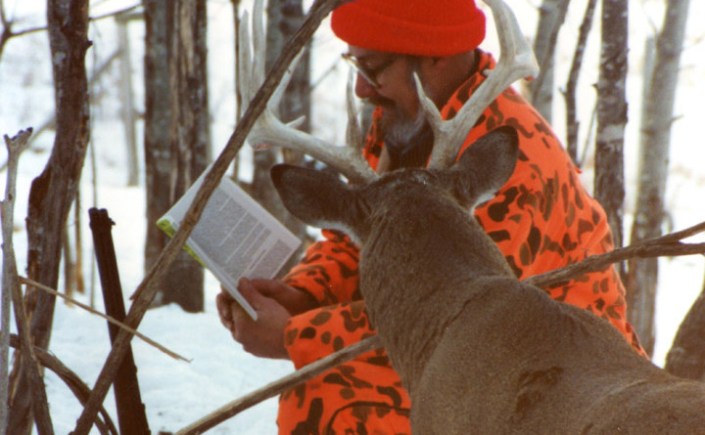
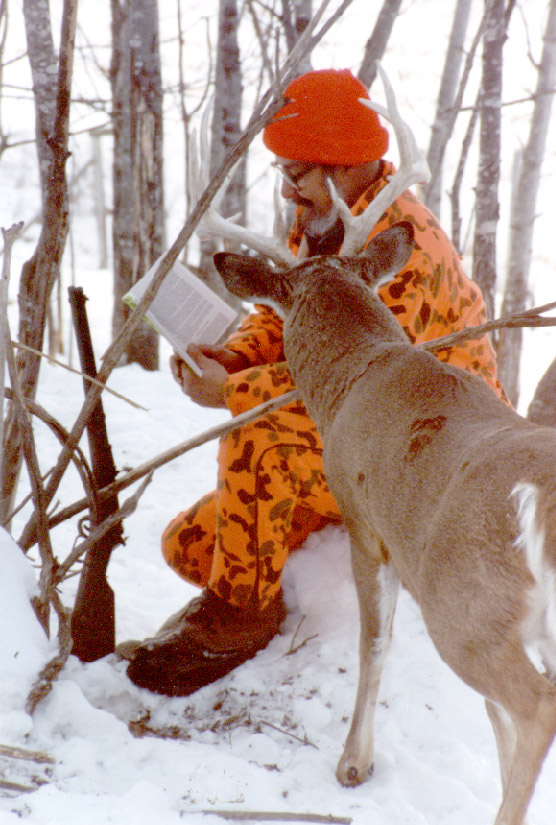
A true tale: this photo first appeared in my 6th Edition of Whitetail Hunters Almanac in 1993 with the caption: “Let’s see. I’ve done this, and this and this. According to this book (my 2nd Edition) I should soon see a big buck.”

I first met this buck when it was a fawn on the top of a limestone bluff fronted with NO HUNTING signs in western Wisconsin on January 1st, 1988. [Doc knew the landowner.] While other deer were sneaking or bounding away, it never stopped moving toward me, finally putting a nose-print on the lens of my camera. Always strangely tame, during succeeding visits I rewarded its welcome with potato chips. It dearly loved salty potato chips. During a following visit, I gave it some of my chocolate covered peanuts (M&Ms). It loved them even more. Though more cautious when Jene and I returned during following January firsts, the moment it heard the cracking of a bag containing these peanuts, it came running, giving me the idea for setting up this priceless photo.

Doc

A less cropped version of Dr. Ken Nordberg with a live, wild buck looking over his shoulder.

A less cropped version of Dr. Ken Nordberg with a live, wild buck looking over his shoulder.

Another photo of the same buck.

Another photo of the same buck.

Doc is talking to the buck.

Doc is talking to the buck.

A True Tale: Jene’s Buck Battle

whitetail deer buck battle

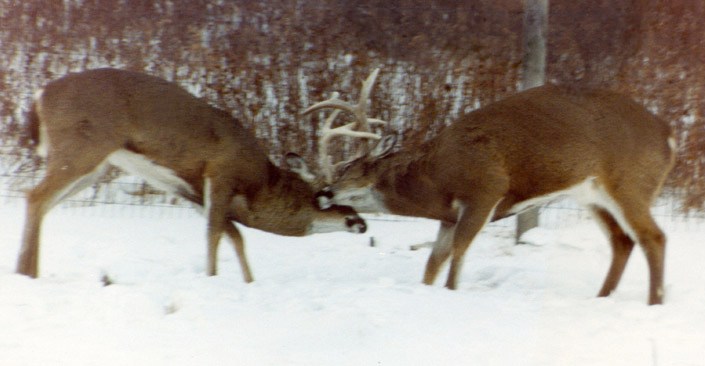
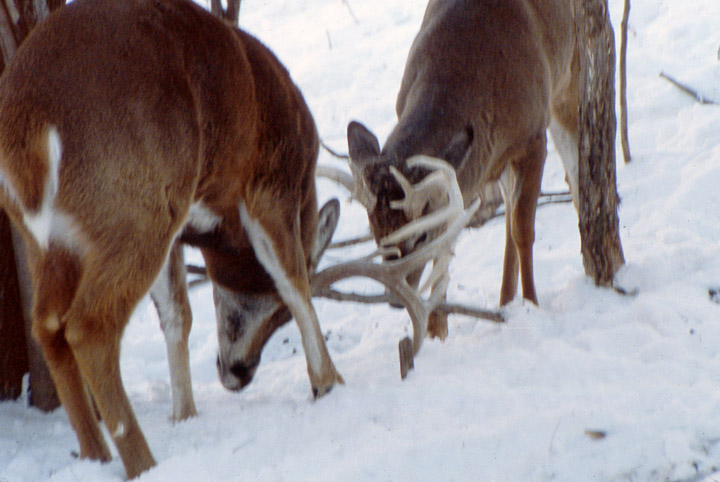
A true tale: while I was hiking back to our pickup to get more film, my wife, Jene, suddenly found herself witnessing a battled between two big bucks. Pleased for the opportunity to photograph this battle, she stepped behind a big tree trunk and began snapping away. Finally forced to give significant ground and jump away to avoid injury, the buck on the right lost the battle. Soon thereafter, however, it spotted Jene and headed toward her. Before she realized what the buck was up to, it lowered its head and pressed is antlers against her chest. Knowing it would be extremely dangerous to push back or even touch those antlers in such a circumstance, she began backing away, all the while softly informing the buck she had no wish to fight, At one point it backed her into a fence but she managed to turn without putting pressure against those 10-point antlers and continued backing away. About five minutes later, the buck finally halted, raised its head and walked away, its ego doubtless restored.

Buck_Battle_02

It took a lot longer for Jene’s heartbeat to be restored.

Doc