How to Make Still-hunting a Great Way to Hunt Whitetails — Part II

It being nearly impossible for still-hunters to avoid being easily recognized by experienced whitetails 100–200 yards away, the next best thing to do, aside from making your footsteps as silent as possible (never dragging boot heels) is quit sounding as if you are hunting. Rather than stop often to scan ahead, don’t stop at all between spots to sit still for a while.

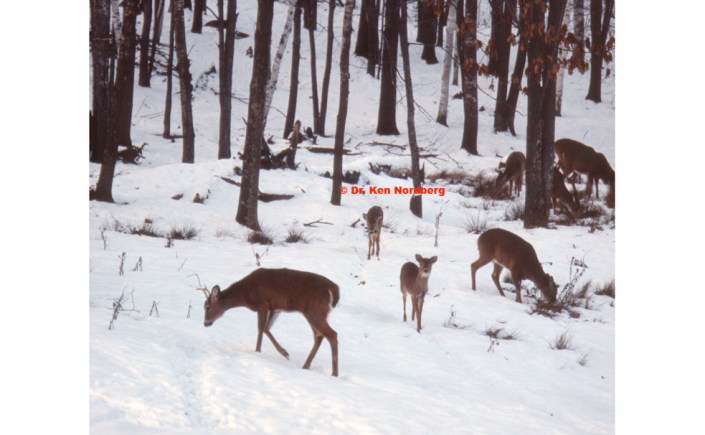
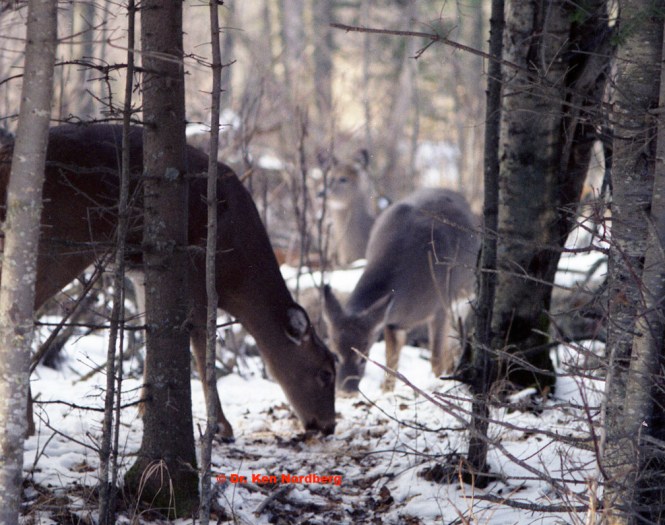
Having 36 years experience as stand hunter who regularly takes mature bucks, and having amassed a consider number of observations of reactions of mature whitetails being approached by hunters since 1970, the tip I will now share with you is absolutely true. Whitetails of any age that cannot positively identify you as a hunting human via your approaching footsteps will not abandon the area — a feeding area, for example. They may move off a bit and remain hidden for a while, but rather than react with alarm, they’ll generally react with curiosity, anxious to discover what is making those difficult to hear sounds. If you approach from downwind or crosswind via a deer trail relatively clear of dead branches (cleaned preseason) that courses through dense cover or is hidden by intervening terrain, walking softly and not halting along the way — thus making sounds that indicate you are not hunting and therefore likely harmless — those deer will nonetheless wait to make sure of this before resuming feeding. After making it very difficult if not impossible for those deer to identify you via airborne scents, motions or sounds while walking your stand site, if you then become absolutely silent and move your head very little and very slowly, within 30 minutes those curious deer will decide whatever you were you were not dangerous and likely no longer near, after which they will resume feeding, then becoming visible and moving slowly — easy targets.

Ground_Blind_07_2003_8pt_04_2a_med

To be a regularly successful still-hunter, then, you should walk non-stop as silently as possible from a place where you sat still for a while to the next place to be still for a while. How long should you remain still at each of these places? Normally, as you now realize, your odds for success will only begin to improve after your first thirty minutes of being still has passed. For each hour you remain silent and still, your odds for success will usually peak only during the final thirty minutes. Surely you can sit patiently enough to enjoy thirty minutes of much improved hunting odds during every sixty minutes you sit still.
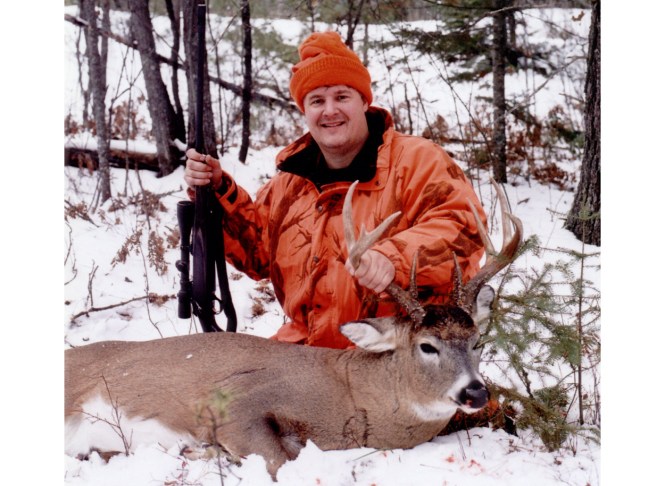
2003Buckb

The best places to sit still for an hour are 100–200 yards apart, sites where there are fresh deer tracks and droppings nearby, upwind or crosswind, and where you will be well hidden (while wearing a camo headnet) by natural, not recently altered cover with a solid background at ground level — easily, comfortably and silently done by sitting on a back-packed stool. Rather than merely attempting to improve your odds for hunting success by wandering greater distances during a day of hunting, you will actually much improve your odds by becoming very difficult for those 15–30 deer living in the square-mile mile ahead to identify and avoid you. On the average, eight or more of those deer will be within easy shooting distance of some of the places where you sit still per mile you proceed on foot into the wind or crosswind. Imagine that! Before long you will be thanking that unknown guy who long ago invented such a great way to hunt whitetails. Though other hunters, especially stand hunters, in the area may not thank you, they should because unlike other still-hunters you won’t be chasing deer out of the area, giving everyone a better chance for hunting success.


Hey Guys, don’t miss my latest You Tube presentations

How to Make Still-hunting a Great Way to Hunt Whitetails — Part I

Today there are still a lot of whitetail hunters who can’t stand the thought of sitting in one place for hours at a time. Such hunters prefer to keep moving on foot, calling themselves still-hunters. The trouble is, today’ popular form of still-hunting is not particularly productive for taking mature whitetails. It can be made more productive, but to understand how, it is important to understand why today’s still-hunting is not particularly productive. Having been an avid still-hunter for more than a decade (beginning in 1960), I am qualified to describe it as a restless walk in the woods, in the process frightening an awful lot of deer enough to make them abandon their ranges and/or become nocturnal early during a hunting season. Ironically, little about still-hunting today can be mistaken for anything having to do with the word “still.” Occasionally halting to scan ahead while sneaking or walking like most still-hunters imagine it should be done fools few if any whitetails older than fawns or yearlings. No hunter is easier for mature whitetails to identify via hearing and seeing within 100–200 yards and thereafter avoid. It’s the reason still-hunters today can wander throughout an entire square-mile of whitetail habitat without seeing any of the usual 15 to 30 deer living there. Whoever originally coined the name of this method of hunting obviously had something more in mind. When the word “still” in still-hunting includes being still for a while, still-hunting can actually become a very productive way to hunt whitetails.

As even most stand hunters fail to realize, it is nearly impossible for tall, heavy, big-footed humans to walk through the woods without making sounds and movements easily recognized by mature whitetails considerable distances away. Sounds made by a typical still-hunter not only reveal the hunter is a human, but worse, a dangerous deer hunting human. A human who sneaks or walks softly and often halts to scan ahead, occasionally changing direction, makes sounds very similar to those made a stalking or trailing wolf or bear, though much louder and more frequent. A hunter often stopping in the woods sounds nothing like a feeding deer like most still-hunters imagine. Dead branches frequently snapping loudly means a human is approaching. Bears, wolves and even moose rarely make such sounds — just soft footsteps with very infrequent, very soft twig snaps. Moreover, experienced whitetails know motions made by something taller than a walking bear or wolf can only be made by a human or a moose. The difference in appearance between the two is so great that a positive identification is quickly made by all experienced deer.

To add to a still-hunter’s failings, everywhere the hunter wanders, he or she lays down a yard-wide trail of scents most feared by whitetails, easily smelled and recognized four or more days afterwards.

159eEvery whitetail along the way that raises it tail and bounds away lays down a trail of ammonia-like scent emitted from its tarsal glands which also can be smelled up four or more days by other deer. This odor warns all downwind deer within 200 yards something dangerous is near.

Stand_Site_Locator

Meanwhile, wherever the hunter walks, airborne scents characteristic of human hunters only, including human breath and the strong odor emitted by rubber boot soles, sweeps across the landscape within a triangular area up to 200 yards wide 200 yards downwind.

Don’t miss Part II or my latest You Tube presentations.

Productive Scouting — Part I

Step one: heed this basic whitetail scouting truth — freshly made signs such as tracks or droppings made by undisturbed, unseen whitetails yield far greater hunting success than sightings of bounding (greatly alarmed) deer. Most deer seen while scouting are alarmed deer. All you will learn from sightings of them is, greatly alarmed whitetails bound away. Later you may also learn bounding deer do not return to their home ranges soon, especially older bucks. You will be much more successful during hunting seasons if you see no deer while scouting. If you do it right, most deer will remain unseen while you are scouting, being able to easily keep out of sight without becoming greatly alarmed. When not greatly alarmed, your scouting will not seriously affect their habits and behavior during following hunting seasons. Given time, all will then be in their home ranges opening morning, doing predictable things in predictable places during predictable hours.

Before stepping into the woods to scout therefore, plan to make it easy for whitetails ahead to hear, smell and/or see you coming so they have adequate time move out of your path without great haste while still what they consider to be a safe distance away. Don’t try to scout (walk about) without making telltale sounds. Instead, feel free to talk out loud and don’t concern yourself with snapping branches or wind direction. The time for that only begins opening day.

Keep in mind too, whitetails 2-1/2 years of age or older (especially older bucks) that are commonly seen feeding a great distance away in farm fields, clearcuts or food (bait) plots, for example, will likely be seen by many other hunters who will also plan to hunt them. Following minutes before or after sunrise opening morning, competing hunters will be almost certain to convince those deer it would be advisable to feed in such an area only at night only or abandon it altogether for the rest of the hunting season. Don’t waste valuable time or effort preparing to hunt commonly sighted deer unless they are on private land and you have an exclusive right to hunt them.

Time to Start Growing Larger Antlers

Mineral block bucks from yearling to 5-1/2 year-old from a calcium poor area in Northern Minnesota.

Back in 1970 I often wondered if a lack of adequate calcium and phosphorus might be the reason so many yearling bucks in my original Minnesota whitetail study area were spike bucks, about two for every forkie. To find out, I placed four cattle-type mineral blocks in the western half about the first of May that year, the beginning of the antler growing season, That fall the numbers were reversed, two out of three yearling bucks were forkies or better (one even an eight-pointer with a nine inch spread). Then wondering if mineral blocks could increase the size if antlers grown by older bucks in my low-calcium study area, I continued setting out blocks every spring for 19 years and compared masses of antlers of bucks of same ages taken in the treated half with antlers of bucks taken in the untreated half every year. I did this by filling a large pot to the brim with water placed in a larger pan, submerging the antlers in the water and then measured the amount of water that overflowed into the pan. Antlers from the treated half averaged about 10–20% greater in mass than antlers from the untreated half. Moreover, numbers of surviving fawns (in wolf country) in early November throughout the following 18 years were always about 10– 20% greater in the treated half. Convinced of the benefits of mineral blocks, capable of enabling some bucks with 150–inch antlers (Boone and Crockett measuring system) to grow 170 or 180–inch antlers, my sons and I have been placing mineral blocks throughout my second primary study area every spring since 1990. Though we have not continued comparing antler sizes since then, the number of bucks worthy of being mounted taken by my sons, daughters, grandsons and I since 1990 is eight times greater taken than the number taken by an equal number of my family, including uncles and cousins, between 1945 and 1989.

In recent years sporting goods stores have become filled with a great number of products claimed to enable bucks to grow larger antlers, some in liquid form and powder form and some even being seeds. Last spring my son John and I decided to try a different, less expensive brand of mineral blocks claimed to grow larger antlers. When we checked them while scouting last October, they were gone, and judging by the lack of hoof prints and wear around the sites where they were placed, they were gone well before the antler growing season ended (growth ends about the first of September). This was strange because the more expensive blocks we had traditionally used always lasted 2–3 years. From now on, we decided, we’ll stick to using what we know works: our usual $12.95 much-more-durable cattle type 40–50 pound mineral blocks with the top two listed ingredients being calcium and phosphorus (the primary ingredients of bones and antlers) followed by a trace of needed zinc, a trace of unneeded salt and vitamins.

We place our blocks on exposed roots of mature evergreen trees where well hidden by surrounding cover. A mature evergreen protects the blocks from rain, making them last longer. The surrounding cover keeps them from discovered by other hunters who might decide they’ve discovered a great stand site. Actually, mineral blocks are very poor stand sites. Neither bucks nor does are much interested in mineral blocks during hunting seasons because by then antlers of bucks are fully grown and fawns of does are fully weaned. Wherever mineral blocks are placed, 4-6 deer of the near vicinity will quickly find them and create beaten paths leading to them from several directions.

To get the desired antler growth, the blocks should be placed within or near bedding areas of mature bucks. The reason is, while growing antlers, older bucks tend to be recluses, bedding, watering and feeding in or near their secluded, difficult-to-find hideaways only 1–2 acres in size. While scouting in search of them, look for plenty of fresh and old tracks 3-1/2 to 4 inches long, fresh and old droppings 5/8 to 1-1/4 inch long, beds in deep grass 45 to 56 inches long and clusters of six or more antler rubs on tree trunks 2–4 inches or more in diameter — characteristic signs of bedding areas of mature bucks. Where you find plenty of fresh mature buck sized tracks and droppings, you are probably close enough, especially if near water. We typically place 2–4 blocks in or near buck bedding areas per square-mile.

My sons tote mineral blocks with their hands. I prefer carrying one block in a large plastic bag in a packsack attached to a heavy-duty pack frame along with 2–3 bottles of water and much-needed insect and tick repellent or two blocks tied down on a plastic toboggan. It’s now mid-April, an ideal time to take care of this chore. Early May is okay.

By the end of a day of scouting and dropping off mineral blocks, my sons and I are usually weary and hungry but grinning, anxious to share our findings over a meal at a lakeside resort on the way home. Our grinning reveals we have each found some fresh tracks in the 4-inch range, fresh droppings 7/8-inch or more in length, antler rubs on tree trunks 4 inches or more in diameter (rubs made during the previous fall) and/or beds 50–56 inches in length — signs only made by trophy class bucks. Following this particular day in spring, fall can never come quickly enough.

An afterthought: since whitetails can’t be kept from congregating in wintering areas in winter, I have often wondered if a drug could be added to mineral blocks that can kill parasites such as brain worms in deer and moose, not fatal to whitetails but sometimes fatal to moose. After researching this, my son John recommends the tapeworm dewormer Praziquantel as an example. Similarly, I wonder if adding a proper drug could be a way to eliminate chronic wasting disease in whitetails.

A Whitetail Buck’s Calendar for Fall & Early Winter — Part XIV

Nine deer in a wintering area. (Note the one laying down in the upper left.) Later, when I find it, I will add a photo of a forky attacking an older, dominant — but antler less — buck.

Since 1970 when I first began studying habits and behavior of wild whitetails in northern Minnesota, I have always been astonished by their sudden, overnight disappearance in late December, their recently made antler rubs and aging tracks in snow mute evidence of their once great numbers and activities. It usually happens about December 22nd, plus or minus a few days, depending on snow depths and weather. Following a three-foot snowfall that began on Halloween in 1992, this happened much earlier. This annual disappearance is due to their annual migration to better places to survive winter. Such places are commonly called “deer yards.” I prefer to call them “wintering areas.” They are generally traditional in location for different populations of deer. They provide varying numbers of whitetails with superior cover from frigid winds and precipitation and adequate quantities of winter foods — woody browse or crop residues — until snow melt in early spring. Some wintering areas are small, shared by as few as two-dozen deer, and some are huge, shared by hundreds. Many whitetails, trailed by fawns making the trip for the first time, migrate as far as 20–30 miles to reach their winter destinations. Once there, though they feed together within the wintering area or in areas surrounding them, does and their young, fawns and yearlings, bed together in one or more areas and bucks 2-1/2 years of age and older (bachelor groups) bed together in separate areas.

While in wintering areas, it is very difficult to get near whitetails (within easy shooting range for late season archers or muzzleloader hunters) without being seen, heard or scented. All it takes is a series of snorts that starts with one to warn the entire population within seconds. Extreme care must be taken, using dense intervening cover or terrain downwind or crosswind to hide your approach to a stand site near a well-used deer trail within or adjacent to a wintering area feeding area. Appropriate winter camo clothing is also important. Keep in mind, with all those unseen whitetail eyes, ears and noses often pointed in your direction, odds for success at one stand site are certain to be short-lived.

Another change common to the same late days of December is shedding of antlers by many (not all) of the largest of bucks, typically dominant breeding bucks. I don’t know if early shedding reflects the diminished health of these bucks in consequent of the great demands on their bodies throughout the previous four months or because bucks destined to be most dominant are somehow on a earlier schedule of photoperiodism and/or hormonal changes. At any rate, sometime in December the blood flow to the very strong connective tissues that attach antlers to skulls of older bucks shuts down, these tissues begin to deteriorate and then the antlers drop off, usually around December 22nd, plus or minus a few days. Progressively younger bucks shed their antlers progressively later, yearling bucks typically last, well into April.

There are therefore three reasons why the odds of taking a whitetail buck with enormous antlers in in late December might not be favorable: 1) they are absent from your usual hunting area, 2) they are well protected by great numbers of deer in their wintering areas and 3) they might not have antlers.

I have to find the photo.

After my wife Jene and I saw a big 10-point dominant buck drop both of its antlers on December 22nd in a Minnesota wintering area in 1984, she and I and that buck were then equally surprised to see a fork-horned yearling buck suddenly lower it head and attack the big buck (see photo), likely taking revenge for all the times it was quickly vanquished by that buck during the previous months. With an obvious look if disbelief, the big buck had no choice but to retreat with all possible speed.

Upon shedding antlers, even the most aggressive of bucks will suddenly become docile. It is said bucks can no longer produce sperm and father young after this happens, but it’s more likely, I believe, because they can no longer compete with antlered bucks for opportunities to breed.

The usual 5% of does (about one mature doe in 18) not yet bred by this time will again begin to experience estrus (heat) for the third and final time in a wintering area during the last few days of December. Estrus in does no longer occurs after this two-week period because before another 28 days passes, the ratio of darkness to sunlight necessary to trigger estrus in does no longer exists (it has changed significantly).

097c2

A killer buck with part of his harem. This Wisconsin buck killed a larger 10-pointer.

Jene and I regularly photographed two Wisconsin does (in widely separated areas) that were always in heat and always accompanied by dangerous-acting dominant breeding bucks on January 1st. One of these bucks killed a shadowing 10-pointer the evening after we photographed them. The fiercest of battles between large bucks, especially between equally matched dominant breeding bucks fighting for the opportunity to breed the same doe in heat, generally occur during the three separate ywo-week breeding periods. An opportunity to take advantage of the one day of unusual vulnerability of a dominant breeding buck accompanying of a doe in heat is very limited during the final few days of the year, of course, though not impossible, weather permitting.

Weather in December can be brutal for whitetails and whitetail hunters alike. Under severe conditions, whitetails are likely to remain bedded throughout hours they normally feed, temporarily living on fat stores. Weather in December can also be a boon for late season whitetail hunters. Following a spell of very cold weather, a thaw or near-thaw with the wind calm to light will trigger a flurry of whitetail feeding midday. For a couple of hours every whitetail in the woods will be on the move. Keep track of weather forecasts. Whenever a midday thaw or near thaw is predicted, be at a stand site adjacent to a forest browse area or a farm field with crop residues that have been attracting deer with lots of fresh tracks of walking deer between 10 AM and 3 PM for one the year’s very best opportunities to take a deer.

This is it: the end of whitetail rut. After about the 9th of January until about September 1st a whitetail buck’s calendar is bare.

A Whitetail Buck’s Calendar in Fall & Early Winter — Part XIII

A big buck returning to his bedding area.

One morning during the third week in November doe-in-heat pheromone no longer permeates the air of a dominant breeding buck’s mile-square breeding range. It will nonetheless searches diligently for a another doe in heat during the next 24 hours. When finally convinced breeding has ended (having experienced this before), Rut phase IV, the two-week breeding buck recovery phase, begins.

39a

At this point a dominant breeding buck’s behavior changes remarkably. Exhausted, head low, eyes red, drooling, sore, possibly even slightly wounded, moving slowly and having lost up to a third of its weight during the previous month’s ordeal, it is no longer interested in battling other bucks, keeping other bucks out of its breeding range or renewing the appearance and musk odors of its breeding range markers, antler rubs and ground scrapes. What it most wants now is uninterrupted rest in the safest place it knows, its secluded spring and summer bedding area. Before arriving there, it is likely to encourage one or two other bucks to accompany it (actually acting friendly), likely to secure a well-rested companion to act as an alert sentinel while it slumbers. Two or more antlered bucks seen moving peacefully together beginning around the 17th of November (in Minnesota and other northern states) or pairs of buck-sized tracks revealing this has happened means rut phase IV is in progress. Within a short period of time after this begins, typically within 1–3 days, most lesser bucks that were previously driven from their ranges by savage dominant breeding bucks will be back in their usual haunts.

Whereas fresh tracks and droppings of antlered bucks of all ages will suddenly seem more common in areas where most or all hunters up to this point were stand hunters, dominant breeding bucks (and their companion bucks if they have any) will become recluses for a week or more. Though they will feed during hours whitetails normally feed, most of their feeding will occur within or very near their bedding areas. After a week has passed, they will begin to forage for browse (or farm crops) along paths taken by feeding does and their young within the nearest home ranges of does, sometimes feeding within sight of these other deer, using them like radar to avoid danger, and sometimes feeding among their fresh tracks up to a hour later, their noses constantly alert for whiffs of ammonia-like danger scent emitted by tarsal glands of whitetails that passed earlier that may have been alarmed enough to raise their tails and flee. While up and about, feeding, dominant breeding bucks (and others) are unlikely to renew their original doe range ground scrapes or antler rubs.

I have occasionally discovered a rub that had been renewed in December and even in early January — revealed by fragments of bark on top of new fallen snow at the base of the rub tree. After deliberately kicking leaves or snow across some scrapes during this period, some dominant breeding bucks I have known promptly renewed them, letting me know they didn’t appreciate what I had done. With male sex hormone, testosterone, now ebbing, making or renewing rubs and scrapes is now becoming rare among all antlered bucks (until October of the following year).

Between 1970 and 1990 my favorite site to hunt older bucks was their bedding areas. During Rut Phase IV, such an area was one site at which an older buck could be counted on the return two or more times in a row. Hunting such a site is very challenging, however. If the hunter is discovered by a mature buck near it’s bedding area, usually happening without the hunter knowing it (until the buck’s fresh tracks are discovered while the hunter is departing), it is almost certain to quietly abandon its entire home range for the rest of the hunting season. Though the odds of taking a mature buck at its bedding area are never great, I accomplished it often enough to be worthwhile — usually only attempted on the last day or two of a hunting season (hunting there earlier being risky or a waste of time). I made it a point to hunt buck bedding areas in the morning only, it being nearly impossible to approach one undetected while a buck is bedded there. I’d get to my stand site (prepared pre-season) by 8 AM (during daylight), well before the buck could be expected to return after feeding in the morning. My stand site was usually crosswind from the bedding area (characteristically made evident by fresh and old buck-sized tracks, droppings, beds and six or more antler rubs). To reduce the likelihood of being detected by a returning buck, my stands were usually located 40–50 yards from it were I expected to see a buck approaching the bedding area from downwind. This meant I could only hunt the site only while the wind direction was proper for my setup. For this reason, I often made it a point to select and prepare stand sites at two buck bedding areas pre-season, one for hunting while the wind was blowing from the west or southwest and the other for while the wind was blowing from the north or northwest. If I didn’t see the buck during the first morning I hunted there, I gave up hunting at that site, assuming the buck had discovered me (tracks in snow invariably revealed this had indeed been the case).

In early December, two weeks after rut phase IV began, doe-n-estrus pheromone again permeates the air. Imagine what happens then when most antlered bucks are back in their usual square-mile home ranges.

A Whitetail Buck’s Calendar for Fall & Early Winter — Part XII

John Nordberg with buck taken where its fresh tracks and droppings and fresh tracks and droppings of a doe and fawn were discovered in this feeding area three weeks earlier.

Every year, to keep our stand sites selected preseason from losing their hunting value before we have a chance to use them, we take time to remove dead branches from the deer trails we adopt as stand site approach trails and any others within 100 yards of stand sites. Then, while heading to our stand sites during hunting seasons, especially when within 100 yards, we imitate the exaggerated stepping of whitetails and black bears when they want to move silently: we bend our knees and raise our feet well clear of the ground and then ease them down softly with each step. It’s difficult to do if you don’t keep your mind on it all the way to your stand site. Meanwhile, we maintain a moderate, non-stop pace while keeping our heads pointed straight ahead, even in darkness because whitetails tails can see as well at night as by day. While making no heavy footsteps, not dragging our heels across rocks or pebbles or through dead leaves and grasses and not stepping on dead branches that snap loudly underfoot, though whitetails currently feeding in the vicinity of your stand site ahead may nonetheless occasionally hear your soft footsteps, they will not be able to positively identify what is making those footsteps. If you were to halt often to listen and scan ahead, still-hunting along the way, though it may be difficult for whitetails ahead determine what is making the footsteps they hear, your ominous short periods of silence during each pause will likely brand you as a dangerous hunter, after which which your stand site and the adjacent feeding area can immediately lose their hunting value for the rest of the hunting season. When deer feeding ahead cannot see you approaching because dense forest cover or high terrain is between you and them all the way to your stand site, when they cannot see the beam of your flashlight because you turned it off before it could be spotted by them, when they cannot smell you because you are downwind or crosswind of them and when they cannot be sure about what is making the occasional footsteps they hear, though they may remain curious and extra alert for a while and may even temporarily move out of sight of your stand site, they won’t abandon the area. Thirty minutes or so after you arrive and become motionless and silent, they will likely be seen feeding and slowly moving in your direction. This happened to my son John at a feeding area last November, finally giving him an opportunity for an easy shot at a mature buck less than 50 yards from his blind.

For about fifty years I’ve always maintained the best parts of hunting mature bucks are planning for it beforehand and talking about it afterwards, the part in between being mostly hard work. But, if an 82 year-old man like me can continue doing it without any ATVs or OHVs in camp, you can do it too. Actually, once you become successful at it, the part in between is no longer hard work. It’s fun.

There are several other fun things we Nordbergs do when preparing to hunt or while hunting near feeding areas when breeding is in progress. While searching for stand sites before or during a hunting season, for example, we don’t settle for one that is not adjacent an existing deer-trail that courses through dense forest cover or behind intervening terrain that will keep us hidden from feeding deer all the way to the stand site. Where I hunt, such a prerequisite is easy to find. At an especially promising feeding area discovered preseason — it and the forest around it full of fresh buck and doe sized tracks and droppings — we commonly select two stands situated ninety degrees from one another (one on one side and another at an end) so we can approach the feeding area from downwind or crosswind and sit downwind or crosswind (never upwind) whatever the wind direction. Rather than being forced to wait to hunt at a special site because of an adverse wind direction, the extra work of finding another stand site and cleaning a deer trail leading to it is worth it because we can then hunt the site there whenever we want. Another of our rules I occasionally wish I hadn’t ignored because I was in a hurry is, never cross a feeding area to get to a stand site on the opposite side. Always go around. We never approach a stand site with the wind at our back and we never count on something in a bottle that is supposed to make it possible to do this without being smelled by downwind deer. When hunting a big buck, we never take chance like that. We always approach from and sit downwind of a feeding area in the morning because the deer we hope to see will already be there, generally beginning feeding two hours or more before first light. We always approach a feeding area from crosswind in the afternoon and then sit crosswind because whitetails almost always approach feeding areas after we get there from downwind. To minimize the possibility of being seen or heard while approaching a stand site near a feeding area in the afternoon, we plan to arrive at our stand sites by 2 PM, well before whitetails are likely to arrive. Years of study taught us never-used-before stands on the ground or in a tree 10 yards or more back in forest cover from the edge of a feeding area (with 2–3 natural shooting windows, no man-made shooting lanes, in between) are much more productive than stand sites located at the very edge of a feeding area. Stand sites with a solid background of natural, unaltered cover are also much more productive than stand sites with little or no background cover, especially when the background is primarily sky or a snow-covered hillside. Small masses of cover can be every bit as effective at hiding the hunter as large masses of cover as long as the hunter’s background is fairly solid and intervening cover masks the hunter’s silhouette shoulder high (while seated on a backpacked stool) and hides motions necessary while preparing to fire at a deer. During the past ten years, single six-foot evergreens or a red oak with retained dead leaves, a camo headnet to cover the bright skin and white beard of my face and a solid background of tree trunks, brush, a boulder and even tall grasses have been enough to provide me with very easy shots at some of the biggest bucks I have ever taken. Good cover and camo headnets have also enabled my three sons, two daughters and two grandsons to take many unsuspecting trophy bucks at very short range, one only 25 feet from my youngest daughter, Katy, one only 11 feet from my oldest daughter, Peggy, and another only three feet from my son, John.

It’s graduation day! You have been taught all you need to know to successfully hunt mature bucks during rut phase III, the two-week primary breeding phase of the rut in November. All the tips that took us so many years to for my hunting partners and I to realize that were sared with you in this and previous blogs have served my family of avid bucks hunters and me very well, enabling us to enjoy the best whitetail hunting of our lives despite low deer numbers, excessive numbers of wolves and unexpected directions and mile-long movements made by the largest bucks in our hunting area.

Actually, despite the number of fawns they prey on each summer, the number of half-days of hunting they have spoiled by unexpectedly spooking bucks away from my stand sites and the degree to which they have made our whitetails extra alert and elusive, I like wolves. I enjoy hearing their howls each evening at sunset. I feel privileged to have been often visited by them. I feel blessed for what they have taught me. Though I realize their numbers must be reduced for their sake and the sake of their primary prey, our white-tailed deer and moose, I hope they will always be a part of the boreal/Canadian Shield wilderness we share and cherish, an area I hope many generations of my family will also cherish and often be thrilled by the mournful howls of our magnificent grey wolves.

A Whitetail Buck’s Calendar for Fall & Early Winter — Part XI

As skilled as we are at approaching and using our stand sites, my studies have long proven most bucks 3-1/2 to 6-1/2 years of age discover us between the moment we first arrive at a stand site and the morning we depart from it two or three consecutive half-days later — during the evening of the first day or the morning of the second day. Very few bucks of these ages ever fail to avoid once-discovered stand sites throughout the rest of a hunting season (not always true of younger bucks and other deer). The buck hunting rule that evolved in our camp because of this discovery is as follows: if a hunter stand hunts downwind or crosswind of very fresh, 3-1/2 to 4 inch-long tracks and/or very fresh 5/8 to 1-1/4 inch-long droppings made by an unalarmed buck (not trotting or bounding) but fails to see that buck during a half day of stand hunting, the buck knows the hunter is there and is already avoiding that stand site, meaning it is time to move to another unused stand site near such tracks and/or droppings 100 yards or more away. This is a viable rule because upon discovering a typically silent, stationary stand hunter free of strong odors, most mature whitetails (not shot at) including the most wary of big bucks will not abandon the area. They will only begin keeping a safe distance away from the site where the stand hunter was discovered until the hunting season ends.

The necessity to move to a new stand site each half day is the reason we devote an hour or so midday daily to searching for more fresh tracks or droppings made by mature unalarmed bucks or does hopefully in heat to hunt near later that day and the early the next morning.

The way we search for fresh deer signs during a hunting season was inspired by years of observing wolf packs hunting vulnerable deer. A pack (annually formed about November 8th in my study area) only needs to kill one mature whitetail a week to be adequately fed. Having hunting ranges 100 square miles or more in size, their impact on deer numbers in one square-mile is therefore usually minimal in winter. Normally, wolves find it very difficult to catch healthy whitetails 1-½ years of age or older, such deer being up to 10 mph faster than they are and able to leap over obstacles while bounding that wolves must detour around. For this reason our grey wolves spend considerable time cruising along specific trails or frozen watercourses in search of deer made slow for some reason: deer that are old, very young, arthritic, sick, crippled, wounded or fallen on slippery lake ice and can’t get up. While cruising in search of a prey, upon discovering very fresh trail scents of a potentially vulnerable, unalarmed deer (meaning it is near), rather than immediately give chase (unless unexpectedly jumped at close range), the wolves continue walking past (single file) without pause and without turning their heads toward the deer, acting as if unaware the deer is near or not interested in pursuing it, doing nothing to warn the deer it has actually been selected as a prey. When finally out of sight, crosswind or downwind, the alpha male or female wolf will turn to sneak back while the rest of the pack circles downwind until directly downwind of the prey where they wait. Meanwhile the alpha wolf stalks cautiously crosswind until very near the unsuspecting deer or until the deer suddenly spots it and realizes it is a selected prey, at which point the wolf will immediately give chase and drive the deer downwind toward the waiting pack, then spreading out a bit. This doesn’t always work, but it apparently works often enough to satisfy our wolves.

188a

After having witnessed this several times, it occurred to me our whitetails were not fearful nearby wolves unless it appeared the wolves had selected them as a prey. Upon seeing one suddenly halt to stare at them, display a lot of interest in their tracks or trail scents, suddenly turn and begin moving directly toward them, cautiously stalk toward them or appear to be hunting in their direction — sneaking, often changing direction and often halting to listen, sniff the air and scan ahead, the whitetails of my study area rarely hesitate to sneak quietly away or flee with all possible speed whether such behavior is displayed by one or more wolves or a blaze-orange clad human.

192a

After my wife and I often successfully used this wolf ruse of pretending to have no idea a deer is near or pretending to have no interest in them to get close enough for full frame photos of wild whitetails (the first photo taken upon halting usually featuring a deer standing, feeding or bedded and the second photo taken usually featuring a deer bonding away, tail erect), I finally introduced it to my hunting partners in deer camp about 20 years ago.

190a

191a

chair_20

Since then, walking non-stop at a moderate pace while keeping our heads pointed straight ahead has been standard technique without regard for wind direction while cruising selected deer trails in search of fresh deer signs during hunting seasons, standard technique while hiking into the wind or crosswind only while heading toward a stand and site and standard technique without regard for wind direction while hiking away from a stand site. Subsequent studies in snow revealed most deer along the way approached in this manner merely moved aside, watched us pass while hidden by intervening cover and them resumed whatever they were doing after we were out of sight and hearing. This wolf ruse has not only enabled us to see more deer near our stand sites, but it has greatly increased to number of deer, including older bucks, that remain our hunting area throughout a hunting season, giving us reason to believe each time we head to another stand site our odds for success are as favorable as they were on opening weekend. Since 1990, including that year and last year, we have taken quite a few mature bucks, several now on the wall, during the final two days of our hunts.

A Whitetail Buck’s Calendar for Fall & Early Winter — Part X

When Doc is scouting he is constantly picking up dead branches from trails.

Most stand hunters realize hunting for trophy whitetail bucks is very difficult, but few know why. The innate elusiveness of an older bucks is not the only reason. Most of the following more common reasons have something to do with you the hunter:

  1. Among the 15–23 deer normally living in an average unfenced square-mile of suitable habitat, only one is likely to have antlers measuring more than 150 inches (a normal distribution of the largest of bucks, enforced by the largest of bucks).
  2. Though the largest of bucks are likely to be most predictable and vulnerable to skilled stand hunting while breeding is in progress, most American whitetail hunters believe they are more likely to take big bucks at sites far less likely to be productive during this period and use lures, baits and other hunting aids also less likely to be effective during this period.
  3. Except for farm fields and clearcuts, most hunters are unable to identify doe feeding areas.
  4. Most stand hunters only use one stand site per hunting season.
  5. Though it has become popular to attempt to be scent-free while hunting whitetails, few hunters concern themselves with avoiding discovery by motion-sensitive eyes of whitetails and their very sensitive ears that constantly evaluate sounds heard within surrounding circles having a radius of 200 yards or more.

My hunting partners and I avoid making the above common mistakes several ways. To begin with, we scout, often in early spring and always in fall, often several times. Initially, we are most interested in finding fresh deer signs made by mature bucks — absolute evidences of their existence and locations of their home ranges — and whitetail graze and browse feeding areas.

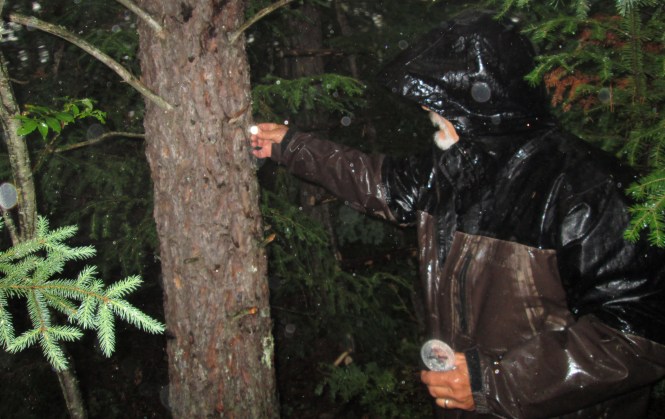
In fall we select 3–5 stand sites per hunter, each intended to be used 1–2 half days each during the first 2–3 days of the hunting season (occasionally used a week later). We also check deer trails that were used to search for fresh deer signs during previous hunting seasons (using a wolf-inspired form if no-alarm scouting) and deer trails never used before, adding those with promise to the maze of deer trails used during past hunting seasons. All stand sites selected preseason are adjacent to deer trails that connect to these trails, thereafter regarded as stand site approach trails. To make our approach trails sufficiently silent while hiking within 100 yards of selected or probable (unselected) stand sites and make them easy to follow in darkness, we remove all dead branches that lie across them and attach double-sided fluorescent tacks that light up like Christmas tree light bulbs in the beam of a flashlight to trunks of trailside trees at regular intervals. We make it a rule to complete these preseason preparations 2-3 weeks before a hunting season begins to ensure all deer that were unavoidably alarmed will be back in their home ranges doing predictable things during predictable hours at predictable places by opening day.

IMG_0331a

While working on a stand site approach trail, in pouring rain, Doc attaches a double-sided fluorescent tack to a tree. This tack is placed fairly high, so this tree is probably over 100 yards from the stand site. Doc places them progressively lower as the stand site gets close. The final tack might be only a foot off the ground. This reminds the hunter to keep the flashlight pointed low.

Each stand site we select preseason or mid–hunt is intended for only one-half to one full day of buck hunting at well separated sites. Several in our gang are weekend hunters only and require few stand sites. Those of us who remain in camp throughout a hunting season, myself included, need many more. This is not a time consuming ordeal for us. Stand sites selected during the hunting season are generally ground level sites (for hunting with a backpacked stool) that require no significant preparations. Most are selected on the fly (without stopping) midday upon discovering fresh tracks or droppings near promising locations while whitetails are normally bedded, beginning an hour or so before lunch. Promising locations at this time are feeding areas currently favored by does, revealed by lots of fresh doe and fawn-sized, zigzagging tracks and/or droppings off-trail — characteristics of feeding areas. Most stand sites selected at this time are either at unprepared sites never used before or sites that haven’t been used for two or more years. Years of doing this has taught us sites that require no altering of cover tend to be the most productive for taking trophy-class dominant breeding bucks.

[Some hunters in the Nordberg Camp have 4–6 tree stands each but only a handful of ground blinds, while other hunters have only 1–2 tree stand and 20 or more ground blinds. We have a wide range of preferences.]

A Whitetail Buck’s Calendar for Fall and Early Winter — Part IX (Rut Phase IIIe)

Whitetails have lived among dangerous predators and human hunters more than 10,000 years. During this time they adapted well to changing conditions and circumstances. So well, in fact, that even today mature whitetails (2-1/2 years of age or older) are as difficult to hunt as ever. Ten-million American whitetail hunters, the largest and best equipped army of deer hunters the world has ever known, cannot annually reduce their numbers to levels that can keep them from overwhelming their natural food supplies in winter. Today, mature whitetails make shambles of old traditional deer hunting methods. They have never failed to quickly learn to counter every new tactic and hunting aid introduced by hunters since I first began hunting them in 1945.

Take hunting older bucks while breeding is in progress. Such bucks realize when they are being hunted or soon will be, many recognizing preludes to hunting. They then rarely use the same deer trail or appear at the same location twice in a day, twice in a week or even twice in a hunting season. The fact that only 10-12% of does are in heat during any one day of the primary breeding phase of the rut in November and the added fact that each doe is only in heat for 24–26 hours during this two week period causes the largest of bucks of every square mile to be here one day and a mile away the next, contributing immeasurably to the frustration of trying to decide where to hunt such a buck next. Add to this the fact that such deer discover and begin avoiding stand hunters using elevated or ground level stands very quickly and usually without the hunter realizing it. Add to this the fact that when such deer are seriously threatened by hunters, they quickly abandon their ranges, not uncommonly heading to proven safe refuges miles away, and/or become completely nocturnal (active during nighttime only). There’s more, but this is enough to explain why one stand site is unlikely to be productive for taking an older buck throughout a hunting season, why so many hunters are convinced there are few if any mature bucks in their hunting areas and why most whitetail hunters are fortunate to take 1-2 trophy bucks in a lifetime.

Yet, regular buck hunting success is possible. My hunting partners and I hunt in a region where losses of deer due to starvation because of severe winters is common and grey wolves are overabundant. Only one deer was taken by other hunters per ten square miles in our region during our past three hunting seasons. We don’t use baits (illegal in our state), we don’t use buck lures and we don’t use ATVs or OHVs. We just hunt well. My hunting partners and I continue to take our usual self-imposed limit of four or five mature bucks per hunting season (to prevent overhunting bucks).

Actually, all that is needed to regularly take a mature buck each hunting season is hunt where such bucks are located right now, today, day after day. Wherever they are located right now, they make easily recognized deer signs that indicate they are near or likely soon will be: very fresh tracks and droppings. If from this day forth you make it a rule to stand hunt only within easy shooting distance of very fresh tracks and/or droppings made by mature, unalarmed bucks, you will see and take many mature bucks in the future.

Is this actually true? Is there a catch? Depending on how serious you are about hunting older bucks, there are some prerequisites that might make you decide to settle for taking anything with a white tail. After devoting 47 years to studying hunting related habits and behavior of wild whitetails over much of America with the goal of improving buck hunting success, I know of only one reliable way to regularly take mature bucks. It requires learning to recognize deer signs such as tracks and droppings and their meanings, learning to accurately assess their relative hunting value and recognizing states of mind of the deer that made them. The hunter must learn to identify classes of whitetails by lengths of their tracks and droppings without having to stop to measure them. The hunter must learn to recognize meanings of sizes and other characteristics of antler rubs and ground scrapes. Because hunting values of fresh signs made by whitetails are short-lived, the hunter must also learn to quickly and skillfully stand hunt near fresh deer signs with great hunting value after discovering them. In addition, the hunter must learn to properly use a wolf-inspired, non-alarming scouting technique to find fresh deer signs daily, beginning on day two or three of a hunting season. I call this combination of knowledge and skills, evolved to its present form from 27 years of considerable trial and error, opportunistic stand hunting.

10a

Last November my sons and I proved for the 26th time whitetail feeding areas currently frequented by does are best stand sites for hunting mature bucks while breeding is in progress. The reasons are simple: does in heat maintain normal feeding habits, they are most visible in feeding areas and they are accompanied by the largest of bucks, otherwise the most elusive of whitetails. At no time are such bucks as predictable in location and time, as visible or as vulnerable to skilled stand hunting.