Check the Wind Direction Before Hunting a Whitetail Feeding Area.

If you are a veteran stand hunter, you have doubtless noticed you are far less likely to see whitetails in the evening. Here’s why. Realizing they are most vulnerable while feeding, being most visible and often having their heads down, mature whitetails almost always use their noses to determine whether or not a large predator or human hunter is waiting in ambush within or adjacent to its intended feeding area before entering it. This, of course, must be done from downwind.

Normally, whitetails begin feeding in the morning shortly after 4 AM. Whether you are planning to use an elevated stand or sit at ground level, because whitetails will already be feeding as you approach a feeding area in the morning, it is best approach the feeding area from downwind in the morning, beginning 200 yards or more away, and then sit near a downwind edge. Why 200 yards away? Because feeding whitetails are likely to react with alarm upon smelling you approaching within 200 yards (your airborne odors growing stronger as you draw nearer).

Matters are different in the afternoon. If you arrive at a feeding area before whitetails arrive, which you should always do to avoid the risk of being heard and seen approaching by feeding whitetails, stand hunting at a downwind location is then totally wrong. There, whether high in a tree or stand hunting at ground level. you will be easily smelled and identified by whitetails normally approaching from downwind, it being impossible to eliminate all odors common to human hunters (the pungent odor of rubber boot soles and mouth odors to name a couple). In the afternoon and evening, then, you should approach from and sit crosswind of the edge of a feeding area. Keep in mind your airborne scents will spread out as they drift downwind. A high vantage spot where the wind angles slightly toward your right or left cheek is ideal. This precaution will improve numbers of deer you will see in late afternoon and evening.

Frenzies of October Whitetail Hunting

Whitetail does won’t be in heat until early November. Yet, in a couple of weeks (mid-October) antlered bucks will begin their usual 2–3 week frenzy of making musk-laden antler rubs and ground scrapes. So why do they do this? Because cooler nights and peaking testosterone have inflamed their genetically influenced passion to mark intended breeding ranges with visible and musk-laden signposts. By this time, one enormous and aggressive buck will have conquered all other bucks in battle within its 1–2 square-mile home range, becoming the dominant breeding buck. No longer tolerant of other antlered bucks after weather cools, it will force them to flee off-range where most will remain and keep a low profile until November breeding is over. Until breeding begins, especially during hours whitetails normally feed, the dominant breeding buck will cruise its breeding range daily, searching for lesser bucks that dared to sneak back, visiting all does within its range (anxiously anticipating the first whiff of doe-in-heat pheromone) and renewing musk odors on all of its scrapes and many of its rubs — regarded as no trespassing signs by all other bucks. Between the onset of this activity and the onset of breeding in early November, there is no better time to hunt the largest of bucks living within your hunting area (bowhunting), keying on freshly renewed ground scrapes adjacent to deer trails with fresh deer tracks measuring 3-1/2 inches or more in length and/or fresh droppings measuring ¾ inch or more in length.

Typically, however, the discovery the abundance of freshly made or renewed ground scrapes at this time touches off a frenzy among deer hunters: using so-called “buck lures” to attract bucks to real or fake ground scrapes. Hunters have finally come to realize, however, wherever whiffs of airborne doe-in-heat pheromone are carried by the wind, odors emitted by the nearby hunter using it are also carried, alerting or alarming all downwind deer. This in turn has touched off still another frenzy among hunters: using gimmicks and potions claimed to eliminate or mask human odors.

Throughout the latter half of October, few things are more important to a dominant buck than keeping its musk odors strong at each of its scrapes. The only things that will keep a buck from regularly renewing each of its scrapes at least once every 24–48 hours are unseasonably warm or stormy weather or knowing a hunter is waiting in ambush near one. The more a hunter does to lure a buck to a scrape, the more likely and the sooner the buck will discover the presence of the hunter, usually occurring without the hunter’s knowledge.

The very best way to hunt near a scrape is as follows: 1) only hunt near a freshly made or renewed scrape, 2) stay well away from the scrape and adjacent trail, adding nothing to them including your trail scents, odors emitted from your breath and skin and the strong odor of rubber emitted by your rubber boot soles, 3) approach them from downwind or a crosswind angling toward one of your cheeks only, preferably beginning 200 yards away, and 4) sit silently and without discernable motions in a tree stand or on a stool at ground level without bare skin showing and where your silhouette is well hidden downwind or crosswind of the scrape. If a buck doesn’t show up within two days, it knows you are there, meaning it’s time to move to a new, recently made or renewed scrape.

How to Identify a Whitetail Feeding Area

Caption: Why feeding areas have so many tracks and droppings. (Texas whitetails.)

Whitetails spend nearly half of their lives feeding. They feed twice, sometimes three times, daily. Accordingly, there are more deer signs in feeding areas than just about anywhere else (except where whitetails are concentrated in wintering areas). If you are interested in becoming a more successful whitetail hunter, there is one overwhelming reason why it is important to be able to identify whitetail feeding areas: whitetails are most easy to see while they are up and moving about, feeding and traveling to and from feeding areas. Almost everything else they do while not bedded, including drinking water and engaging in rut related activities from early September to early January — including bucks sparring and battling to gain dominance, making or renewing ground scrapes and antler rubs, dominant bucks searching for does in heat and lesser bucks intruding in their breeding ranges and breeding — occurs during hours whitetails normally feed. Whitetails are most difficult to see while they are bedded, typically motionless (except for cud chewing), well hidden and stubbornly refusing to do anything else.

The deer signs that most make whitetail feeding areas obvious are lots of off-trail deer tracks and droppings, fresh and old among vegetation they normally eat — green grasses and leaves in summer and early fall (also acorns) and woody stems of various shrubs and saplings in late fall and winter. Heavily trampled patches of soil or snow reveal where antlered bucks have battled late during feeding cycles. Evidences of feeding may not be obvious until whitetails begin feeding on stems of woody shrubs and tree saplings in late fall, white ragged tips then becoming prominent. Look for lots of broken shells of acorns beneath oaks.

Off-trail Scouting (for Whitetail Deer)

Where does a mature whitetail spend most of its time each 24 hours? Generally (there are exceptions influenced by weather, phases of the rut, changing foods and hunting), it will spend one six-hour period in one or more feeding areas beginning about 4 AM, the next six-hour period in a bedding area beginning about 10 AM, the next six-hour period in one or more feeding areas beginning about 4 PM and the final six hour period in a bedding area beginning about 10 PM. Between these destinations (and one of several a watering sites), it will spend little time on deer trails. Depending on wind direction, cover needed and a knowledge of trails and sites known to be frequented by hunting humans, a well-experienced whitetail will have a dozen or more trails to use to travel safely to a bedding or feeding area, reducing the odds of seeing a deer on any one trail to I in 12 or less. If the deer is a buck 3-1/2 years of age or older, during hunting seasons it will characteristically travel off-trail more than 50% of the time, reducing the odds to 1 in 24 or less.

Where do whitetail hunters spend most of their time while scouting and hunting? On or near deer trails. There are five reasons: 1) deer trails are easy to identify, 2) easier to travel on foot on than on off-trail routes, 3) they reduce the likelihood of becoming lost, 4) today’s hunters spend much of their time trying to lure antlered bucks to sites along trails marked with ground scrapes and 5) other than farm fields and clear-cuts, most hunters are unable to identify whitetail feeding and bedding areas, generally located well away from much used deer trails. It’s a shame because feeding areas are hubs of all whitetail activities. The odds of seeing unsuspecting deer moving about there via skilled stand hunting are much greater there than anywhere else. Moreover, feeding deer are generally easy targets.

The trouble is, all whitetails have several feeding areas, their selection on any one day influenced by wind direction, available approach cover and previous discoveries of hunters along the way. A mature whitetail will readily abandon any feeding area after one or more hunters are discovered nearby — likely occurring within hours, or at best, within a day and a half. To enjoy superior odds for hunting success, then, the hunter should locate several feeding areas while scouting and plan to hunt each no longer than ½ to 1-1/2 days, always cautiously approaching well concealed stand sites 10–20 yards short of edges of feeding areas from downwind in the morning and crosswind in the afternoon. To set up all this, the serious hunter should spend plenty of time scouting off-trail 2–3 weeks before the opener.

More About Whitetail Deer Danger Scent

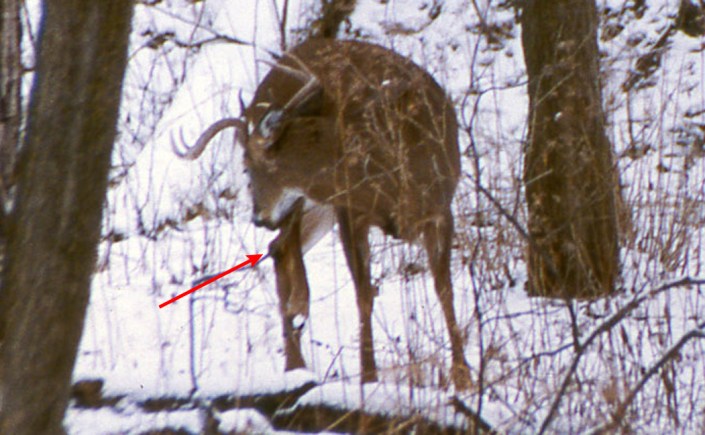
Soon after gaining a safe distance following a harrowing encounter with a hunter or large predator, a bounding whitetail will generally pull up to settle its nerves, assess its back trail to determine whether or not it is being pursued or stalked and lick its tarsal tufts to halt further emissions of the ammonia-like odor released into the air while it was greatly alarmed, thus making it more difficult for a rapidly trailing predator to keep to its trail via scent alone.

About Whitetail Deer Danger Scent

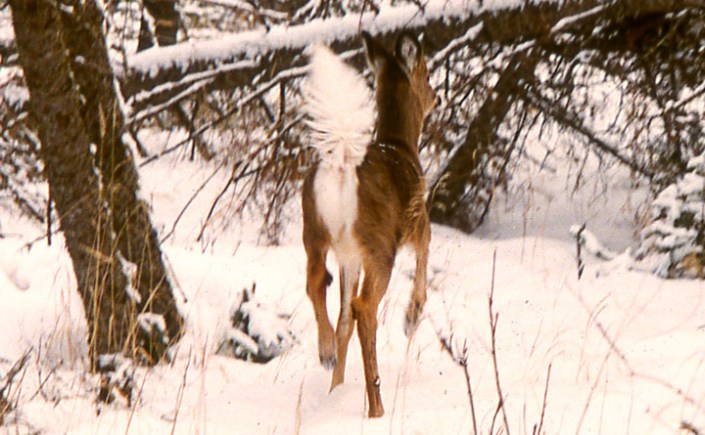
Do you realize an ammonia-like odor is released from tarsal glands of alarmed whitetails that can act as a deer repellent up to four days?

Take a look at the erect tufts of dark hair on the insides of the bounding doe’s hind legs in my accompanying photograph. Whenever a whitetail becomes alarmed enough to raise its tail, snort and/or bound away, the tufts of hair overlying its tarsal glands become erect. While erect, the underlying glands release an ammonia-like odor into the air. While airborne, this odor silently warns all downwind deer (up to 200 yards away) something very dangerous is upwind. It also creates an easily followed (easily smelled) scent trail for less fleet accompanying fawns and other deer to follow. Wherever emitted, the odor persists up to four days (or until it rains or snows), meaning anytime a whitetail bounds from or past your stand site, the persisting odor acts as an effective deer repellent for four days.

Do You Greatly Alarm the Deer You Hunt?

Nothing alarms a mature whitetail more than seeing or hearing a hunter sneaking toward it, halting often to scan ahead. Simply halting suddenly within sight of a deer and gazing toward it or suddenly changing course and walking directly toward it can be equally alarming, whether the hunter actually realizes a deer is there or not. Such are typical actions of wolves that have selected a deer as a prey or much more easily detected human deer hunters making a drive, still-hunting or stalking. The consequences are generally severe, whitetails reacting by bounding away as rapidly as possible through forest cover, becoming extremely difficult targets. Worse, most mature whitetails then quickly flee to off-range areas seldom invaded by hunters, swamps or posted lands, for example, or they become nocturnal (move about in darkness only).

If on the other hand you area a non-aggressive stand hunter, unless your silhouette is obvious against the sky or a snowy background, you are spotted or heard moving or a deer is downwind and able to smell you, not only are you far less likely to be discovered by an approaching or passing whitetail, but even if you are discovered, a whitetail is unlikely to become alarmed enough to abandon its range or become nocturnal. Thereafter, generally occurring without hunters realizing it, the deer will simply stay out of sight or keep a safe distance away from the spot where the hunter was discovered. To effectively counter this evasive action, move to a new stand site at least 100 yards away daily.

New Winter Deer Hunting Boots

The only boots I’ve ever worn during my 70 years of Minnesota whitetail hunting (4 pair) were pac boots, beginning with a hand-me-down pair from L. L. Bean at age 10. Leather uppers annually smeared with mink oil kept my feet dry but lots of homemade woolen socks with red toes and heels found under Christmas trees back then were needed to keep my feet from freezing during our late November hunts. My last two pair came with insulating liners, but the combination was awfully heavy. At age 80, that heaviness was a common complaint at the end of each day in deer camp. A few days ago I decided to see if I could find some new lighter boots at a reasonable price. I discovered a whole new world of exceptional winter hunting boots in one big outfitter’s store. It took more than an hour to try on boots there. Besides being a bargain, the waterproof boots lined with 2000 gram Thinsulate™ I finally settled on weigh a mere one pound each. That is absolutely amazing. This November, this old man is going to feel like a teen-ager again while hiking up and down the boulder strewn, spruce and pine covered hills where a certain big buck lives.

Doc’s New Whitetail Tracks Guidebook

Dr. Ken Nordberg’s NEW 2016 Pocket Guidebook to WHITETAIL TRACKS Fall & Winter is evolved from 45 years of dedicated, hunting-related research with wild deer and 70 years of very successful deer (buck) hunting. Every serious whitetail hunter should own this inexpensive ($4.99) book because it is extremely valuable, its 84 pages introducing the following extensive list of amazing innovations guaranteed to greatly improve success wherever whitetails are hunted.

  • Accurately identify all unseen whitetail deer in your hunting area via their track lengths (first introduced by Dr. Nordberg in the early 1980s in outdoor magazine articles and hunting seminars).
  • Key on one or more classes of whitetails — fawns, yearling does or bucks, does 2-1/2 years of age or older, bucks 2-1/2 years of age or trophy-class bucks 3-1/2 to 6-1/2 years of age.
  • Instantly recognize hunting values of whitetail tracks and track formations.
  • Recognize where, when and how to stand hunt next based on information provided by tracks throughout the 4 month period of rut-related activities beginning in September.
  • Take quick and skillful advantage of promising information provided by tracks.
  • Avoid wasting time where odds of hunting success are poor.
  • Keep whitetails from abandoning their ranges and/or becoming nocturnal during hunting seasons.
  • Become skilled at taking unsuspecting deer, standing or moving slowly, within easy shooting range.
  • Keep close to unsuspecting deer every day or half-day you hunt.

This ebook can now be downloaded in 2 versions. One is designed for Apple’s iBooks software. The second is designed for Amazon’s Kindle software.

Doc used Apple’s iBooks Author software to develop the iBooks version. This provides many advantages, for example, a better quality of typesetting. The Apple ibook version can be downloaded onto computers compatible with Apple’s iBook software. That includes PCs, Macs, iPads, and iPhones. Think of that! You can carry this version into the woods on your phone for quick and easy reference while scouting and hunting. The iBooks  ebook version can be found here.

The Amazon ebook version is now available. This version contains almost exactly the same text, graphics and photos as the iBooks version. However, because the typesetting for this version was much more difficult there are a few, very minor differences. This version can be read with any device compatible with the free Kindle app. That includes: PC, Macs, Kindles, iPads, and almost every type of smart phone.

We will continue to tweak both versions in order to make them better. Keep in mind, with both the iBooks version, and the Kindle version, when changes are made, people that purchase them now will be able to download the updated versions in the future.

Next, Doc has plans to publish a printed version of this GuideBook — a 4″ x 6″ pocket-sized paperback. Watch for announcements about when the printed version becomes available in Midwest Outdoors Magazine, on Twitter, on this blog and at Dr. Ken Nordberg’s encyclopedia-like website: www.drnordbergondeerhnting.com. Ordering information for all versions will be found on this website.

Also watch for announcements about when Dr. Nordberg’s long-awaited 10th Edition of Whitetail Hunters Almanac becomes available (text now completed), a huge 500-plus-page Apple ibook with more than 500 illustrative color photos and interactive videos evolved from Dr. Nordberg’s past 16 years of ongoing hunting-related research with wild deer from Minnesota and Wisconsin to Texas. Like all nine previous editions which many thousands of hunters have long considered to be “Deer Hunting Bibles,” this new book is also loaded with new hunting tips and an introduction to another new, well-tested hunting method, actually the best (most productive) method ever for taking otherwise seldom seen mature bucks and older does. An Amazon ibook and a paperback version are also planned for this book. Don’t miss buying the printed version when it becomes available, it likely to sell out fast. Like all other out-of-print Whitetail Hunters Almanacs today, its resale value will increase 25-fold or more.

Is There a Peak of the Rut? #Rut #Whitetails #DeerHunting

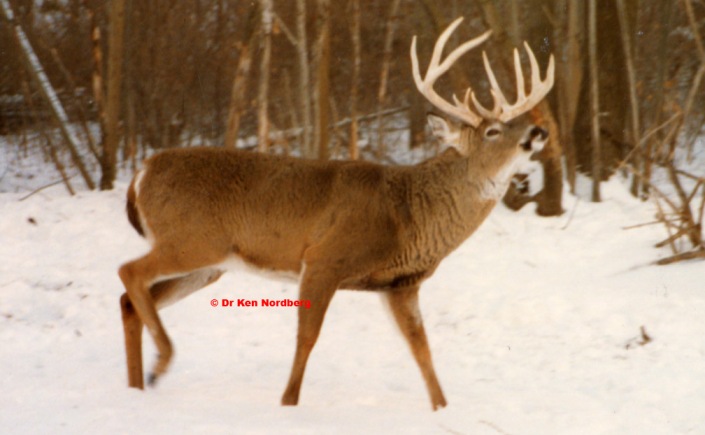
Lots of new or freshly renewed ground scrapes late in October do not signify a so-called “Peak of the Rut” is in progress. It only means cooler weather has finally caused highly aroused antlered bucks with new winter fur to begin a frenzy of marking individual breeding ranges. Does are not yet in heat at this time.

Each fall and early winter whitetails breed during three separate, two-week-long time periods. Estrus (heat) in does is triggered during these periods by a specific ratio of darkness to light (photoperiodism), occurring on the same exact dates in any one region annually. The first period generally occurs in November throughout the U.S. Some differences are seen in parts of Texas and Florida where this period occurs in October. The onset of each breeding period is progressively somewhat later from North to south in the U.S. In northern Minnesota where I hunt and study whitetails, breeding begins November 3rd annually.

At best, only about 10–12% of does are in heat on any one day throughout the two-week November breeding period, meaning, depending on deer densities only 1–2 of the usual 8-12 does capable of producing young per square-mile will be in heat on any one day (more in areas in which whitetails are over-populated or forced to congregate in remaining cover after deer-tall crops such as corn are harvested). Each doe will only be in heat 24-26 hours. During some days during this period, no does will be in heat within a specific square-mile. There should be little wonder, then, why it is so difficult to predict locations of mature breeding bucks while does are in heat.

Does not bred in November (about 15% for various reasons) will experience estrus again 28 days later and 28 days later again if still not bred, accounting for the second and third periods of annual breeding. In my Northern Minnesota study area, the second period of breeding begins December 1st. The third period begins December 28th, meaning, some breeding actually occurs well into January. My wife Jene and I have known and photographed several does that were always in heat on New Years Day.

The 85% of does bred during November give birth to 1–2 young in May. The 10% of does bred in December bear young in June. The remaining 5% bred in January and give birth to young in July (providing a means of determining which were bred during which time period).

“All of the above reveals there is no peak of the rut.” Just add the widespread notion there is one to the list of many strange beliefs American deer hunters continue to have about the whitetail rut (future blog posts).