No. 3 Best Tip for Whitetail Hunting Today

Especially if you want to take a big buck, become invisible to whitetails, best done by stand hunting. However, no longer is it okay to sit fully exposed in a tree stand. No longer is it okay to trim all branches from a stand tree to facilitate spotting and firing at whitetails great distances away in all directions. After nearly four decades of hunters using tree stands, whitetails almost everywhere that have survived two or more hunting seasons are now very adept at finding, identifying and avoiding stand hunters. Older bucks quickly spot man-made construction, destruction and intense and widely-dispersed trail scents characteristic of most stand sites. Mature whitetails, especially much-experienced, stand-smart bucks 3-12 to 6-1/2 years of age, generally find and begin avoiding stand hunters within 1–30 hours after hunters begin using their stands. Whether moving or not and whatever the hunter is wearing, the large, dark, sky-lighted silhouette of a hunter poorly hidden in a tree is readily recognized great distances away by mature whitetails (not including fawns and yearlings), thereafter avoiding them. There should be little wonder why so many stand hunters today erroneously believe something must be done to improve numbers of older bucks.

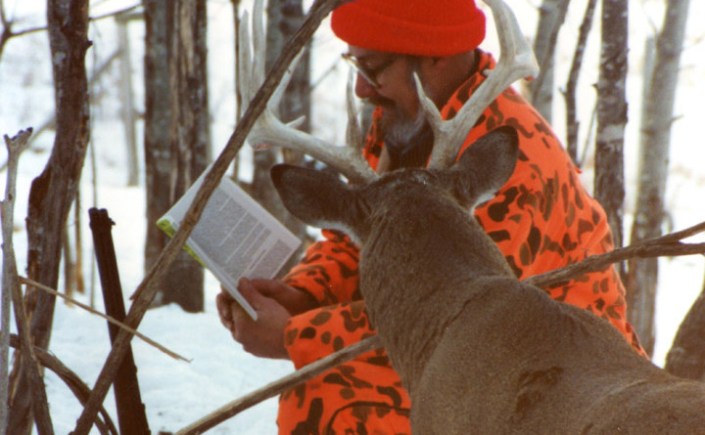
 Especially when hunting older bucks, bowhunters should wear dark camo clothing—no light tan, gray or white readily spotted by whitetails, especially while moving. Firearm hunters should wear camo blaze-orange, keeping in mind blaze-orange bathed in sunlight appears glowing white to whitetails. Human skin, which contrasts greatly with natural cover, should be covered, head and face with a camo headnet or mask, cap on top, hands with dark gloves. This is not enough. The hunter’s silhouette and stand should be screened by natural cover in front and fairly solid natural cover behind, preferably in shade, never clearly sky-lighted or snow-lighted. Colors of man-made stands or blinds should blend well with surrounding natural cover. Straight edges of portable blinds should be masked by natural cover. The hunter afoot should also be adequately masked by surrounding cover throughout the final 100 yards to a stand site. Natural cover surrounding a stand site should not appear significantly altered. Tree stands and blinds should be located 10–20 yards back in forest cover, never at edges of openings such as whitetail feeding areas or farm fields. Today, adequate natural screening cover is much more important than a wide field or view or a man-made shooting lane. A skilled marksman with a rifle only needs a few clear openings a foot or less in diameter, two feet or less for a bowhunter. Dense, intervening cover may occasionally make it impossible to fire at a nearby deer, but over the long run it will provide much greater numbers of opportunities to fire at unsuspecting deer at short range.

 Finally, every precaution should be taken to avoid being scented by whitetails. A mature whitetail’s eyes and ears can be fooled, but never it’s nose. As recent research with K9 dogs has revealed, though intensities of human odors can be minimized by various store-bought products (which is beneficial), nothing can eliminate them. Always approach stand sites from downwind or crosswind and always sit downwind or crosswind of sites or trails where you expect a white-tailed quarry to appear. Never trash a stand site or the trail or site where you expect deer to appear with human trail scents, readily smelled by whitetails four or more days after deposited—much longer if often renewed. Best stand sites for taking mature bucks are those never used before (no obvious changes in appearance present) and where care has been taken to minimize the intensity and spread of human trail scents. The more quickly a stand site is prepared for hunting (needing little or no alterations) and the less that was necessary to accommodate and hide the hunter, the better. After selecting a stand site, get well away from it as quickly as possible and then stay away from it until the hunting season begins. To make certain everything is back to normal by opening day, my sons and I always complete our scouting and prehunt preparations two weeks earlier.
America’s White-tailed Deer Need More Bona Fide Hunters

“Deer hunting” is defined as “the practice of taking deer.” One step up, “mature-buck hunting” is defined as “the practice of taking mature bucks.” This fall, are you going to again settle for failing to be a deer or buck hunter? That’s a shame because nowadays, America’s white-tailed deer almost everywhere, including seldom seen and normally wasted mature bucks, truly need more bona fide deer or buck hunters to keep them from being overabundant in winter, then suffering the cruelest fate of all, slowly dying from starvation because there isn’t enough natural food anywhere to feed overabundant deer in winter. It’s not the fault of state deer managers. If you are unable to regularly do your part to help keep the consequences of overabundance from recurring, it’s your fault. It’s your fault because you failed again to make an effort to become skilled and knowledgeable enough to more regularly take deer.

No. 2 Best Tip for Whitetail Hunting Today

Stand hunt only within easy shooting distance of very fresh tracks and/or droppings made by unalarmed whitetails (not trotting or bounding), especially those located in or adjacent to feeding areas. Why feeding areas? Because whitetails are most visible and most predictable time-wise and location-wise during hours they feed. All deer trails funnel down to feeding areas. Fresh tracks and droppings reveal locations of sites and trails being used by whitetails today—earlier, right now, later or tomorrow morning. Don’t count on seeing mature whitetails after you have stand hunted three consecutive feeding periods or more near any site or trail previously frequented by whitetails. To keep close to whitetails every day you hunt, move to a new stand site 100 yards or more away near very fresh tracks and or droppings every day or two. To key on mature bucks, key on fresh tracks and droppings made by mature bucks,


No. 1 Best Tip for Whitetail Hunting Today

The number one best tip for whitetail hunting today is, be a mobile stand hunter.

Stand hunting is still the best way to hunt mature whitetails, especially trophy bucks, but if you’ve been stand hunting during the past 20–30 years, you’ve doubtless noticed stand hunting isn’t as near as productive as it once was. Nowadays, you mostly see younger does, fawns and yearlings. Why? Because during the past 20–30 years stand hunting became so popular that today there is hardly a whitetail that has survived two or more hunting seasons anywhere in America that has not learned how to quickly find, identify and avoid stand hunters without abandoning their ranges. Climbing higher into trees hasn’t improved matters and using bait only provides temporary improvement (about two hunting seasons) because today’s mature stand-smart whitetails soon realize it is dangerous to approach bait sites in daylight hours during hunting seasons (fresh human airborne scents and trail scents being the primary tip-off). Despite all this, the addition of the word “mobile” to “stand hunting” can make stand hunting method as productive as ever, if not more so.

The word “mobile” in “stand hunting” means you should quit being the permanent, long-familiar, hunting season fixture known by every mature whitetail living within the square-mile or more surrounding your stand site. Mature stand-smart bucks living within that square that do not know you yet, being new residents, will generally discover you very soon, usually without your knowledge, during some brief moment in the first 1–30 hours after you once again begin using your stand, thereafter becoming another mature buck in the area that regularly detours widely around you.

The only practical way to stop this from happening is to quit stand hunting at the same site longer than 1–2 days per hunting season. Even better, change to a new, yet unused stand site 100 yards or more away every day or half-day. When you do this, every mature whitetail, including every mature buck, in the surrounding square-mile must find you all over again to be safe from you. Sooner or later, if you are well hidden by natural cover or man-made cover that closely blends with surrounding natural cover and downwind or crosswind of where you expect a deer to appear at each new stand site (absolute necessities when hunting older bucks these days), one or more mature bucks and other deer will approach within easy shooting range before they realize you are near.

Watch for best tip No. 2

Which is Best When Hunting Deer: Cover or Minimize Human Odors?

While ten other hunters were climbing aboard the hay wagon that would convey us to sites where we would make the first drives of my first hunting season (1945), my Uncle Jack turned to me and said, ”Before we go, there’s one more thing you should do to get ready. Come with me.” Upon entering the barn, he stepped to the gutter behind a cow and began stomping his hunting boots in a fresh cow pie. “The deer around here are used to smelling cow pies,” he explained. “With this stuff on your boots, deer that smell you will think you are just another cow, making it easy to get close for an easy shot.”

Most hunters back then used some strong odor to hide their human odors. My dad preferred stuffing his pockets with sprigs from cedar trees. A few years later, I began using a liquid containing buck musk, emitted into the air from the wick of a special hand warmer. In the 1980s I painted my boots with fox urine, the odor of which made my eyes sting, after which my boots were no longer allowed inside a house. Years later, I felt fortunate whitetails cannot laugh out loud, knowing the woods would then have been filled with laughter of deer that discovered humans were being urinated on by foxes.

To explain, consider what you smell upon entering Grandma’s house on Thanksgiving, Number one, of course, would be the roasting turkey, perhaps tainted with the familiar odor of sage dressing. You’d also smell pumpkin pie and sweet potatoes in the oven and coffee brewing. The point is, your human nose can identify lots of different things at the same time despite an overwhelming odor like that of a roasting turkey. Similarly, whitetails with noses ten-thousand-times more sensitive than human noses, can easily identify a multitude of human odors at one time along with any strong-smelling additional odor such as a so-called “cover scent,” likely actually making it easier for mature whitetails to identify and avoid hunters. Yes, I know, you have n uncle that swears by his favorite “cover scent” and you believe the one you’ve been using works great too because you’ve seen or taken deer that approached from downwind, though there are logical reasons why this can happen whether you use a cover scent or something claimed to eliminate human odors or not.

Much better, though identifying airborne odors or trail scents emitted by deer hunters cannot be totally eliminated, rather than add a strong odor when hunting whitetails, minimize your existing odors. Whitetails react with far less alarm upon identifying a motionless stand hunter that emits no strong and unusual odors than a motionless stand hunter that emits one or more strong and unusual odors. Minimizing odors emitted by your body, clothing, boots and hunting gear as best you can will therefore significantly improve your odds for hunting success.

In Praise of Stand Hunters

Suffering through endless attacks by hordes of blood-crazed insects and ticks, one more hour, and then another, and then another of motion sickness in a wind tossed tree stand, soaked clothing, shivering and frozen noses, fingers and toes in winter, urinary bladder and intestinal distress, muscles and joints aching for relief, thirst, hunger, incredible boredom, withering patience and a growing danger of falling asleep sixteen feet above the ground are characteristic of just another ordinary day of stand hunting. The amazing thing is, millions of American deer hunters talk about it as if they have been having the time of their lives and can’t wait to do it again.

When I began hunting deer in 1945, standard hunting clothing included cotton or itchy wool long underwear and socks that refused to dry after being soaked by perspiration, wet snow or rain and laced up leather boots that wouldn’t dry until a week or so after a hunting season ended. Our red or buffalo plaid heavy wool outer clothing became water logged and heavier and heavier because of the same refusal to dry, making stand hunting in winter weather a form of hunting during which a hunter could not bear to remain in one place very long.

To an inexperienced hunter or non-hunter today, recent inovations such wicking and quick-drying polypropylene underwear and socks, synthetic insulation and lightweight waterproof fabrics in outer clothing and boots plus padded seats on portable tree stands with railings might make it seem as if stand hunting has become akin to lounging in complete comfort on a featherbed. It ain’t so. A stand hunter today must still be a special breed of hunter, necessarily tough and enduring mentally and physically, able to endure anything nature unleashes during a half or entire day of hunting, ever determined  to finally outfox a cunning mossy-horned buck.

Time to Scout for September Bowhunting

Unless you are using bait, scouting in preparation for bowhunting beginning in mid-September is rarely easy. Obvious buck signs like freshly made antler rubs and ground scrapes are no help because, except for a few velvet rubs on bushes or small trees, they will not made by bucks in northern states until it is frosty at night, beginning about mid-October. Lots of green leaves and tall vegetation and then falling leaves also makes it difficult to find and identify deer via tracks and droppings, reasons trail cams have become popular. As my son’s and I have repeatedly been taught, unfortunately, big bucks magically begin spending time elsewhere once a hunting season begins, so we no longer trust trail cams to dominate our scouting.

Our early scouting begins with searching for absolute evidence of the existence of older bucks (not yearlings): fresh tracks 3-5/8 to 4 inches long and/or fresh droppings (usually clumped) 3/4 to 1-1/4 inch long. Finding a lot of such signs is unnecessary. If made by a deer that was not trotting or bounding, upon discovering such a sign we know we are in the range of a mature buck—about 250-500 acres in size for lesser bucks 2-1/2 to 6-1/2 years of age and about a square-mile (sometimes two) for a dominant breeding buck. We key on trails (especially past scrape trails) or feeding areas that were frequented by older bucks during previous hunting seasons, good to do because home ranges, trails and sites frequented by mature bucks tend to be traditional year after year, usually even used by bucks of similar sizes that adopt ranges of bucks that were taken by hunters during previous hunting seasons. Having learned it is a mistake to count on taking one certain buck per hunting season, for various reasons, my sons and I never consider our scouting done until we have each found 2-3 different mature bucks to hunt and up to six widely separated stand sites that need little or no preparation to hunt each buck—sites that can be approached from different directions, making it possible to approach stand sites from downwind or crosswind whatever the wind direction. The main reasons for preparing to hunt more than one buck and using a number of stand sites for each are: 1) some bucks prove to be impossible to hunt (being especially cunning or becoming nocturnal, for example) and 2) today’s mature bucks generally find and begin avoiding even the most skilled of stand hunters within 1–30 hours after they begin using a stand site, usually without the hunters realizing it. This means, when hunting older bucks (not necessarily true when hunting other deer), it is generally a waste of time to use a stand site more than 1/2 to 1-1/2 days per hunting season. We therefore switch to different unused stand sites 100 yards or more away from previouly used stand sites every day or half-day we hunt.

Yes I know, hardly any bowhunter anywhere hunts this way but then most bowhunters rarely have an opportunity to take a mature buck and certainly not regularly (unless perhaps guided). Using one stand site per hunting season and using bait can’t make you regularly successful at hunting mature bucks. Trail cams used in place of scouting , buck lure scents accompanied by human scents and ATVs that taint your clothes with exhaust fumes and announce your approach and location to experienced whitetails cannot make regular buck hunting success happen. Sitting where your silhouette, skin and necessary movements are easily spotted by deer safe distances away or where your trail scents are intense and/or widespread certainly can’t make it happen either—things to think about while preparing for a coming archery season. Maybe it’s time to quit being so reluctant to change the way you hunt.

Nevertheless, having experienced the frustrations and joys of bowhunting for whitetails and black bears myself since 1960, I can’t help but wish all you avid bowhunters the very best of luck this fall.

My Apology to Well-Meaning Deer Hunters who Use Bait

Sometimes I feel sorry for being a defender of “fair chase” whitetail hunting in America. I realize using bait to attract whitetails to stand sites in the many states where it is legal today was likely the first and continues to be the only known means of successfully taking deer for a lot of U.S. hunters — actually millions. A big reason is, stand hunting near bait proved to be far more productive and practical than using old traditional hunting methods. Though I fail to understand why deer that have been flourishing on wild foods for more than 10,000 years now suddenly need bait foods with greater amounts of protein to be healthy, such hunting does have some benefits. It does not generally cause deer to abandon their ranges or become nocturnal during hunting seasons (though few stand hunters know how to take advantage of this). Temporaily, at least, it enables more hunters to take part in keeping deer from suffering the tragic consequences of starvation due to overabundance in winter. The trouble with using bait is, most mature whitetails soon realize it is dangerous to approach bait and stand sites where human airborne and trail scents are prevalent in daylight hours during hunting seasons. Most deer taken by stand hunters using bait today are therefore inexperienced fawns and yearlings. Except for hunters determined to take mature bucks, this seems to be acceptable to most huntrs.

My trouble is, I’m a relic of the “old school”of whitetail hunting. I’ve been hunting whitetails 73 years. I began when hunters like my rural grandfathers who were yet suffering from the hardships of the Great Depression were being forced to get use to the idea that they could no longer take deer year-around to feed their families. About that time it had become obvious whitetails and other edible American wildlife could no longer sustain suitable numbers under the pressure of year-around hunting (subsistence hunting) by growing numbers of Americans. Concerned hunters and politicians of that period scrambled to do something to save deer and other wild game while at the same time preserving our American heritage of hunting. To do this they decided deer hunting should only be a sport, limited to taking one deer per hunter per year during a limited hunting season and no hunting method should provide an unfair advantage over deer. Words like “sportshunter, sportshunting, sportsmanship, ethical hunting” and “fair chase hunting” thereafter described American deer hunting and hunters adhering to these principles were admired and respected.

The trouble is, annual, large-scale culling of less-fit, easy-to-hunt deer by millions of American hunters inevitably produced a race of whitetails that is far less vulnerable to old traditional hunting methods today, including stand hunting. To add to this vexing problem, about six decades ago forest whitetails began invading intensely farmed, suburban and even urban areas where their numbers are difficult or impossible to control via hunting. Using bait to attract whitetails to stand sites was soon discovered to be a practical way to alleviate matters (though not very productive for taking mature whitetails after bait has been widely used in any area for two or more years). Using bait thus became legal in many U.S. states. Unfortunately, it’s not “fair chase” deer hunting.

Many of us old school whitetail hunters feel using bait to hunt whitetails is not only unnecessary but downright disgraceful. If we say something that makes you younger hunters who use bait feel “blasted,” however, I for one am truly sorry. I know you are all “good guys,” many of you have become real experts at using bait and I also realize you and most others who use bait only do it because it is legal and much ecouraged in your state today, but now maybe you understand why some of us are beginning to feel a need to begin protecting our once revered principle of “fair chase” whitetail hunting.

Actually, while a beginning deer hunter back in the 1940s, I too soon became dissatisfied with old traditional hunting methods, not because we didn’t take a lot of deer back then, but because we so seldom even saw bucks like those commonly pictured on covers of outdoor magazines and calendars. Thus in the 1960s I began scientific hunting-related studies of habits and behavior of wild whitetails never done before by anyone I have ever heard of, hoping to discover more productive ways to hunt deer, specially older bucks. Beginning in 1980, I began sharing what I was learning in the first of more than 800 articles in popular outdoor magazines and 17 books. I was a pioneer of tree stand hunting and the first to accurately describe the whitetail rut. Since 1990 I developed six new variations of mature-buck-effective, “fair chase” stand hunting methods that without the help of anyone else enabled my three sons and me to take 98 mature bucks on unfenced public land in wolf country during the past 27 years where deer numbers have have never exceeded 11 per square mile and where only one buck could be legally taken per hunter per year. Many are now on our walls. By any standards, this is unusually great, do-it-yourself buck hunting.

It now being my goal to help preserve “fair chase” whitetail hunting and our country’s much revered, 85-year-old heritage of sportshunting, I am going to try to teach as many American whitetail hunter as I can how to use one or more of my new, much-needed, mature-buck-effective hunting methods, all “fair chase.”

Meanwhile, I promise to go easier on you guys who use bait.

How to Finally Outfox an Unpredictable Buck

The five phases of activities of whitetail bucks related to breeding are about to begin — beginning about September 1st and ending shortly after January 1st. Breeding of does will be limited to three two-week periods during these months and will have little affect on day-to-day locations of mature unalarmed does and their young. Whenever you hunt whitetails during the coming fall and winter period, however, breeding-related activities will be influencing the timing and locations of unalarmed antlered bucks every day you hunt. Triggered by specific ratios of darkness to light, the onsets of each of these activities (one also influenced by air temperature) are very predictable and each phase has characteristic deer signs that aid in determining when it is in progress, contributing to greater buck hunting success for hunters who recognize these activities and their identifying deer signs.

Aside from weather, moon phases, availability of water and specific foods which also contribute to predictability of whitetails, though not always in ways that favor hunters, nothing makes whitetails less predictable and less vulnerable to hunting more than hunting by humans. The one response of whitetails being hunted by humans that is most ruinous to whitetail predictability and subsequent hunting is alarm great enough to make whitetails raise and fan their white tails and bound away with all possible speed. Whitetails that do this are not only likely in the process of abandoning your hunting area and becoming nocturnal for extended periods of time, but they are warning other deer along the way via sight, hearing and scent emitted by their tarsal glands to do the same. Over the long run, therefore, your success as a whitetail hunter or buck hunter is determined by how often you make whitetails raise their tails and bound away, which can  happen much more often than you realize.

One important key to becoming regularly successful at hunting whitetails, especially elusive mature bucks, therefore, is to learn how to hunt in a manner that does not cause whitetails to raise their tails and bound away. Yes, there are such hunting methods: certain forms of stand hunting. The trouble with any form of stand hunting is, today’s mature, stand-smart whitetails living within a half-mile, especially older bucks, generally find and identify stand hunters at stand sites, typically without stand hunters realizing it, within the first 1–30 hours they are used and thereafter avoid them. To eliminate this handicap, the stand hunter must become extra difficult by various means for nearby whitetails to possitively identify while hiking to and from stand sites and while hunting at stand sites. The hunter must also switch to a different, yet unused stand site 100 yards or more away once or twice daily. There ‘s more, but once a proper stand hunting method is mastered, the hunter can finally become regularly successful at taking any class of whitetail, including older bucks, seldom seen, if at all, by other hunters during hunting seasons.

Advice for Deer Baiters Determined to Take a Mature Buck

Be at your opening morning stand site at the crack of dawn. Avoid alarming all deer there. Unalarmed does, yearlings and fawns (like those pictured above) are the very best of mature buck decoys. Your best odds for taking a mature buck at your bait plot, bait pile or electronic bait feeder will occur during the first 1–30 hours of the hunting season, unless you have been regularly laying down fresh trail scent there (which mature whitetails can identify during the following four days) while anxiously checking your trail cam and/or bait, in which case the damage may have already been done. If you don’t take a mature buck during those first 1–30 hours, your odds for success at that site will thereafter be slim because by noon on day two it is almost certain all whitetails living within a half mile that have survived two or more hunting seasons will have discovered you with or without your knowledge, after which mature bucks especially, the most elusive of whitetails, will subsequently avoid your bait during daylight hours throughout the rest of the hunting season. You will then have three viable options: 1) settle for a mature doe, fawn or yearling, 2) move to an unused bait plot, bait pile or electronic bait feeder 100 yards or more away and begin the above cycle anew, but with lesser odds for success  because by then all mature bucks will realize they are again being hunted by humans and will thus be taking the precations that enabled them to survive previous hunting seasons, or 3) try mature-buck-effective deer hunting.